PHILOSOPHICAL DRAWINGS
Part 6:
Books and Knowledge
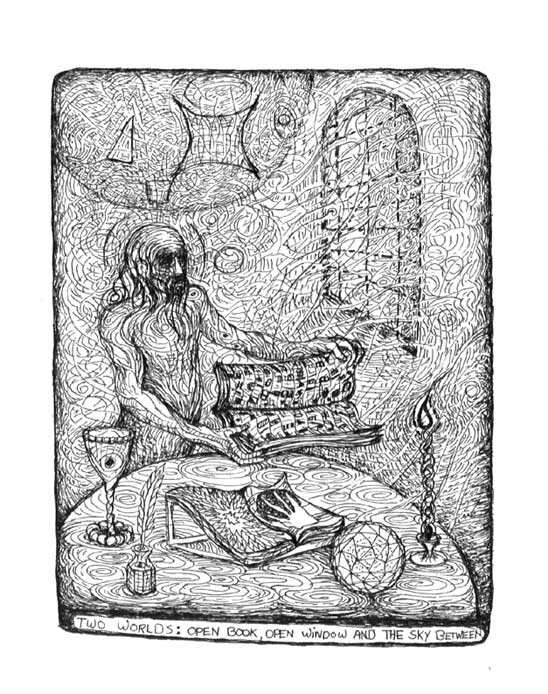
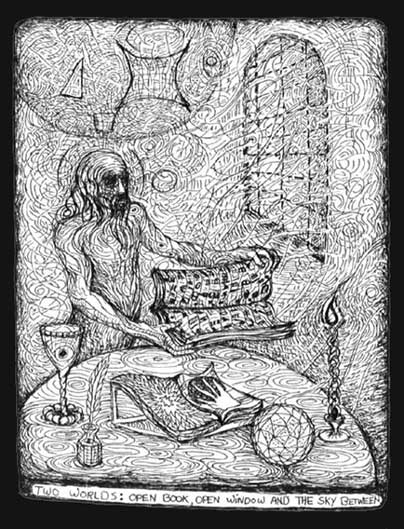
Two Worlds: Open Book, Open Window and the Sky
Between
(Portrait of Leonardo Da Vinci)
Books and Knowledge
In our universe there are endless galaxies, suns, and planets. Saturn and Earth are two such planets. In this endless infinity, it is amazing that on Earth, a small, partly hairless, close relative of Chimpanzees and Gorillas called Homo Sapiens has learned how to enclose what little they know between the covers of books. I read books in the small orbit of these great mysteries around me, my largely simian brain trying to grasp what is so hard to understand. I look at a universe that is all questions and few answers. But the questions pour forth.... What is the meaning of the world and our existence in it? Certainly, the human experiment is highly dubious. What is the meaning of this book of my body that is written in the DNA of my own cells? So much of my life has been lived in reference to books, seeking though their information and emptiness, looking for something solid and secure. I have changed so much over the years and what I thought I knew is now uncertain. My certainties are all undermined.
My view and understanding of reality was very different in 1982 that it is now in 2004. Not surprising, certainly. Not surprising either, that no matter how hard I try I cannot enter again into exactly the mentality I had when I did these drawings---or event he exact mentality of a year ago. My old self is is something of a ghost. Not a ghost of the supernatural variety. But a ghost as all literature is a conversation of ghosts. I am a voice of a poem that is past. I once was someone else. I made art then as now, but my art then was very different. All art hovers in the no man's land between reality and loss, existence and death. That is me, a breath on the glass and whisper in the ear of time. I wished I could be more, I wished I could live forever, like all writers and artists. I live merely in the words of this page, as substantial as a groan for help in a dark room, a hand reaching out of the corner
I do not agree or even like some of the beliefs I had in 1982. I used to think that the "Great Books", the Harvard Classics etc... were beyond my abilities to think critically about them. We were trained in public education to think the "canon" of "great books" was somehow holy. I know better now. It took me from 1970 to 1990, roughly, to learn to question the authority of these books. The concept of the "Great Books" is a political construction. The Classics or Great Books are not icons, though they are treated as such by partisans of various traditional religions or knowledge systems. Most of the great books are milestones in empires,dictatorships, elitist regimes that excuse Imperial cruelties. Celebrating Caesar's Gallic Wars, Plato's Republic, Machiavelli's the Prince, Aquinas' Summa Theologica, or Homer's Illiad is of dubious festivity. They are excuses for injustice and apologies for elitism in government, violations of human rights, forced labor and exploitation of the poor.
Except for rare beings like Da Vinci, who is far ahead of his time, the Renaissance does not yet offer much improvement over classical culture. It was really the rise of science and the Enlightenment that began to erode the injustice inherent in classical ideals. It was the Enlightenment that really began the questioning of superstitious books as the Bible or the Koran. Moreover it is only in recent years that the history of world culture has become sufficiently accessible that the "classics" from other cultures, are now open to criticism. It is clear to me that Aquinas's thought has a relation to the Inquisition. So likewise Confucius, or the Bhagavad Gita, have a relation to the injustice the Chinese feudal system or the Hindu caste system. I learned to question the ethics of Christian thinkers or literary exemplars as well as the questionable ideologies of the Persian mystics, such as Hafiz of Rumi. Culture is now a global phenomena that requires global analysis.
But if the authority of past greatness is in question, on a global scale, who am I to offer my opinions? Am I to doubt myself as much as I doubt Plato and Lao Tzu? Yes. This is what enlightenment is, or should be--- to learn to question, including questioning oneself. I am a flawed human being, part of nature and I claim no divine sanction, indeed, the very notion of divinity seems absurd. So many of the authors of the "great books" claim divine sanction or inspiration. Foolish humanity has believed these nonsensical claims. A book like the Bible should be measured more by the corpses it created than the prayers it encouraged. So, there are no divine sanctions and therefore I must be as skeptical towards myself as well as towards the so called great books. I am fallible and imperfect and my works are too.
My current interpretations of these drawings cannot be called "authoritative" in any total sense. I already notice that during the course of writing this book that my view of these drawings and the writings of the period is over-simple and in some cases distorted. But that is not to say that my view is wrong. I am trying to correct for possible distortions by being as accurate as I can be, and looking and re-looking at all the source material I have. I am enough of a trained historian to know how to do that. But I do have a "point of view" and thus, to some degree, a bias. No one is totally objective, and the claim to be totally objective is always questionable. On the other hand, I am certainly not saying that anyone else could be more "objective" about these drawings than I can be. There is a reality out there and there are facts about it that can be known.
The argument between the notions that 'all views are subjective' and 'objectivity is possible' is an argument I have explored for many years. Noam Chomsky helped me see into this question more deeply than I might have done without his help. Chomsky said to me the simple idea that there is " a reality out there". Edward Said, an very interesting scholar, who was very important to me in the early 1990's, and whose book Orientalism helped me see through the illusions of post-modernists and traditionalists, also helped me on this question. He writes that "verbal retrospection is very far from being an objective mirror of reality". ( Reflections on Exile, pg. 126) Yes, but Said does nto deny that there is a reality out there. It is true that my writing about these drawings is not entirely objective. But there is an objective reality, even if verbal retrospection or art does not quite reach the standard of complete accuracy. It is true that no one can be totally objective, but some are more objective that others. I am saying that no author is "authoritative" in any absolute sense and that I am fallible and am no doubt making mistakes even as I write. No reason to be paralyzed by this. I just try to be has honest as I can be. If I am a fish, I must swim in the waters of my own limitations as best I can. I try to see the world as accurately as I can. These drawings were themselves subjectively created, even if they had objective references. So telling the stories of what they meant to me then and now creates complex interactions between the actual world and my interpretations of it.
I want this whole book of writings about these drawings to be a testament to making mistakes and learning from them. One never stops learning. But for all that I am not saying that every view of the past is entirely "relative". There is no absolute, no pure, impartial or total point of view, as some religious fanatics claim. But nor is there is a totally relative point of view either, as some or post modern fiction writers would like to claim. No one is entirely objective and no one is entirely subjective. There are degrees, nuanced views and always the necessity to try to be as accurate as possible, in addition to having compassion on the poor and questioning the powerful. Admitting I am imperfect does not mean that others know more about my life than I do. It does not mean that I must deny the reality that is out there, and that I know to be as it is.
My effort to admit my mistakes and learn from failure goes against the grain of a society that is all about success. The corporate partisans of the "power of positive thinking" pretending to never fail or doubt, as they say on their infomercials. But that is just it. I deny the religious delusions that cause people to live a life of lies, believing in positive outcomes that will never happen. The religion of American success is a similar delusion to believing that there is life after death. In American culture winning is all. But this is a fraud. Everyone loses at many points in their lives. We learn from our losses and it is our losses that teach us about how the world really is. This is not to say that there is no point in doing well. I am trying to do well here by writing clearly and presenting things as clearly as I can.
Perhaps if I hadn't spent so many years with dusty shelves of books: what would I be like then? Too many years studying symbols and dry ideas leaves unsure where reality begins and sadness ends. I'm not trying to say after Ecclesiastes that much knowledge is deep sorrow.
But much knowledge is much sorrow---- not because an imaginary god supplies some sort of escape. Ecclesiastes and its fatalism does not tell the truth about the world. There are new things under the sun everyday. Each new life is an experiment that the earth offers to the future. The entire self making miracle or evolution is all about newness and an earth on which life that created life out of itself. There is no escape from earth, as Buddhist or Biblical writers imagine, and consequently knowledge is the only way to face the inescapable sorrows of reality, the facts of our existence: our losses, aging, sickness and deaths.. Knowledge is not only sorrow, it is also life and joy.
One thing I know is true: I spent too many years haunted by signs and symbols that I didn't know how to read. And when I finally learned to read them at last, they didn't say anything worth repeating. No. That is not quite accurate. Rather, I should say, what I have read in life is the struggle of living. My genes read themselves to make me when I was conceived in my mother's womb. I've been reading ever since trying to make sense of why I am here: why do I exist: what is existence? Amazing as genes are, what does it all mean? Some days bring me a joy where I know all is worth the suffering and I am brother to birds flying. Other days show me the weariness of being, the heavy weight of time, the forward march of becoming, the opening flower of sadness that carries me like a red blossom down the inevitable stream of being and dying.
All these years of reading and seeking and still I feel as if the person I thought I was is not who I am in actuality. There is truth in the idea that reading does not prepare one for real life, and certainly does not prepare one for work or responsibility, in the corporate sense of serving a boss. For most people in America, being responsible means serving the arbitrary dictatorship of a corporation. Corporations are unjust totalitarian agents. Subservience has value to many people who must work for these entities. They internalize the ideas of their masters. But there are other and better forms of responsibility. To take care of nature, the old, the babies, the sick, these are better than punching the clock of the corporate man. Literature and non-fiction,--- my education in short--- always gave me the idea that I had the right to be my own person. I have rights, nature has rights. Me and the birds matter more than any corporate entity. That is a dangerous idea in this society. Reading made me a rebel and a renegade. Some people despised me for this and thought me arrogant and cocky, rightly so, perhaps, in some instances. I was often prone to passionate enthusiasm, even when I was wrong. I regret this. But, at the same time, I always have tried to learn the truth and when it became clear I was wrong, I retreated, admitted my error and said I was sorry. But still, mistakes and all, I try to assert the rights of those who are weak and unheard.
Reading prepares one to dream and desire and to see the world in new terms. But it is not a replacement for experience. But I had enough experience and read widely enough to think myself a person who had value. Maybe that was foolish and I should have been a better drone, more subservient to corporate culture. I just couldn't do it. In any case, time changes us, and there is no stopping the change. There is only the effort to praise what passes. I have not gotten wiser as I have gotten older: I only see much deeper. I am not better than I was. Certainly. Indeed, time has made me feel I have many fewer options to change myself now than I once had. My awareness of our helplessness and mechanical thoughtlessness has increased even as I realize that what must be done requires that we must help each other. But even as I know this, as I get older, I am aware that fewer and fewer people listen to what I am actually saying. Old age brings isolation as those you knew drift away or die. Indeed, old age appears to be mostly about loss, loss not just of the people one knew, and of the past one lived in, but loss of aspects of oneself and eventually, total loss of oneself too. Soon there will be little left of me but the shell of these words, left behind me like and abandoned bird's nest.
I don't think Marcel Proust was right that the past could be truthfully recaptured, transforming the past into a mythic preserve. The past cannot be made into a sort of petrified forest of memory--- an entombed existence of nominally eternal recurrence, as Proust or Nietzsche conceived it. Having read Swann's Way I am not sure that the 19th aristocratic fantasy of what life is about is what I would wish to preserve. But that is neither here nor there. I think we can approximate something like the past in art--- to hold the past like a hushed breath, a gasp of air, a clutched mirror of what was,---but it always it is a similitude, an effort, a sketch. One must always remember that nothing is eternal, and that the very notion of eternity is a conceit, a mental construct, a chimera made half of concept and half of deceiving mirrors. But my effort is strangely opposite to Proust's. I am not trying to make the past eternal or of petrified mythic meaning. This book I am making is paradoxical, since, when I did the drawings in the 1980's, I was seeking to create myths out of existence. But I am not seeking to make myths now, but to undo the myths I made. I'm seeking to create a non-mythic preserve, an memoir of how certainties created errors, a remembrance of how eternity failed, a meditation on my un-tombed existence, in praise of real forests. I want to record the conflict of a self who is not what he was, even if he is the same person.
This book is merely a series of fragile re-enactments, re-visited failures, snapshots of the only impermanences that matter---it is not a dip into eternity. This book is not about eternal recurrence, nor is it about timelessness. It is about acceptance of the changes that have occurred in my life. I hold my books to my breast as dearly as deformed children who I love with all my heart. My books are my beloved half-blind, one armed, children. I am not setting up an ideal self to live by or an example of what others should be like. As a historian who has seized the right to write my own history, I have a responsibility to be accurate and socially responsible. This means I must tell the truth and try to give voice to the powerless.
Ecstatic DespairIn the end, I have rebelled against fiction, and only what to write about cherishing the real and the actual world that I have lived in and known. I want to show my burn-downed castles. I want to show all these sad candles that are about to go out. These torn and tattered dreams of a perfection that would never be and a hope that could only wither and die. Sad flowers withering and dying. I was a little boy who struck out at the plate every time one year when I played baseball. I got to crying even before I got to the plate, sure I would strike out again. I was that fragile young man who tried to find the truth in so many places and failed so often. I did not claim to be great. I just wanted to find a way to live. I fought against the self pity that would drag me into oblivion. Life is a buoy at sea and one day I will have to let it go. No, it is not that dismal. There were glorious days too.
I fought to carve myself out of world that wanted and tried, all my years, to make me other than what I am. Human society is about power and control and resisting that power is very hard. To love the earth: one would think this would be an easy task. But it never has been. Society seeks to drag one into the dream of difficult and obsessive wealth, and this distorts all that one sees and does.
To live in such a world seeking to find a way to praise our rare earth is exquisitely thankless, difficult and painful. I have live a life of lonely ecstasies, always seeking, full of profound understanding in a vacuum of an unlistening society that goes one destroying the earth I love. This is not self-pity-- to state this bald fact. The human world is cruel and self destructive. To serve life and earth is a thankless, arduous task in a society that cares more for death and abstract and unreal entities like money, property and gods.
I know I will not last forever. But these stories might last longer than I. I just want to tell the stories and to do it as truly as I can. In this sense I am not Proustian in my attempts here. I am not trying to do a "Remembrance of Things Past" but rather I'm seeking to understand what my past was--- to undo the myths I created and stand naked in the cold light of cruel time. This is not an easy endeavor, since the ground under my feet is shifting, or rather , I shift and the ground below me is always the trustworthy earth.
Yet, here I walk on an uncertain earth that silently groans from eons of marvels of evolution. I am deconstructing my own mythic imagination, taking apart those dreams of other worlds trying to find the ground were my aging body meets the evolving history of life coming out of the seas. I do not want my past to be "another country" from which I am in exile. My country is the sum of what was and am. I am learning to live with myself in the lands of both memory and presence. Those alien days when I walked a lighter step and wandered further and had energy that seemed endless. I am at home without a nation. I accept my homelessness as a place in the midst of my lost and seeking homeland. Home is my travel toward a heart-land born of memory and longing for the land of my childhood, with something of that land appears even in places far away from home. I am this looking, this seeking for what I already know and love, this reverence for green, this acceptance of my aging skin.
I am a meditation upon an egg, a sky that no longer seeks for gods, but looks into the mystery of being on an endlessly sad and lovely, but endangered earth.
I accept You Can Never Go Home Again" as Thomas Wolfe put it, but still, like Wolfe's other book, Look Homeward, Angel, I "look homeward" everyday and am almost there. Sure, I am lonely for my own past, lonely for friends who are gone, lonely for those who have died. I wish I could have again those lost days, happy days, blue days, sad days, salad days, days of youth, experiment, young skin, first loving, smelling hair and daffodils. So many flowers. Even now there are those to share with me the burden of being lonely on earth. Still others to come might join me in celebrating what is here and what has been lost. In the end everyone is like a child left behind--- a lonely child still left on the enchanted garden of our earth--- so, all is not lost. All is not lost, but most is lost. Most of all that is dear is lost. One’s parents die and best friends fade into obscurity. Nothing I can do to change that. I love the child that I have made and in my child is the book of my memory. My art works and writings might persist. I will be lost. What I have loved remains in faded notebooks. In the end one is alone with nothing left but the book of being that one has made together with those one loves. Our book is a family of being, an earth of remembering. These fragile notes are my text of life, my yellowing bequest, my browning pages recording what I cared about most. Pairings of my heritage, leavings of longings now lost. One does one's best to live in a way that leaves more good in the world than was there when one arrived. I try to tell the truth as best I can, and even if I do not have the great voice of a "Prophet", I do not believe in prophets anyway and do not want puffed up rhetoric. I merely try to sing the songs of my labored heart as best as I can sing. Do not come to me for spiritual sublimity. I adjured that long ago. I rest in my fragile mortality and have nothing but this poor earth of life to live on, trying with all my strength to see the marvel of what existence is left to me. Sad beauty is all I can offer, earth and green things and dust.
My memory cannot be the reader's memory, as much as I might wish that the reader could crawl inside my head and heart and feel and see what I feel and see. "Take this my deepest joy of all my years and give it to the poor", I'd like to say. But that is not possible. I don't want to pretend. All I can do is show a way to think about how life is and has been for me. I therefore hope others would see things in these drawings that have escaped me. Maybe they will see themselves in my drawings, feel their own pains in my pains or see their own loves in my loves. There are certainly meanings that I have not brought out in this book, or meanings that others can create that I have neglected to bring out. It is all about sharing what I have come to know with readers who might care about what has mattered to me. I invite you to give birds the freedom to live longer lives in the wilds of the restored forests. Give yourself this gift too. Let imagination go until it tires of itself and returns to the sad earth where we all seek refuge in the green arms of life.
I invite you into the complex world of these drawings, where questions abound and the seeking never ceases, and the only place to rest is in gazing upon the sad and sympathetic faces that are looking out toward you and mirroring you. There are many ways to see these drawings. But there is only one interpretation of these drawings I would oppose. There is a mythic interpretation of these drawings that is possible, and I sometimes took such an interpretation some years after I did them. They can be assessed from a Jungian or a 'spiritual' or "traditional" point of view.. I do not assess these drawings as mythic or spiritual documents here, and deliberately. Indeed, such a reading of these drawings would be a lie against my youth as well as my current person. There are paradoxically constants in my person as well as provisional tendencies in my character. I called these drawings "assays" when I was doing them, and they present potential meanings and predictions, tendencies and possibilities, in addition to presenting more of less obvious or suggestive meanings. But I know there are aspects of these drawings that are problematic. I knew that when I did them. There is some daring in a few of these works just as there is some platitude and cliché. How could there not be? To completely eliminate cliché is to eliminate our humanity, because clichés are common expressions. I was trying to tell the truth and much of waht is called 'truth' is mindless repetition and unexamined habit. But for all that, the drawings are not cliche most of the time. They are not always as naive as they might appear, nor as knowing as I might sometimes like to imagine them. They try on masks and then they take them off and try on other masks.
There are tendencies in these drawings that led me into harms way or which represented philosophical orientations which I latter decided were harmful or mistaken. It would be irresponsible of me to let these meanings and tendencies stand unquestioned and unchallenged. A few of the drawings suggest "spiritual" tendencies, I am not denying that, I am saying that these tendencies are not to be taken seriously, except as vestiges or other tendencies in my person at the time---hypertrophies of impulses and yearnings that had not yet been really tested in real life. These 'spiritual yearnings' died cruel deaths in the harsh world of experience. These drawings are archives of the hopes, fears and dreams of a young man, who had not yet come to know himself. So the drawing represent virtualities, not what actually happened. These drawings are being assessed by an older man, who is not as gullible as he was when he was younger. Something of my current self is in them, but something of my confused yearning and later searches are in them too. They explore possibilities long abandoned, like a ghost town I lived in once, not realizing its people were ghosts.
Yet, though I might oppose certain interpretations of these works, I still must assert that there is no miraculously true, one and only way to interpret these drawings, these drawings or anything else. This is not to deny science. On the contrary. I think only a scientific or quasi-scientific concern with accurate perception can come even close to describing reality. The real mysteries of life are not found in imagined miracles or religous dogmas, in stale priesthoods of Byzantium or Mecca, but rather in obvious and often overlooked occurrences, ordinary days and nights where dogs smell tree trunks, cats sleep and plants germinate. It is a mistake to look for the ultimate meaning of life in Tibet or on the mountain tops. The Tibetans did not know it, whatever some priests may claim, or however much the Dalai Lama smiles Buddha-like in the public relations he does before cameras.The Dalai Lamas were the figureheads of a political theatre. He is merely a Public Relations man pretending to be a reincarnation of another sales executive--an earlier Dalai Lama, who himself was salesman trained form birth to sell a religion to a population, justifying the power of a Tibetan bureaucracy. There is no ultimate, absolute or transcendent truth, and those who claim to have possession of such truths are either very young, liars, insane, deluded or charlatans. Transcendent truths are merely the big business of small minds. Transcendent truths are merely advertisements for overblown institutions, exercises in correct thinking, systems of mind control meant to bolster and encourage reactionary ways of seeing the world.
The meaning in life is not in Berlin, Moscow, New York or in cathedrals. It is not in books. Though it might be in all these, it might even be where the dog is pissing on the townhouse wall or where a group of mentally challenged men and women walk through the shopping mall. It is in your breathing and the seeing of your eyes, in the moment of your passing. The meaning of life is where your fingers are reaching and where your eyes watch the seeing of children. Truths I once held to be fallible have since proven false. Your eyes have slipped and the thought you thought was a certainty has become a dream and you no longer understand why you embraced it . I cannot suppose that what I say here is true. But the concrete and obvious appears to be what is most true. But every child knows that the simple, important things are true. Grass. Playing. Eating. Mother. Father. Friend. Go whatever way you wish, in the end it is your own heart you must face. Remember the child that you were and weep. In that weeping, remember those glad days of sun and a body running in circles, light shinning on a beaming child's face, bright with sheer laughter. That was you, that little boy or girl, that happiness running in the yard, that endless play until your mother called you home for dinner. And once you got home for dinner that smell in the kitchen, your mother's smile and face, the way she put the plate in front of you.
I can only hope that my perceptions are accurate and that something of I what might say might help someone ease their own inquiry into the meaning of life. Part of the reason I am writing this analysis of these drawings is that I want to understand how it is that I understood so little of what these drawings meant when I did them. The little that I thought I once knew turned out to be false knowledge, and I was wrong. Am I wrong now too? Perhaps. The drawings were coming from a place very deep in me and they have many other meanings than I thought were meant. It is shocking to find out I am not the persona I thought I was.
I was once a person who traveled elsewhere to find the meaning of life and sought out teachers far away. I actually believed there were enlightened beings in the world and that the truth could be taught to me, like driving a car. Then one day I learned at last that what truth or meaning I might find in life was not about travel or teachers. I was as much a meaningful part of the world as a plant or a deer in the forest, and traveling was about going to find myself, and teachers might be anyone along the road, not those who claimed to know the "Truth". Indeed, I learned that those who claim the "Truth", capital "T", are almost invariably liars or con men. Religions are the sad repository of myths created by those who exploit the disappointed dreams of naive and insecure people. I sought religion because I sought another life than that promised by American notions of money and success. I sought religion out of disappointed dreams, lost loves, grasping at a knowledge that could buffer the suffering I saw all around me. But in the end I somehow escaped the lie of religion. How could have I have changed so much?. How could I have at last became myself, when I tried for so many years to be other than who I am?.
One thing I think I have learned is to be more tolerant and willing to admit my own fallibility. Let us say I am a failed philosopher who has not yet stopped thinking. "Fail better" Samuel Beckett said. Yes. I am trying to fail better. I was aware from an early age that spinning out intellectual theories is primarily about self-protection and self-defense. Philosophy is part amour, part attack. Imagine that: the whole history of philosophy is little more than an effort to create systems of thought that control how reality is seen and operated---mostly in order to insure certain classes or regimes stay in power. Totalistic thinking creates dogmas. And what is dogma but an effort to stall the inevitability of change and deny the fallibility of being human. Dogmas are castles, guns or military embankments meant to secure power for those who ought not to have it. In other words, what is called "philosophy" is mostly the intellectual militia of the paranoid and insecure. That is why I gave up philosophy. In contrast to intellectual militias, nature is not about Laws and Dogmas, whatever those who benefit from doctrinal truth in science or religion might claim. Nature is about diversity and diversity is about reducing competition and this reducing harms and violence. In contrast most of what is called culture is about increasing competition, suppressing diversity and maximizing violence. The more exalted the system of knowledge the more likely the atrocities. The more rigid the dogma, the more absolute the claim to know, the greater the chance of harm being done to others. No one is infallible, no book is perfect and irreproachable, no person is perfect. If anyone or any church or institution claims to be infallible, begin doubting and questioning and if the questions are refused, recognize that something is wrong and walk away. This is why I cling to nature and am skeptical of cultural hegemonies.
What is knowledge?: what is worth writing down: what is worth remembering? What if the things that the world has deemed important, the great warriors, the religious heroes, the presidents and rich men, are, in fact, what matters least? Suppose I told a history of my weaknesses, a history of where I went wrong and the mistakes I made?
One only lives once, it is best to take a chance. Live, give yourself away for free. Why not? Flowers give themselves away with all they have. The journey of life is short. Besides---who cares what others think of me in the end, when I die, it is only my voice still trying to tell the truth in pages I can no longer see or hear. I traveled all those years with my eyes open, looking down streets, into the eyes of women, at my own child looking back at me. Isn't it time to account for myself---to try to say what a life worth living was or might be? What is the good of writing or remembering if it does not liberate, free us, or take us to a future that is fuller and more appreciative of the wonder and sadness of life? Even the suicide that writes a long book about his death before he drowns himself or pulls the trigger, writes because he hopes others will not go the way of despair that he had to go. "Do not go the way I went, but look where you are going more than I did" is what the suicide tries to say. I am not suicidal. But I find myself wishing to tell someone " Try to find the meaning of who you are early, if you can, rather than giving yourself away in mindless sacrifice to invisible ideas. Avoid Philosophy, and hold to the actual. Say yes to everything in the world that you love".
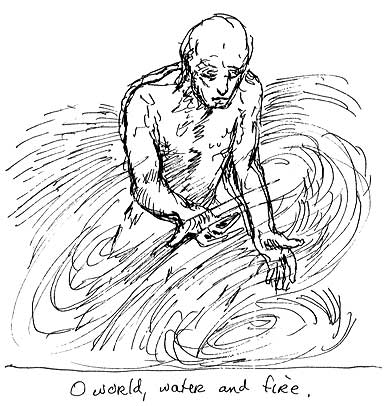
( this little drawing is a sort of memorial my brother, who tried to escape from life into drugs and into the sea-going life, where he was a sailor and lost himself going to sea.)
But I am not interested in making Christian confessions, nor an effort to improve my chances of advancement in a mythical "next world" . I refuse to enter the casino where Pascal's Wager is meaningful. What is Pascal's Wager anyway but another Faust myth: selling one's "soul" to a deity in return for power or immortality. I am not interested in transcendental magnifications. I wrote the Faust myth to death years ago. In six or seven notebooks in 1980 and 81 I wrote the Faust myth out of my flesh and blood. Goethe and Marlowe and Mann died in me. Not interested in that . Rather, I am interested in improving the chances of understanding and appreciating this world. Things of great concern to me 20 years ago now seem either wrong or irrelevant. Gods, for instance, which seemed important to me 20 years ago now seem to be merely inflated religious and mythic concepts, fog and mirrors hiding institutional motives. I rarely think of gods and myths except to remark to myself the context of those who use them or profit from their use. Respect for human rights and nature's rights, toleration of others provided they do no harm, real concern for actualities on the earth seem to me to be values far more important than archaic religions with their myths about other worlds. I have given up on transcendental abstractions.
But what about Books? But what about books, books are not entirely abstract things, and they have been important objects in my life since childhood. Gods I can do without: Archetypes be gone. But books---- let gods die, but leave me some books--- books are something that were always important to my hands and eyes. They were my friends and my refuge. I'm not exactly a bibliophile, but I love books, bookstores and libraries. How could I live without books? I who have always loved coffee shops and Cafes. I have sat reading studying or writing in Cafe Trieste, Vesuvio's or Savoy Tivoli in San Francisco: great and not so great cafes in New York, London, Paris, Amsterdam, or Cleveland. Little town cafes. suburban cafes, Five and Dime cafes, Black Cat Cafes, Cafe Louvre: Red Star Cafe. There was Kay's books which I will speak of in a minute and West 25th Street Books, where me and Adam Brodsky, Jim Lang, Steve Smith, warm hearted Nancy, Marian's electric mind of the times, Russ Vidrick, Terry Provost and others read their hearts out every Saturday in Cleveland. My wife and I would walk in with our baby and listen to them all voice their deepest thoughts in round robin fashion, one poet taking off form the one who ran before, with not schedule and no director.
One of my warmest pleasures in life has been sitting in a lonely cafe drinking coffee or eating bread or black bean soup and thinking about life, writing in a beloved notebook. What would a sad cafe be without a good book in which I could read or write? I can't remember ever living entirely without books even on those rare occasions when I briefly decided, ( probably because of some book I read!!) that all books and word-knowledge was vanity and I should give up books to rely on direct experience alone. Certainly direct experience is invaluable. But books help to define what one has experienced. The world is not only outside the eyes, but also in the mind. Nature looks at us from without, but also from within. I close my eyes and still feel the sun shinning in the forest behind my eyelids. I open my eyes to the time I live in and close my eyes and see Shakespeare's King Lear walking with his Fool in the midst of a storm. How will Lear understand the world he lives in, how will I? What is Raskolnikov thinking now? What does Basho see in the flower on the road traveling north. What would life be without books? How much wider and interesting the world is because of them!!
Indeed, the drawing above that heads this chapter is called Two Worlds for a reason. The drawing seems to ask the question: what is the relation of what is in one's own heart and mind to what is in the world ? How does what is inside books relate to what is inside oneself ? And how does what is inside books relate to what is out there in the world, outside the eyes? And moreover, how does the past, present and future relate to the inner-book of the heart and the outer-book of nature ? Is the notion of a 'book" a valid metaphor for how the world really is? Genes and the implicate order and simplicity they imply seem more valid as how nature is that books, with their self protecting cover and linear directionality.... but Ill have to think about that further....
The person in the first drawing that opens this chapter is a imaginary portrait of Leonardo Da Vinci. It is a recollection of his marvelous late self portrait in red chalk on pink paper at age 60, possibly the the only image of him from his own hand. ( 1513 Biblioteca Reale, Turin) It may not be a self portrait, exactly, but it has a certain similarity to the one portrait that is thought to be authentic (See Portrait of Leonardo,1519, in the Windsor Leoni volume 12726, probably done by a student of his). My drawing is is not an accurate copy of these images. It was done from memory and interprets Leonardo in a way that recalls the original without imitating it. The angle of the head is about the same as the original as is the fall of the hair. In any case, in my drawing, Leonardo is holding a book open to a window and light is pouring in through the window. The only reference to this drawing in my writings of the time is as follows:" The logic I am speaking of is not a rational logic like mathematics. It is an underground logic, a logic of nature, a logic hidden in the structure of nature and built into the mind... a logic that can only be perceived and shown obliquely... as we perceive sunlight illuminating the pages and words of a book when the book is too far away to be able to read it or interpret its meaning. Nature is the model of all books and the sky holds words and laws that we can only dimly read in moments of illumination"
This quote defining an intuitive logic inherent in nature is from a long essay on Chance and the Imagination I wrote in 1980. The text of this essay specifies that this drawing of Da Vinci illustrates the concept in this paragraph. The last sentence is confusing, since it seems to suggest something about science or an obscure mystical vision. The idea of a 'logic of nature' comes from John Dewy and the theory of evolution. But if I bracket out the mystical vision and simply read the sentence literally, the meaning changes. Im trying to define existence in space..............
So, read literally, what the quoted paragraph above is saying is that Da Vinci ( in the drawing) is showing us an idea about the 'logic of nature'. This 'logic' is visible in the sunlight pouring in the window onto the pages of the book. The book itself seems to contain hieroglyphs that appear to be interacting with the light and air.
The drawing appears to describe two kinds of reality. The first is the process of luminous lines and spirals that dominate the entire room with light and space, and the second is the separate world of Euclidean forms that descends down on Da Vinci from above and which is also visible in the book and some of the objects on the table. It would seem that the drawing is trying to define the relation of forms to formlessness and process. Or better yet, the drawing is trying to define the intangible nature of light and air, the feel of space and how air and light hold meaning in time. The drawing is trying to use Da Vinci to reconcile conflicting views of existence. It is also trying define for me the nature of how I feel about the space of existence and the relation of mind to spatial existence or extension. In other words how does it feel to stand in the midst of space and time, inside my body in a world of light .
Two Worlds: Open Book, Open Window and the Sky Between
(Leonardo Da Vinci)Is it strange that I would have Da Vinci say something that actually is mine to say? Why I didn't simply picture myself I do not know. I did so in other drawings. Certainly an affection for Leonardo is part of it. It was not that I thought Da Vinci carried more weight than my lowly self. Did I need high heroes to bolster a rather timid ego? No, it was more of a love of his curiosity-- a curiosity that I shared, that I am trying to celebrate here. I also was aware of Leonardo's love of vortexes, spirals, the fabulous motions of water and all recurved and serpentine motions. The Philosophical Drawings in general are hymns to curves, waves, spirals, vortexes and undulating patters of fire, growth and life.
In any case, in the drawing, the book as a human and hand-made thing, (resembling my own notebooks). Da Vinci is holding up the book to the light. He seems to think that this demonstration has meaning, and that the unreadable symbols of the book are somehow explained by their interaction with sunlight and space between the book and the window. Leonardo is trying to define the nature of existence by reference to the motion of light in space and time. This is a profound thing, really, if one pauses to think about it. Leonardo is trying to show the depth of space and light as having a fundamental relation to human existence, to human creativity, to human productions. In other words nature and human nature are really the same thing. The mind, at its deepest levels, shares a fundamental relation to light and space.
A simpler, perhaps less interesting, explanation is that the drawing presents the idea of "two worlds": first, the ideal world of the book and the Platonic forms above Leonardo's head. The second world is the actual world of sunlight, existence, space, time, objects on the table and the book, in addition to Leonardo himself. That is more or less what I meant by the drawing when I did it. I was defining different ways of defining what is real and trying to imagine if there was an interaction between the ideal and the real: human symbols as opposed to natural facts. This is a theme is Leonardo's work too, since in his drawings, mathematical diagrams often contend against rounded forms modeled with exquisite loveliness. Leonardo had not yet escaped the medieval mentality. I hadn't escaped it either, when I did this drawing--though I was straining toward a way of seeing beyond religion.
Now I would say that the mystical Platonism implied in parts of this drawing is something I no longer agree is "real", as I have explained elsewhere in this book. So, even if I state that Plato has nothing to do with this drawing, as I see it now, I can still say that human imagination and reality interact in complex ways. But the drawing draws attention to the interplay of books and reality and reality and minds. It is above all a drawing about the relation of space and light to human existence. Yes. This subject still matters to me. The ideal world of the book and the abstract Euclidean forms above Leonardo's head (let's not call them Platonic), could symbolize the abstract world of human creations of whatever kind. Gods and philosophical concepts are virtual objects or virtual realities that are not actual as are birds and trees. Ideas can be delusional or reasonable, beneficial or potentially harmful. Ideas can promote murder and unjust power just as they can encourage peace, equality and fair treatment. Ideas can also seem to be fair and equitable ideas when in fact they are the opposite. Ideas can deceive as well as lead to truths. Ideas and virtual concepts do influence the world we live in, whether we wish it or no.
Indeed most humans live almost completely enclosed in systems of abstract knowledge, myths and human centered concerns, scarcely aware of the actual world of other beings and nature that surrounds them. Drive down any highway in any big city and you can see how alienated people are driving in the metal cars, divorced from the earth and enclosed behind glass and probably listening to music through headphones or radio voices pumped through the air into the metal cars. Or they are talking on cell phones. Go into any church. God concepts are basically like cars, metal boxes--- blinders against reality. There are no "Gods", no "Man", there are only individuals, actualities, things, minds, lives, all part of nature. But to take off the encrustations of ideology and religion, myth and cultural enclosure is no easy matter. The blinders are thick and largely unconscious. Advertising and propaganda are about exploiting symbols to try to 'manufacture consent', as Chomsky put it.
Alienation from the earth results from excessive reliance on systems of abstractions; Aquinas, Marx, Mao, Jesus are all promoters of abstract sytems. The drawing above is trying to grasp what a good relation between the world of ideas and the world of nature and actual things might be. Leonardo himself seems to have become more and more realistic as he got older as well, leaving abstract ideology behind him. With the exception of the strange Deluge series, his later drawings are increasingly scientific. I agree with him. This happened with Thoreau as well. Thoreau becomes less and less transcendentalist, more an more down to earth. It is important to come down to earth and plant one's feet in the fragile world of actuality. Da Vinci was trying to escape from the myths of his time, as was Thoreau. I am trying to escape for the myths of our time. The world, such as it is, is what we have to work with. There is no escape into religion, poetic fantasy, technology or other ideologies, capitalist, Marxist or otherwise. One must face the real with open eyes, however hard, however painful. I only have one life, and it is up to me to live it well or not. What si real, waht is not real? That is the question.
The Two Worlds drawing is conceived of in general enough terms that one interpretation does not exhaust it. Da Vinci is asking a question in the drawing, or presenting objects to meditate on. His question is: what does the meaning that is carried inside books or minds has to do with the meaning of sunlight and air streaming through a window? Or how does the subjective realm of the human imagination ( books, gods, language, numbers, symbols) relate to the world of actual space, time, sunlight, open windows and hard objects? This is a very good question. It is a question I have pondered for decades now. And my views have changed radically with my experience. It is the world that we must concentrate on. The earth is our teacher. Science is what matters. I need to be skeptical of symbols and systems of abstractions.
I did this drawing in praise of Leonardo, asking of him one of the big questions of my life. My image of Leonardo is partly an image of my concerns at that time I did the drawing. But it also an attempt to grapple with the genius of Leonardo himself as a scientist and observer of the actual. I loved Leonardo from an early age and love him still. His was a marvelous mind, a scientist and artist all at once. My view of him has matured over the years. Now I love his adventurous mind, his love of birds and flying, his endless curiosity, love of water and mountains, his willingness to study the human heart, fossils, seashells, rock formations. I love the wonderful landscapes are in the backgrounds of his paintings. They are landscapes that would not be envisioned for another 400 or 500 years, amazing panoramas of the earth as a crucible of evolution. In his mountains and flower studies he suggests in paint the theory of evolution long in advance of it being discovered or created by Darwin, Wallace and others. I love his anatomy drawing such as those did of the vortex patterns of blood as it washes against the values of the heart. Amazingly enough, his drawing of this was only confirmed as accurate in the last 25 years. He drew clouds dumping their rain over mountain and valley. He drew water bubbling up out of depths. He drew the beauty of human muscles, birds wings, rivers flowing, lithe cats, human hair. I love his drawings of chain links, pulleys, hair braids, octahedrons, coitus, neck muscles, horses, beautiful boys, ancient old men with no teeth, and luminous faces. What a man of amazing insight, fresh eyes and a willingness to see outside of the conventions of his time---openly and honestly looking at the world everyday of his life. This is a drawing of praise and thanks for Leonardo, as well as a meditation on existence and the meaning of light and space.
So the drawing I did of Leonardo gropes toward and understanding of what the world means. When I did the drawing I did not yet see just how marvelous Leonardo's insistence on avoiding the mystical and staying with the actual and the real and earthly actually was. What is actuality? What is air? what is sunlight?, how do we talk about the actual facts of our existence here on this wonderful planet floating in the immensity of space? How can our minds penetrate and see further into this mystery? Leonardo is such a great example of this effort to look directly and life, without recourse to fictional myth and other confabulations of religion, myth or custom.
I am making a book about a book here. Philosophical Drawings is a book and was conceived to be a literary and artistic creation from its inception. It was an object in which I have recorded images and drawings, now complicated by an exegesis written 20 years after the fact. I no longer have much belief in the ideal realm that Leonardo exhibits in the drawing above. But I still love books and I certainly still love sunlight, shinning down on books or any other object. So, in terms of the alternative presented by Leonardo above, my concerns are now mostly with the actual and a not the ideal.
Silent words (unsaid)
Concerning the actuality of this book: I did the Philosophical Drawing between 79 and 86, roughly, ---though some of the paintings were done as late as 1991--- and during that time I lived in San Francisco, New York City, Maine, Indiana and Cleveland Ohio and visited Europe, where I did drawings in Paris and Amsterdam. I had various kinds of jobs, dishwasher, apprentice furniture maker, bookstore clerk, waiter, oriental rug store rug worker and eventfully oriental carpet repair man and restorer. But my concern was not money, rather I sought a job in which I would have to work as little as possible so as to give me time for creative work. I sought work outside corporate conformity and control. I wanted to understand the world I was living in. I have always resisted involvement or conformity to corporate culture to the degree that I could. Indeed, I have considered it something of a Gandhian obligation to resist and protest corporate power.
In the many places I lived between 1979 and 91 I brought books along. I do not remember which books but certainly my journals and notebooks always went with me. The Philosophical Drawings themselves were done in green, black, red or canvas-colored journals, or sketchbooks, roughly 9x11 inches. Many of the drawings and a few of the paintings were done on fine paper notebooks which I managed to find in specialty shops New York and London. So the drawings are drawings meant to be in a book along with a text, and often the drawing is itself a text or accompanied by text. So the drawings were done in widely separate places and times but always in a similar sized book with text of some kind. The line between writing and drawings is always blurred. I employed a consistent style despite the various environments in which they were done. There are slight stylistic changes over time, but mostly the changes from drawing to drawing are not stylistic but based on content. My drawing books or journals were the mirrors in which I sought to reflect on the changed places and meanings of times that were also changing. There is also a deepening investigation of my own interior life. Who was I and what was the world I saw in this mirror of meanings in places and times ? The drawings are veils made up of my mind and heart. They are veils that hover delicately between my heart, mind and the reality of the places I lived from 1979 to 1991. This is the way life was and is, complexes of time in mirrors and mirrors and veils drifting over forgotten things and faces: mirrors and veils or time and place and faces and all the mirrors and veils and and places all mixed together with no absolute certainty as to what is where and who is when and why. In this strange veil of mirrors and times and veils and places I try to some sort of order and meaning. There it is beauty and nature and sadness and longing reflected back at you, veiled, but mirrored back onto loveliness of the world and myself, ourselves within it. So to try to create understanding I am writing this book and this book involves the further complication of interpreting these drawings in 2004-6. I want to take the mirrors and veils away and show life as it was, to the degree that is possible.
To focus on one of the places I lived: in 1982, when I did some of these drawings, I was living in a tiny apartment with a large room and a bathroom and couch covered with an ocher blanket, an old recliner chair and a desk where i could sit and write or draw. I was working at a bookstore in Cleveland, getting on a dirty bus every morning and riding past downtown Lake Erie. Once I walked though the Euclid Arcade to Prospect Street and past the pawn shops and bums and drunks I was near the bookstore. There I was to help customer or restock dusty shelves with used Harlequin Romance novels someone read years ago and sold to Kay for a pittance. I also restocking the latest issue of Model Train magazine, or more interestingly, the works of W.E.B. Dubois in the Black history section or Wordsworth and Mark Twain the the literature section. It was a phenomenal bookstore with 3 floors of every title imaginable. The bookstore was owned by Rachel "Kay" Rowan, a hard-as nails- old lady with white hair who only could be seen smiling once in a great while. Mostly she was concerned with money and her fingers did not seem made for touching anything but dollar bills, cash registers and quarters. But she just greedy: she was also very brave. One day a man came in a pulled a gun on her and demanded her money, and she yelled at him and told him to "put that thing away" and chased him out of the store. She was like the forbidding grey-haired old school teacher--- the one all the kids respected, but of whom all the kids were afraid . She knew this, of course, and cultured even more fear from her employyees and customers, always in the interst of making more money. Though with customers she could also be fawing and even smile, even it would make her a sale. It was a bitter greed that made Kay smile so rarely. And her greed was noticed and resented by all who worked for her. They did not respect her for it and some of her workers stole from her to compensate for being treated as inferior and underpaid.
I loved some aspects of her bookstore and learned allot from some of the employees there. I didn't mind that Kay carried "mature" material as well, magazines of the x-rated variety. That was something g of an education, to see so many varieties of pornography. I have nothing against nudity, but do object to sexual exploitation. But I was more surprised and disgusted that so many men have a fetish for guns, battleships and military history books. Kay had a whole section of this rubbish and men, always men, right wing men, would come in and gloat over the guns and killing machines, tanks and ammo in magazines like 'Soldiers of Fortune' or 'Guns and Ammo'. The people that came to look at the "girlie magazines" were harmless and inoffensive by comparison.
I liked the literature and philosophy sections, especially. What was really great about Kay's bookstore was its used books. She had everything. I often came across real jewels of works I have never seen. It was a good job for a poet and allowed me to be around ideas and books all day long. I learned to value world culture and world art and poetry there. It is where I learned most about world poetry for instance. This is reflected in scholarly and intellectual drawings like Meditations: the Young Philosopher, Knowledge or Evolution and the Limits of Language or the Fall: tragic Veil. I did some of these drawings when i was working at Kay's.
The bookstore itself was unusual and full of eccentric characters. For instance the oldest worker was a man named Harry who was very fat and badly dressed but who spoke a very fine and elegant English. He was gay and had a young man who was not altogether right in the head who came to see him to ask him for money. The young man thought that there were conspiracies everywhere. He imagined the license plates on the cars in the street had secret messages to tell him. There another man, Gary, who did marvelous cartoons for a comic book series by Harvey Pekar, called American Splendor, as well as a very intelligent, budding songwriter and would-be rock star, and a born again Christian. These people were all colorful and sad, full of dreams that very likely might not come to pass. I was certainly no better than any of them. My dreams, written down at night in poems or meticulously drawn in notebooks, also might come to nothing or shatter like glass.
I enjoy people, indeed, I prefer people who are not quite "normal" and none of the people who worked at Kay's were quite normal.. Normalcy involves a certain lack of imagination, a certain unthinking allegiance to mass marketed gossip, corporate culture, the catholic church or other meddlesome and conformist watchers of social acceptability. Life is sad, and from one day to the next, I am often surprised that we go on and continue with things. Being surrounded by all those old books made me think the world has gone on in its haphazard way for centuries, but yet something of all the trouble and sorrow remains, and somewhere in all the seeking and knowledge there ought to be some understanding of the mystery of life, a slight smile on the corner of the mouth of history, even as Rembrandt late self portrait shows him laughing, a hearty laugh that is full of tragic humor. Rembrandt's laughing self portrait is supposedly based on a story or myth about Zeuxis, a painter who painted old women who died when he laughed so loud he choked on some food. But I have wondered if the picture actually portrays Diogenes the Cynic, the one who told Emperor Alexander to stand out of his sunshine. "Get out of my sunshinel" he is supposed to have said to the conqueror, disrespectfully. Such a man, who respects no power, has the right to a hearty laugh and my admiration.
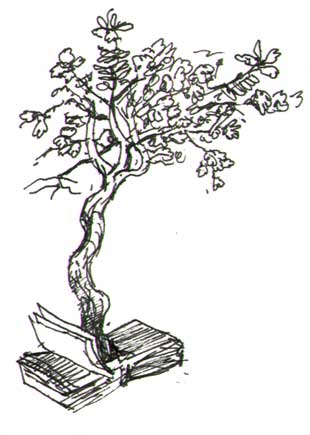
( perhaps it would have been more accurate to draw the book being born like fruit form the tree rather than the tree from the book!!)I was wonderful to be with all the books everyday. Bookstores like Kay's, independently owned and run, had amazing diversity. The corporate bookstore has largely eliminated these wonderful Mom and Pop stores. Now that the computer seems to be supplanting the need of books, it is a loss all around. I can think back to favorite bookstores in various cities around the country and the world. Bookstores like Foley's in London, Shakespeare's in Paris, in City Lights and Cody's San Francisco and many small bookstores in New York. Kay's books was one of the best I had ever been in, for all its funky mustiness and chaos, or perhaps because of its excellence in the midst of funky chaos.
There is something intimate and friendly about books, something that calls forth a certain care and charm for intimate human objects, like old shoes, baby clothes an old man's pipe or a woman's favorite purse. Good Books are like dolls or children's toys, well worn jewelry or ones favorite pottery. The book has a marvelous hand held intimacy that one takes into ones eyes and shares with the author her or his most special and personal reflections. Not all books do this, obviously, some books are not worth the paper they are printed on, but some stretch the imagination to the stars, or bring one down into the deepest sorrows, and some merely recount facts of no interest. But I loved all those used books, with their worn spines, and their musty smell, and the dust of ages on their bookends. Books were like a tree that I climbed from branch to branch and book to book, like a bird flying from limb to limb or from rivers to hills.
It was a good job for a while. I would come home and make myself some simple dinner and work on my drawings or my poems. I was full of 'high' purpose in a world that neither shared my interests or cared if I cared about a better world worth living in. I was very lonely in those days as the woman I was then involved with lived in New York City and I disliked New York and did not wish to live there again. She would come to see me periodically and I would go to see her, ecstatic to go meet her at the airport periodically. She ended up moving back to where I lived for a time.
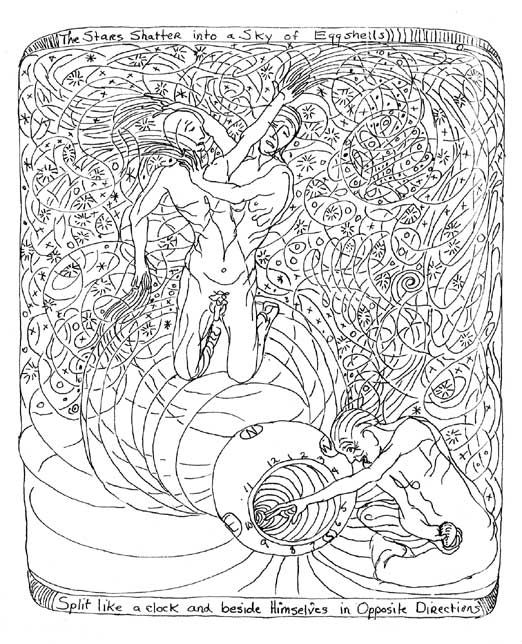
I left Kay's books eventually for various reasons. It wasn't just a feeling of suffocating in a house of books. There were other pressing reasons. A man who worked in the store decided he did not like me and came up behind me one day with a nose and put it around my neck laughing. Another day he ran a razor blade up and own my arm, threatening to cut me. I got the message. This drawing was done around the time that I left the bookstore. The clock and screaming hands above the house of books in the drawing probably express some terror in the house of books, some feeling that I am wasting my life and must learn elsewhere. It was not an entirely safe place to work. I had to get out. The world of books is not the world in which books are sold. I was living in a world of poetry and rare knowledge and the bookstore where I worked harbored one person who did not have my well being in view. It was easier to leave the bookstore than to try to fight that particular individual and his malice. It is not the first time in my life I inspired hated in an unbalanced individual. He wanted me to quit and threatened me with a razor blade, which he ran up my arm, and suggested it might be well if I left. Another day he put a hangman's noose around my neck. I obliged him. What else was I to do? I was suffocating the the house of books. I left the bookstore carrying Plato's writings with me as I went out the door the last time. It was a fateful book I left with. I did not realize then that that book would haunt the next 10 years until I finally renounced Plato.
House of Books
I was often frightened in those days, frightened yet longing for a freedom that I did not yet understand. How could I not be? I was a sensitive and feeling person living in a world that does not care about much of anything except money and power. Money has never held my interest much. My concern was doing my creative work. I was restless with a need to know. I knew that what I needed to know was not going to be taught to me in a university. I wanted to find out what the world was and how it worked. This rather Kafkaesque vision, in the above drawing, of a man trying to find comfort from fear in a tiny cell or cave of books offers a psychological truth. Above the drawing I have written the words "St. Anthony". This is not a drawing of Anthony, but I was commenting on the man in this drawing seeking refuge in the realm abstractions as Anthony did. Books were a defense, I hoped, against the power of the world to exploit me. It is true that gods can be a defense too. There is reason to believe that gods are entirely the fiction of makers of books. Or rather the priests had the books, or in some tribes the lore, the oral histories and oral traditions, and these fictions are fed to the illiterate to keep them content with their quiet suffering. Religion was and is mostly palliative stories spoken down to ignorant children to pacify their fears. Sometimes after the Gutenberg revolution, books ceased to be accessible only to the ruling classes, and religion begins to fail. So it is not books that were the problem behind religion, but rather the control of knowledge by elite classes. Inexpensive books, and the whole process of gathering accurate information, were primary in overthrowing Catholic dogma and domination in Europe. So in this sense, books are liberation, insofar as they represent an effort oto be objective and socailly conscious. But insofar as books are symbols of dogma or holy writ, literal interpretation or "revealed truth", they are something retrogressive, harmful, and imprisoning. The St. Anthony myth in the above drawign is thus employed ironically. I wanted to break out of the house of books. But I did not yet know how to do it. I lef tht bookstore carrying a copy of Plato's works. I was not aware that this was another trap or prison that I would not get out of for ten years.
During the years where I explored religion I was not content with quietly suffering for the sake of a god who was merely a puffed up pretender. But I did not have enough education yet to understand how dogmas form and who they serve. I did feel, despite my love of them, that sometimes I disliked books and wanted to escape from them. Books are necessarily time bound. That is what gives them their dusty vanity, their musty, leather-worn feeling of death and decay. Even books that claim to have escaped time have not done so, and even their spines show wear. There is no eternal book: there are only deceitful tomes. There are reasons to want to be free of books, free of abstract prisons of thought, free of endlessly thinking about what has no solution. To hold on to what is real and get out of the imaginations of others. Too much time in books and around ideas and I want to give myself back to green flow of life, to flowers and birds and my body's life and the life of seeing and reaching, eating and walking.
But there are other times where I needed books badly. I needed and loved books in some parts of my life more than I loved human beings. I did not know how else to try to find a way out of my sorrows unless it was to appeal to the dead people inside books. Someone must have learned something in this life of ours. Of course, books are still about people. So I guess I was not denying humanity so much as I was seeking answers from the dead, because the living were unable or unwilling to help me. I often wish I could walk up to people and say, "what do you think about the fact of your aging, how does that feel to you?" or, "how do you feel about death"? --- But there are few people one can get close enough to to ask really deep and personal questions. So there have been times where I was desperate for books and believed I would only be able survive the harsh selfishness of a world that does not care about me if I can learn enough to defend myself. Knowledge is not power, as Francis Bacon said, but rather a way to stave off power: to defend myself against abusive powers, to find a way to live a life of truth and care. Books will protect me from harm, I believed. I really believed in those days that books could offer me a way to find a truth and certainty that were real and permanent. This was naive of course. They have led me to some truths. but not to "Truth". There is no "Truth". Yet still I am reading everyday, hoping to learn, seeking answers, asking questions. Life is questions.
On the one hand, like Don Quixote, I had read too many books and that had made me a little crazy in the head. I didn't think that windmills were dragons, literally, but I did believe many of the myths that I had been brought up with, some of which are not as harmless as windmills. I was led by books into a number of delusions, mistaken beliefs which encouraged me to follow various beautiful lies. I was as zealous in my folly as Don Quixote. It is better to be fat and skeptical, like Sancho Panza, perhaps. So I am becoming in my old age. But just as Books would deceive me in some cases, on the other hand they also helped me out over the years. Knowledge can benefit and it can do harm. Knowledge is not an unalloyed good, nor is it an unalloyed bad.
But that said, I still love books, even if I sometimes accuse or doubt them. In the core of me I think that education is paramount in life. Teaching my child is the deepest gift I can give her. Her education will protect here and guide her on her way. I cannot exactly remember when I started loving loving books and caring so much about education. My mother, probably, taught me to love books before I was born. She was a great lover of both books and education. Smart woman. When I was a kid, there were lots of books around the house. She did not hesitate to offer to buy me any book I expressed interest in. I remember at age 10 or so getting the Time/Life series of books about planets and the universe, and then biology and evolution, birds, and animal behavior and then others. I was full of curiosity about the world I lived in, and followed my wonder from one subject to another, heedless of the artificial categories they taught me in school.
His Flowering BookMy earliest interest was in nature and I loved thinking about the starry sky and the planets, and forests and animals. I remember writing a paper about Salmon in 4th grade and doing a drawing of Salmon leaping up a waterfall. And I made a wooden Condor out of plywood and I painted it in the colors of the Condor. Probably in 5th or 6th grade. In 7th grade I probably read my first full length novel, Jack London's White Fang. It was a great book that kept me in its enchantment for weeks. Little did I know that its pages describing the cruelty of life would turn out to be so true.
The other full length book that I read was The Journals of Lewis and Clark and that fired my imagination and rekindled my love for western North America, where I spent my childhood. All those visions of endless Buffalo and Pronghorn, and wildflowers brimming across the Prairie and Indians living in a world as yet unharmed. I loved imagining the world of waterfalls and crystal mountains and the Big River---the Columbia--- going down to the Pacific Ocean.
My interest in reading as a way of experiencing the wider world around me grew into my teens. A 6th grade teacher whose beauty, shapely breasts and sexual appeal increased my willingness to listen to her got me reading Edgar Poe. By 10th grade I moved form Poe to Coleridge and the romantic poets, from Shelley to Baudelaire. I was then given many of philosophy, literary and cultural books that had belonged to my epileptic uncle Jack, who was a journalist but whose illness compromised his employability and who spent his last years studying philosophy and culture. He had a very incisive mind and marked his books as he read so, in a way, i read along with him as I read his books. There was Dante's Divine Comedy and Dostoevsky's Brothers Karamazov, Crime and Punishment, William James Varieties of Religious Experience and many others. Jack became my main role model. His books opened up entire areas of interest. I speak of Jack in more detail in other writings.
I suppose if I have anyone to thank for a sense of wonder and a love of knowledge and books it is my mother and her brother Jack. They themselves were inspired by their mother and grandfather, as their mother, Edna Gormley, was quite a fiery and independent woman for the time, and their grandfather was a very forward seeing friend of African American people who wrote a wonderful book int he 1930's called Who is Who In Colored America ( Thomas Yenzer,1933-1947). I learned very little from my father's family, since all they seemed to care about was making money, taking advantage of others and climbing the unjust ladder of corporate 'success'. More than once I have considered changing my name to Gormley. Mark Gormley. yes, it sounds much better than Koslow.
So, my mother, my uncle, and my great-grandfather taught me the importance of books. But they did not teach me to fear what books can and cannot teach. My mother read partly to be informed but largely for entertainment. Nothing wrong with reading a good novel. But especially after my father died in 1973, she increasingly used books as an adjunct to a need to escape from her grief and disappointment in life. Books became a kind of alcohol, a drug. In moderation I have no objection to that either. But she was sometimes immoderate in such uses, especially and her later years before her dementia took over. I did not want to use books for such a means and in general have preferred non-fiction to fiction, though there are fictional works I have deeply loved.
But certainly I did use books to compensate for losses and sorrows in my life. In my teens, between 14 and 18, I was extremely lonely and books became a way of having friends and conversation. They kept my mind and curiosity alive. I so much longed for a real teacher I could taste it. But my teachers at school were not very good. Books offered me imaginary friends. One of the the friends I had was Vincent Van Gogh, who was also a very lonely man. I read his letters with some recognition of my own state. I loved the Vincent of the letters and paintings and retain a feeling of sympathy and intimate respect for him and his work today. I also read a physically huge book about Da Vinci in high school. It took me months to read parts of it by going to the library at school and reading it in installments. A few pages everyday. I studied Da Vinci's notebooks too. Leonardo was not a warm hearted man as was Vincent, but his love of knowledge and nature impressed me. I felt like I could swim in his notebooks, and identified with his far ranging curiosity, as I have discussed above.
I love art books and would bring home great, heavy stacks of them from the library--- Chinese or Hindu art, the Pre- Raphaelites, Honore Daumier, the strange artist Gregory Gillespie, Monet, El Greco or others no one has heard of. I also studied Rembrandt deeply in my teens. I found a book of drawings by him( at Kay's books, incidentally, some years before I worked there). It was a beautiful book with allot of room on the page besides the drawings. I copied passages from the sayings of Christ that the drawing illustrated, and sent the book to a girl who I thought I was in love with. She didn't value my effort very much. But it was in any case a work of love, justified for its own sake, as this book I am now making is also justified. And in any case, the weeks of immersion in the marvelous humanistic drawings of Rembrandt made it well worth it. No one ever told a story with so few and such well drawn lines as Rembrandt's marvelous drawings. I sometimes think that if the wonderful Christianity of the early social realist paintings of Van Gogh and and the drawings and the paintings of Rembrandt were the sum total of what Christianity were about, I might not have left religion behind me. But Christianity has done too much harm for me to to believe its myths. The fact is that Rembrandt's humanistic compassion goes well beyond the limits of an archaic and ossified religious institution. It might be said that Rembrandt is great despite his unfortunate religion. And Van Gogh himself eventually saw through the harmfulness of Christianity and abandoned it. Vincent's early career as a preacher in the coal mines of Borniage could not have been sustained, since such preachers were merely 'pie-in-the-sky' apologists for the injustices of a very cruel capitalism. Vincent ended as a poetic and secular socialist with deep feelings for nature.
Christian priests did not invent religious war but they perfected it, sharpening swords against the bones of "pagans" of the Roman empire, smashing "pagan" temples, burning their books, including, in particular, the Library of Alexandria. There were calls for the elimination of all non-Christians from the Roman empire following Justinian’s edict of 529.The Christian killing of those who were different continued through the perfidy of the Crusades and up to the present in foolish wars stared by a sadistic American president named Bush. The hatred of anything outside the bible has obsessed Christians for centuries and the burning of the Library in Alexandria was just the first of centuries of Inquisition, book burnings and efforts to censor and control minds. Even today American Christians seek to eliminate knowledge that conflicts with the absurd superstitions of the fictional tale they call the bible.
Seeking in many different kinds of books, was an early passion. Even before my father died, when I was 17, I felt a huge chasm open in me concerning the times I lived in and what I was to do with my life. The urgent need to understand the world and life drove me into books and into philosophy. I was skeptical about religion and liked what the American philosopher John Dewey said about religion being an effort to explain away the uncertainty and precariousness of life. Religion offered a false security, an 'opium" for the people as Marx put it. But the fascination of the religion was too tempting and its opium's were exciting in the early 1970's when the hippie movement and the Beatles had made eastern religions fashionable.
I did not know how to face my father's death. His death widened the chasm of my confusion even further. Nor did I know how to face my mother's grief. But necessity had thrown me into the situation and I had no choice but to do the best that i could. I was my mother's primary caretaker after her husband died, and she wanted to die too. How was I to keep my mother alive and deal with my father's death as well as with the adolescent confusions of my age, all at the same time? I think I probably made tentative compromises with religion because I needed it so that I could tell my mother stories to keep her from killing herself. So, I think I was already put in a deep conflict about what religion was and what validity it might have at age17. At 17 my father was dead, and my mother was insane with grief and I was left alone to try to sort it out. My mother's life depended on it, as she was often wildly, drunkenly suicidal. My mind told me that religion was a lie, my pain told me that I had to believe it to comfort others. I kept my mother alive, when really what she wanted was to throw herself on a burning pyre, literally, and she often said this, exactly.
There was no one there to help me deal with my own grief. So, books were a great comfort to me as well as a source of ideas and insights about possible ways to deal with the issues life had put before me. Thus, my love affair with books was always nuanced with sorrows and searches, seeking for alleviation of that which harmed me and those I loved. "In much wisdom there is much sorrow" someone said. I was not old enough to be wise. But I was old enough to seek knowledge and to be sad in the search. Hence the following drawing, which shows a character, more or less a self portrait, on the verge of weeping, or perhaps sad beyond the ability to weep. But it is not just me. It is someone who is seeking and not finding, seeking and not finding..... It could be anybody....
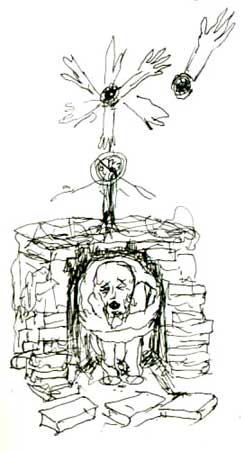
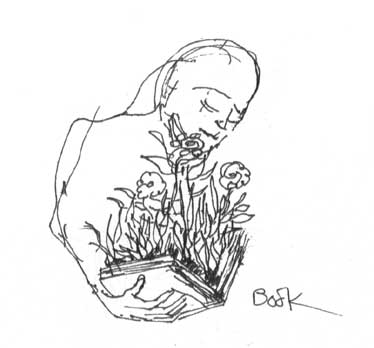
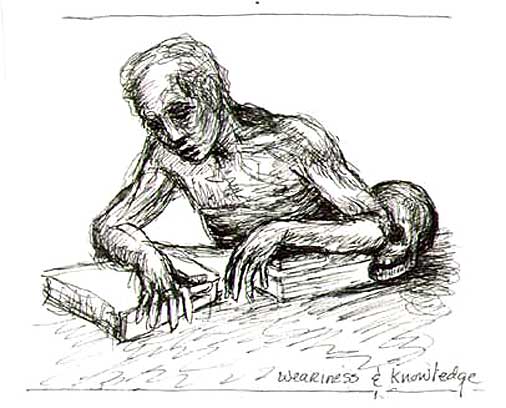
Being constantly around books in years of study can make one one sick of knowledge, at least for a time. After I had worked in the bookstore many months and then spent years studying philosophy and religion books sometimes seemed to be all about vanity. I was trying to learn the truth and was unable to do so. I clicked into hat whole tradition of thinking the world is "vanity", without questioning that tradition at all. The above drawing is a kind of "Memento Mori" such as one sees in grim Christian, Dutch still lives from the 16th and 17th centuries. These paintings try to state in different ways that you should "remember that you will die", and so show wormy fruit, dying flowers, hourglass sand timers, oil lamps, watches and other objects are used as symbols meant to remind the viewer of the transitory nature of human life. They try to make the viewer feel remorse for sexual appetite ,greed or over eating. One is supposed to look at the these paintings and want a more spiritual life, rejecting the "world" and the "flesh" in preparation for an imaginary afterlife. This drawing does not go that far. But it suggests a weariness with knowledge or the search for knowledge. It is, as it were, my personal Ecclesiastes. " All is Vanity" the preacher is supposed to have said. In this drawings I was using some of the symbols of the Momento Mori tradition to suggest my weariness. There is not much time in life, and it is true that you had better decide how you are to live before someone lese decides for you. All is not "vanity", one must beware of that kind of despair: death and gods are delusions. It is not true that all is vanity. There is no afterlife and flowers are not symbols of decay and and watches symbolize time passing but that does not mean that Christianity or any other religion is true. Existence is not vanity: religious superstitions and myths are what is vain. There are many reasons not to despair, not least of which is the beauty of sunlight, the wonder of nature, the depths of space and the marvel of existing. Even if I have at times been weary of learning and books, I still know life is life and I affirm it, in sprite of its difficult moments of suffering. There is only ourselves and our bodies. Loving our earth and our bodies upon it is sometimes hard, but that is all there is.
In fact, one of my first oil paintings, now lost, was a Still Life of a small pile of books ( I remember two of the books, one was Experience and Nature by John Dewey and the other was the selected writings of Bertrand Russell) and a birds nest ( an oriole's nest, to be exact) and the nest and books were placed before a wooden carving of a covered wagon rolling westward.. The symbolism of this early painting is rather the opposite of what is pictured in the drawing above. When I was 16 and books seemed to me to be the key and source of hope to allowing me to return to my beloved California. Life was not "vanity". I was not painting a momento mori but a Momento Viva, as it were, a remembrance of life. That hope was partly if not entirely realized in later years. Books would be my nest, and I would be born like a little bird out of heavy volumes of Poetry and Philosophy. There is even some truth in this: books did eventually help teach me a way of looking at the world that was my own. They taught me not shrink from critical thinking. They taught me that I didn't need books but could use them if I needed to and even love them if I must, but to love life first, if possible.
In contrast, when I did the drawing above I was weary of working with books and weary of study and was longing to go out and see more of the real world. And not long after doing this drawing I made a trip to Europe and went again to live in New York City for awhile. New journeys always seemed to bring me into proximity to new books, almost as if books were stairways or steps along a road in life. It seemed to me that one was only ready to read a given book once one had been prepared to read it. One abandoned that book or that author as one outgrew those concerns. Few authors are there indeed that survive a lifetime of interest.
On the other hand there are books that one comes across on the road of life that lead one astray, into confusion or do one damage. One should not have read them and misery could have been avoided. Fateful books come ones way that turn ones mind in a direction that counters who one truly is----books that preach harmful beliefs, or advocate for human tendencies that are destructive. "How to Win Friends and Influence People" and the millions of variants of this book teach people how to put it over on others, to lie and sell things that are better not sold or bought. Mein Kampf: Machiavelli; The Art of War being notable examples. There were books that did me real harm and I am sorry I ever read them, such as the writings of the traditionalist Rene Guenon and his followers. I thought there was some truth to their writings at first, but found out that they were little more than far right cultists. But I learned from them painful lessons about how unjust systems of knowledge operate, how dogmas distort human behavior and how people become ignorant and malicious when in certain groups, cults or religious organizations.
I had a different experience reading Nietzsche in art school. His work intoxicated me for some weeks or perhaps a month. Zarathustra was very exciting, both its language and its wild excess of sunlight and feelings of power and strength. But I eventually figured out how racist and human centered it was and lost interest in it. The "overman," was merely another puffed up fiction with Germanic delusions of grandeur. I would later learn about Fichte's "universal ego" and Schuon's claim to be the last prophet at the end of time, and realize what folly was the will to power and the caste ridden desire to be above everyone and everything. But I agree with Nietzsche that "To do wrong to the earth is now the most awful thing"
We fortunately live in a society that cannot ban books. Plato wanted to ban books and poets from his fascist and caste ridden Republic. The Catholic Church and the Stalinist empire were fond of banning books and killing authors. Republicans and McCarthyites in the U.S. are continually trying to censor books. I certainly do not believe in denying free speech or free expression, and even harmful books need to be available, but there also needs to be free and fair systems of education to make sure that people are able to assess the harm such books can do. There books that fuel hate, racism, envy or greed. Some books lead one astray and offer phony esoteric secrets, but when one goes down the path toward the fountain they promise, alas, the fountain is empty, filled with sand, and the hard work of seeking to get there through the texts and symbols is for nothing. One has been duped, as in the drawing below.
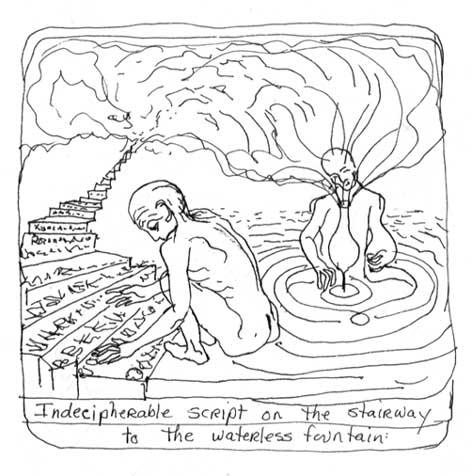
Here is a drawing that pictures the road taken down the highway of symbols that lead into the land of cults and religion and systems of ignorance superstition and social engineering. How beautiful the runes, arcane letters and esoteric scripts look. To know secret languages makes one feel elite and chosen. But such esoteric elitism leads to corrupt societies of people who believe thy are more special that others and those who are outsiders are "profane" or scum. Form there it is a short step toward shunning ostracism, inquisitorial suppression of rights, abuse of women or children, minorities or indigenous people and then murder.
I was just looking at the books in my bookcase and see the sad fact of years gone by that I will never recover again. There is Rilke's collected poems, who I loved deeply once and love no more. How my heart flew in the azure heights and immanent depths of Rilke's metaphysical fictions!! All that narcissistic "within, within, within", as if the poor did not matter and only Buddhist or orientalist escape into the immanent was the answer. I gave up Rilke's secular religion years ago. But what beauty there was in this youthful idealism! So much fullness of feeling about dying early as a martyr to poetry. What aesthetic narcissism it all was. Yes, it could be said that Rilke is a sort of midwife to the Philosophical drawings----Rilke's Duino Elegies, the most religious secular poems every written, along with Jack Hirschman with maybe a little Beckett, Van Gogh, Klee and Da Vinci thrown in too. Not many people see the humor that is in some of these drawings, but no matter. Next to my long neglected collected poems of Rilke is the Mustard Seed Garden, a Chinese painting manual, which I no longer need, but sometimes look at and keep because it is interesting to see how the Chinese stylized nature's infinite variety. There is Shelley and Yeats, Joyce and Plato. There are so many books that occupied me deeply for some many diverse reasons in the past. I cannot recover those enthusiasms now. I have changed with my books over the years, each book evoking a different part of myself from the long ago. Parts of my old self, as if each book were a leaf fallen from the tree of my life, a stairway leading somewhere that seemed too far then, but now is a town I left far behind.Reading is an activity that encloses one in a lovely, private world of the mind and imagination. It is not necessarily an escape from reality. Of course there are situations in life that one legitimately would can wish to escape from. Tyrannical parents, a bad job or bad employers, war, poverty, prison, grief, sickness, boredom are all good reasons to want to escape for awhile into a book. I used books in high school as a means of travel. I needed to get away from the town I lived in, the loneliness of days, the long hours of friendless sorrow, sitting in classes being taught things I already knew or did not care about--- a family that showed little concern for me or eachother. I used books to try to understand why I lived in a world made in such as way, governed by people whose main motives seemed to be to compete or bring defeat or shame to other people----people who wanted to see other people suffer and have less than them--- people who thought that refusing to give to others and having more than poorer people made them virtuous. What kind of world makes a hero of penny-pinching millionaires who give nothing to anyone, or whose gifts merely reinforce the poverty that they themselves created? What kind of world puts selfish and cruel financiers and business men in positions of power ruling democratic governments? The greedy, "cost-benefit" mentality of merchants is not the mentality one wants running a government or any other reasonable organization. People who hurt others to make millions are criminals..
I was trying to find a way out of capitalism, a way out of a destructive economy of "self interest" that excused cruelty by invoking the lie of "necessity". It is never necessary that one has to exploit or cheat others. My father believed that one cannot "change the evil in the world" and that therefore one had to join the evil and profit from it. I longed for a world where good people would not excuse harm done to others or to nature on the basis that " I was just doing my job". I would not worship as my father had, the "Bitch Goddess success" as William James called it. Of course, James is not entirely blameless in his philosophy, which does sometime support the goddess he decries. In any case, I read James and The Logical Positivists and other economic thinkers who tried to justify capitalism. I tried to keep myself at least somewhat informed about those who justified things that were harmful to others. Thus, at times, I have read books not because I loved them, but because it was necessary to study that which does harm, of those thinkers or histories that have caused suffering for myself of others. Sometimes one reads to shore oneself up against ruin and hurt. Sometimes one studies the enemy. Sometimes, one needs to know enough to try to outsmart the many con-men who have most of the power in the world. Book are an important source of resistance to power and injustice. Democracy fails without access to as much freedom of information as possible. I finally came to understand that books and knowledge are important not as a means of preserving power, but as a means of seeking to limit, curtail, resist and restrain powers. Some books are needed to tell the truth about power, analyze the charlatans, expose the liars and unmask those who take from the small and the poor.
Some books seemed to offer a world that did not make a virtue of capitalistic selfishness. I longed to see other lands, know how other people thought, understand other peoples gods, other arts and cultures. I longed for a community of people who cared about each other, a family that did not undermine and destroy each others pursuits as my family had done. Short of that. I sought friends in books, and thought that books provided an intimacy that might help me when I was older and could meet companions who would provide me with deeper intimacies.
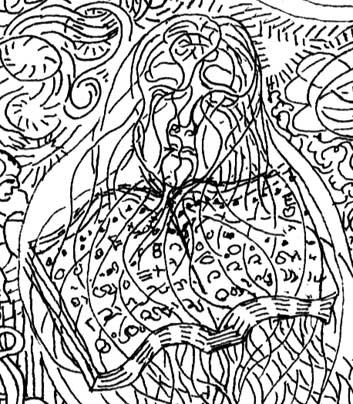
This drawing, a section of a lager drawing below it, tries to show the immersion in the pleasure and luminous wonder of books. There really is a "pleasure of the text", as Roland Barthes called it. It is a pleasure of the mind that sends itself out into the body on the one hand and into the imaginary world the book creates, on the other. Its an extraordinary thing to enter in the world of someone else through writing. It is almost like making love, but it is mental and emotional, rather than physical. In this drawing the book seems almost to create the face of the man that rises or hovers over the opened book. Indeed, books help create and sustain one's inner self, the light of ones eyes. I wonder when I did this drawing if I thought of the man as the creation of the book, or is he so enraptured by the book that he flows in and out of its pages? Or is it the author himself or the reader who is dreaming above or evoked by the luminous pages.
What is one's identity when one reads a book? Does one become the others who are in the book? David Copperfield becomes part of one's own ego. One runs with Oliver Twist through the streets of London and escapes Aunt Polly with Tom Sawyer or goes down the river with Huck Finn and the slave Jim. Is that why the pleasure of a book can be so satisfying, almost as if one made love with another mind, becoming that which one loves? Books can englobe one in another world, that is certain, becoming a brother to the Karamozovs or walking Fairhaven Hill with Henry Thoreau. One can become carried away into a place very different than where the body might happen to be sitting and reading, and from there one can imagine wonderful conversations, amazing feats and wide vistas. It is amazing how some books sing in my heart for years or decades. Thoreau has carried my heart and mind into beautiful ecstasies in this way, even recently. So has Neruda. Edward Abbey's Desert Solitaire is one of the best nature books ever written.. Barry Lopez has written some fine things. I went Sailing on Mutiny on the Bounty and went into the sewer under Paris with Jean Valjean. Rimbaud took me to a hell in my mind and Beckett brought me into a sad self recollection of my own lost and seeking humanity. One of my favorite books does nothing more than describe a hummingbird that was caught up north over the course of a cold winter, and the author lived with the bird in her indoor garden. Another favorite book describes life with a Blue Jay. I especially love books that try to tell the truth about experiences.
Some books live inside one for years, and some live only briefly. Once upon a time Rilke, Tagore and Rumi transported me in ecstasies. But now when I read them I no longer find them alluring. Once I loved Edgar Poe but now do not enjoy reading him. It is hard to define why some books hold ones heart for years and other books lose their luster quickly. It my teens I loved both King Lear and Dante, but now I find Dante ridiculous but still love Lear and his fool. I still love Samuel Beckett, even if he saddens me deeply. I still like Pasternak's Dr. Zhivago. Once I loved Emerson, but now I no longer read him. There are many old books of mine on dusty shelves, unread for years.
| In books, one can feel feelings not belonging to oneself and see pictures that others saw with their eyes. One can walk in the shoes of others and hear with their ears. Books can open up whole new ways of seeing and loving our world. They train the imagination, and the imagination can learn to feel its way into the world of other minds and other places. One can travel to other times, enter into the poems of other hearts, feel the feet walking of those who crossed mountains, touch the clouds with birds of the rain forests, go into the deserts of China and Africa, feel with the suffering of Haitian Sugar cane cutters, go back into the history of Egypt or sit in a sad cafe with poor men and women. One can explore the history of ones own town or city or family, if anyone in one's family wrote books or kept letters or left accounts of oral history or genealogy. The world is an archive of wonders and nature lives in a sympathetic offering of those patient enough to listen to its knowledge. |
|
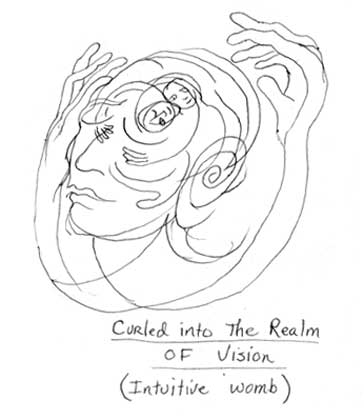
The whole world is a story. We are made of stories on the genetic level. Life on earth has an imagination. One of the Philosophical drawings that expresses this relation of books to the imagination-- the relation of thinker to other thinkers is this one, called The Woven Mind. It is not just about reading but about the interpenetration of minds. Books interlace one mind to another, entwine insights, like music, finding harmony in discords, creating spaces and new vistas, carrying a hope for a better future to other minds far distant.
This drawing is very interesting for the way it uses line as a musical instrument to play themes into each other. The light dances through the line and radiates like gold thread, stitching heads and minds into patterns of interaction and intuitive insight. Rhythms and mazes, Irish knots and and galaxies are set against each other and mutually interlace in patterns of reciprocal influence.
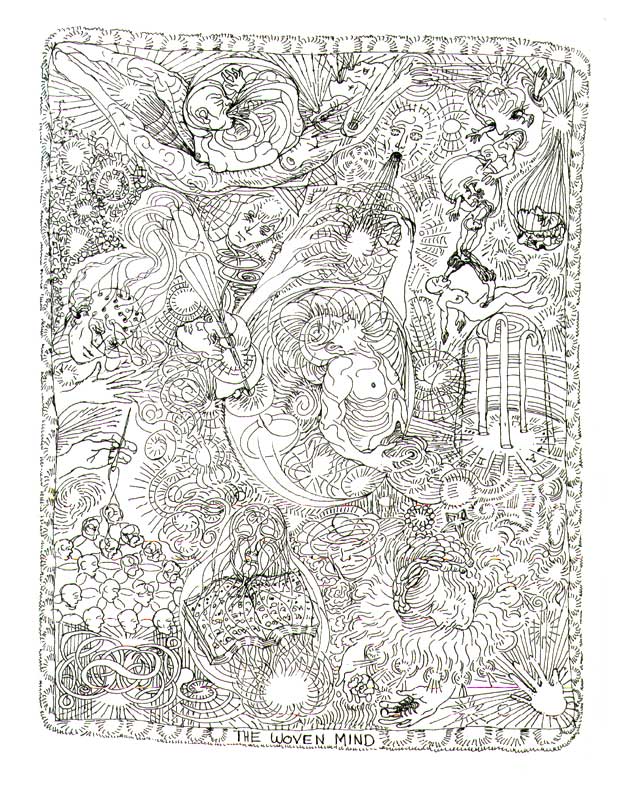
The Woven Mind
Word wheels spin worlds. A man at the bottom reaches down out of waves of vegetation and sunlight and stars shinning to hold out a rose and an insect in each hand. There are images of self -devouring as well as speaking out of the bodies of others, or bodies coming out of other's mouths or ears as if speaking creates bodies. Faces multiply and become other faces. The man in the middle reaches forth from an egg-like oval in an ecstatic gesture.
The drawing is full of strange and interesting detail. The full meaning of it I leave to the reader. But the title is important. How does the mind arise form nature?. Even Paramecium appear to have some ability to make decisions and thin in a rudimentary way. How does the mind arise in nature? How did the ability to reason and think, or feel and speak, come into being?
Parts of this drawing are about the love poet's have for other poet's, for instance, or the tender love that readers can feel for their own favorite author. There is nothing quite like having an author one cares about, as Walt Whitman is easy to care about in this way, and I have carried around his Leaves of Grass for years now. His Song of Myself is a book that holds ones hand. I carry around Thoreau even closer to my heart. His books literally live inside me and sometimes I feel he looks out of my eyes. I don't feel Henry as closely, perhaps, as books live inside the characters at the end of Ray Bradbury's Fahrenheit 451 Those characters have memorized entire books in a future society that burns all its books. But nevertheless, Henry is a dear author to me, who I love. I have loved other authors too, such as Allen Ginsberg, Van Gogh or authors who are less well known, but who are are friends such as Cody Maher and Jack Hirschman. Hints of Van Gogh, Da Vinci, Hirschman and Maher can be found in various drawings.
Of course not all books inspire close relations or seek to bring peace or good in the world. And the drawing above is not entirely uplifting in its presentation of the relation of one mind to another or one way of thought to another. Particularly on the upper right side of the drawing I try to picture how books can be like prisons in which one lives in thoughts of another like a prisoner. There are people who want to control others by means of systems of thoughts. Mind control or systems of dictated dogma and cultic behavioral modification certainly exist, in varying degrees of insistence and infringement on personalities.
The Catholic Church with its Inquisitions and Witch Hunts and destruction of other cultures by missions and use of slaves was one such system. Mao's Little Red Book certainly dominated China for half a century, and as it were "stitched" one mind to another, but probably no other book except the Bible or the Koran was directly or indirectly responsible for helping so many millions to their deaths. There are books that kill or that encourage killing, like the writings of Stalin, the Koran, Bible and Bhagavad-Gita. It would be well if such books were retired from the religion section and were catalogued as in the history of atrocity section, fantasy literature, fiction or war novels instead.
There are various drawings that explore the relation of books to community, citizens in the community or the communities of the thoughtful to one another. Here are four such drawings.
Entangeled in Breathing and Giving Birth to a new sky
The Philosophers
Knowledge
The Earth
Ill discuss them separately in what follows:
1. In the first drawing called "Entangled in Breathing" what might be called the community of citizens and lovers is pictured as an utopian vision in the sky. The man below, clearly suffering, is trying to envision a world that might be worth living in. I did this drawing in Paris, perhaps inspired by seeing Delacroix's great Liberty Leading the People, which really impressed me. This drawing is not a reference to Delacroix, but it does have a feeling that recalls the excitement of hope in the various revolutions of Russia, China, America and France, all of which were more or less ruined by those hungry for money or power.
There is in this drawings a strange effort to give birth by a man. This is an old fantasy of mine, and no doubt of many men. The inability of men to give birth is tragic in some ways, leading them to wish to compensate by creating empires, skyscrapers and all sorts institutions, men's clubs and power structures the world would be much better without. The desire to give birth is here seen as a positive thing, however, and what is envisioned is not power but a society of friends and lovers.
I think however, that there is a regrettable and unexamined gnosticism in the drawing, evident in the expression "entangled in breathing".( I use this term here pejoratively, to mean a theory of knowledge that is anti-nature) Breathing is not entangling, unless of course, one cannot breathe, and in that case, one might be dying. But here I think the meaning is "spiritual", which is to say, that I was trying to express the idea of a realm where breathing is not necessary. There is no such place. Putting my hopes in a sort of separated, discrete, heavenly realm is, of course, an artistic convention, common say, in the paintings of El Greco, whose paintings I admired in those days. The logic of images is such that it is assumed that those who are in heaven are able to breath in some way as yet not understood. The actual breath of those on earth is then seen as some lesser respiration, and thus an "entanglement". This is nonsense of course. There is no heaven where the imaginary dead breathe transcendental breath.. So the premise of the drawing is mistaken. The idealism of of "giving birth to a new sky" is not we expressed. What I meant was that there is suffering on earth and I should have said that the answer tot hat suffering should be on earth too. No more gnostic paradises, hippie promised lands, spiritual new ages. What we need is a recognition of actual sufferings, real losses, and solutions that grow form an awareness of the facts.
2. In the second drawing of the" Philosophers", the community is an interlocking relationship among thinkers. It is an interesting figure in the upper left of the philosophers all embracing each other in a concert of arms. In actuality, few humans a more covertly or overtly disdainful towards each other than philosophers. Though exactly what I had in mind is hard to say. I may have been trying to express the closely intertwined nature of philosophical thinking while poking fun at the rather elite and interbred nature of philosophers and their internecine wars with one another. But i do oppose the figure of the intertwined philosophers against the rather lovely woman who is comforting a man--- or it is her child?--- who is made up of other faces, including a death's head. The woman is central and even pivotal. It would seem the entire drawing revolves around her, the giver of life as well as the comforter of those who suffer death.
In any case, this drawing is not about reality, but about an imagined Manichean conflict of sordid realities posed against dreams of completeness and harmony. A man with his head removed, in the lower right, gives birth to language, alphabets, numbers and music, or, in short, to all 'knowledge'. The book at the bottom of the drawing rests on top of a severed human head. The figure that grows out of the book is on fire and the fire has engulfed the tree, apparently the tree of knowledge. The man's hands become part of the tree. The symbolism here is very complex, but suggestive of an extreme crisis in knowledge, culture and philosophy. Im sure I meant to convey that. The severed body parts at the top of the drawing suggest Tibetan Buddhist iconography. The drawing has its humorous aspects, but also is deadly serious and implies a strong sense of horror about the history of philosophy. This drawing is one of various drawings that prefigure my concerns in the 1990's with knowledge/power and the relation of knowledge to atrocity. Here the nature of the problems are not spelled out clearly. Ther eis expression of thought as feeling. I was unable to articulate my horror at the 20the century yet. I could only express my feeling about it in forms such as I sue in this drawing.
3. The 3rd drawing "Knowledge" is also a very complex drawing and shows a pile of burning books after a nuclear war, with a group of people and animals trying to reconstitute a world worth living in after such a horrendous occurrence. The idea here was that scientific and spiritual knowledge betrayed humanity, and that knowledge must somehow be reconstituted in a way that it serves peace instead of power and war. IN the pile of burning books there is an edition of Kant and Descartes as well as Christian and Jewish Texts. The people whoa re trying to rebuild the world, first seem to be devouring each other brains, metaphorically, and then turn towards animals, perhaps finding redemption in the opposite of religion and Platonism, which condemned animals and nature to the lower orders. But actually, women, animals and nature are what really matters. Maleness is important as an adjunct, procreative and necessary fact, but the whole enterprise of creating disembodied systems of intellectuality is destructive and patriarchal. The brain is offered at the top of the drawing in a lovely gesture to a woman who holds a globe illuminated by the sun. A sense of community is implied in this drawing,, but it is a community that has had to deny aspects of itself, to change and grow into something different than what it was. The border around the drawing is complex and lovely in places and hints at stories, threads, as well as mathematical and geometrical biologics.
4..The fourth drawing, "The Earth" , is not about books, but uses the same theme of a community of minds to talk about nature and our relation to living on the community of the earth. It shows those who love the earth getting together to shower her with the beauty of the stars and the beauty of their own thoughts. On the upper left of the drawings can be seen a loop of heads and hands, each one giving his or her thoughts to the next person and all of them giving their thoughts to the woman who floats in the sky and whose body is giving birth to praise for the earth. The praise issues from her belly in the form of stars. Some might find the image a little gruesome, but I recall not meaning that at all. I thought it was lovely then and still do. I meant the image as a hymn of praise for the earth I love. The drawing has a sort of biological intimacy or embracing density that I like very much and which was one of the goals of this style of drawing. I like the pool of fish down below and the hand that comes form behind the drawing and then reaches back into a space on the other side of the drawing.
"The Philosophers" drawing supports an idea of community that I still basically agree with-- a community that has its roots in the earth and with the earth, and which is not based on power relations of discrimination on the basis of money, caste or class. I hoped to picture a way of knowing and of relating to others that sustained the earth and enabled people to help each other . But of course, such an idealistic view of the world was not without its hazards. It took me many years to learn that utopian idealism has to be tempered by a realistic understanding of the actualities of life. My idealism about books and knowledge and how harmful they could be in some cases resulted in my eventually having to be humbled and hurt by the realities of how the world actually operates. The interlacing of minds is not enough to ensure peace. In the drawing below the group of peoples are trying to understand the questions-- but the questions of "how", "who", "what", "therefore"and "then"? are not answered simply by virtue of wishing to have an answer. Moreover a crowd of humans no matter how bright is still a crowd of humans and prone to all the foibles and fallibility of all human groups. The rather arrogant notion that humanity alone can answer and address the problems that humanity has created is very far fetched. There must be some relationship to nature. There must be a humble wiliness to listen to the wisdom of animals and trees the language of ecologies..
When I was busy doing the Philosophical Drawings I was lonely not just for a community of wholeness but for a book that would encompass everything. I had a nostalgia for the world of the Book of Kells or the Lindisfarne Gospels, and wanted to create a book that would be so wonderful and magical that it would enchant and express the meaning of life and fill others with inexpressible joy and wonder. I am not sure where this came from. It goes back very early, before I read any of Stephan Mallarme's notions of the "Book" as a kind of unrealizable absolute object.
Mallarme imagined a Book that was to be the summation of all knowledge and learning and poetry. It would be a kind of ultimate truth telling which people would come too hear recited and pay money for in large numbers, making Mallarme rich. Like Wagner's totalistic operas Mallarme would combine the arts to express the "absolute" . I never thought of making money from poetry, the most moneyless art. But I had a similar notion of a perfect book, born of Mallarme and Blake, as well as cabbalistic notions of the "absolute book", In addition I was influenced by medieval illuminated Bibles, the Koran or Carl Jung's ideas, but mostly of my own imagination and had fantasies for years about ideal books. Indeed I often thought of a book that would express the mystery of the imagination itself. No doubt I was influenced by Finnegan's Wake, that book that tries to say everything and fails. Perhaps too it was the influence and fascination with the ideas of Einstein and his romantic notion of a totalistic "unified field theory" that would unite all of the universe in one equation. Einstein also failed. I dreamed of a romantic notion of an all encompassing "Word" that would explain the mystery and reveal an essence that would finally bring an end to me uncertainty and clear up my inability to grasp the meaning of life. The resplendent "Book" would picture all the wonders of creation in one final utterance of beauty and simplicity. This would be more that the "great American Novel", perhaps, it would be a book of everything, a book of the universe. I dreamed of a book like a stairway that you carry me out of time. Such was my fantasy anyway.
the Magic of BooksAll this is very interesting fiction, no doubt. There is a certain charm in my having believed this 'pie in the sky' nonsense, but I must say I also find it embarrassing to admit that I really thought I could make such a book, and I tried to make it for at least 10 years . To some degree the Philosophical Drawings are part of this effort, in a sort of inverse way. I am writing a biography of a failed encyclopedia-- a failed dream book of universal images. I could have just let the drawings stand alone, as they do in the catalogue of 150 drawings that accompanies this book. But that would be to miss a great chance to talk to the past in the first person. My idea of a universal book was a failure. The Mallarmean 'universal book' was also a fantasy and a failure. Unlike Mallarme or Joyce, I admit my failure. The dream of total knowledge is a fantasy of total power. It is too bad more people do not dream of acceptance of life and earth and sustaining harmony on the earth and all its beings.
Joyce's Finnegan's Wake, is a book that hardly anyone can read. It is no more truly representative of the totality of life than was the Bible or Diderot and the French Encyclopaedists. I happen to think at this point that Joyce's book, for all its experimental and polyglot antics as well as its obscure creativity, is truer and much more funny than the Bible. I see the bible as little more than a collection of elaborate and sometimes beautifully written fairy tales, which were used to justify some unjust institutions. But there has been no more destructive book that than Bible. The bible and the Koran are both reasons why one should never deify books or think them holy. Whoever claims a given book is sacred, try to get them to look at the blood that soaks its pages.
My attempts in my early work to picture and write a book that is oceanic in scope and expresses the wonder of all "creation" was a failure. But of course, the failures of youth are just that, experiments in learning to live in and create in a difficult world. I did the best I could and do not regret the effort even if the result is not as good or mature as I would wish.
On some level my struggle with the Idea of the Book, as a kind of absolute or eternal object, was a struggle with Platonism and religion. One can see this in the drawing above, where I have invoked a from that is reminiscent of the wide eyed priests of Sumerian or Mesopotamian statuary. I have seen such statues in the Cleveland, New York and some European museums. Sumerian temple statues, like Egyptian statues of the same period, have a strange mindless fixity, sometimes referred to as a "hieratic" style: empty faced kings staring into an a cruel and shelterless sky.. This empty and rather rigid fixity is an image that demands submission. It insists on bowing to kings and being been utterly tamed by a totalistic authority. The Sumerian gods are images of the autocratic injustice and cruelty of the priests and upper classes of those societies. Once one understands the history of these societies the romance of the iconographic art of near eastern, Christian or Hindu art is lost.
The reactionary art historian Ananda Coomaraswamy was nostalgic for spiritual hierarchies. Coomaraswamy, like his mentors, John Ruskin and William Morris, romanticized the art of the Catholic Church, the Roman/Byzantine dogmas and the middle ages. Coomaraswamy idolized and the caste-ridden aesthetics of India. Traditional art does not present "nature in its manner of operation" , as Coomaraswamy claimed--- far form it, in fact--- traditional art is mostly a misuse of natural imagery and promotes an ideology which is against nature. Traditional art was used to excuse, justify and proselytize for unjust institutional powers. But then Coomaraswamy was originally a disciple of Blavatsky, and later a follower of the ultra-right wing monarchist, spiritual fascist and paranoid conspiracy theorist, Rene Guenon. Coomaraswamy, acting on the basis of some deep disappointment in his own life and resentment against the modern world, tried to re-introduce reconstituted versions of mythic symbolisms taken from medieval Hindu and Christian culture into the modern world. Such an attempt has resonated well with other reactionary, fanatical and fascistic tendencies in the 20th century. But overall his theory has had destructive consequences, and little art of any value has come from it. His work tends to lead its readers astray into seeking to reproduce dead imperial, monarchist and religious tyrannies of the past. It took me years to begin to understand this writer, as well as his son, who I got to know a little, and even more years to realize that his views are based on a false romantic nostalgia for a past that never was. Indeed, I think my original attraction to Coomaraswamy derived from his rebellion against capitalism, which I also disliked. I was attracted to Coomarawsamy becasue of my earlier association with Jack Hirshman, who taught me to dislike most of the world we live in. But it took me years to realize how both Hirschman's and Coomaraswamy's solution to the ills of capitalism were worse than the disease. No point in leaping out of the pan into the fire.
In the little drawing above I am invoking Sumerian sculpture and their attitude of withdrawn submission, and connecting it to what is probably a Heideggerean notion of being, since I was reading Heidegger in those days, particularly his later writings. Heidegger, like Coomaraswamy, was a reactionary romantic with fascist tendencies. Indeed, there is something autocratic and tyrannical in Heidegger's notion of "Being". His notion Being is a secular version of the god idea. So the above drawing , like some of the drawings about Saints or Buddhas, is an attempt to incorporate aspects of historical religion and art into a growing awareness of the world as a whole. But I was not yet able to distinguish between how such images functioned as images of unjust authority and power, and how they exploited neutral or positive concepts such as "being" or the idea of the book. Indeed the style and title of the drawing have something Klee-like and innocent about them. But if one notices the two eyes, like the eyes of a huge panther about to pounce, or the eyes of a Near-eastern god looking down in terror upon the small human below, then the drawings ceases to be innocent. The drawing then can be understood as a meditation on Near-eastern religion and its use of images of power and authority as symbols of the necessity of submission to authority.
Was I aware of such meanings when I did the drawing? I'm not sure. Perhaps somewhat. Certainly I was aware of images of gods as images of terror. I have seen such images in may museums, indeed, there was just such a sculpture in the Cleveland Museum where I worked for a time, and this drawing is a memory of their sculpture.. Such images were meant to preach submission to the lower classes. But I am not sure that I yet understood how complex art was as a social phenomena, and certainly I was not yet aware of how traditional theories of art were used by elites to justify exploiting art as a system of institutional propaganda. But my instincts were good. Had I followed them a little more carefully I could have avoided the arduous task of having unravel reactionary writers like Coomaraswamy. On the other hand, ones life course goes as it does, and I am not to blame for being young and making mistakes. It is the nature of youth to err.
It is a complex matter to try to decode and uncover how I thought about books and cultures in those days. For instance I saw the Book of Kells, in Trinity College Dublin, Ireland, in 1984 or 85, and thought it an extraordinary work of art, quite apart from the religion it is supposed to represent. But at that point in time I do not think I separated the Book of Kells as an art work from the Book Of Kells as a religious artifact. What fascinates me now in the Book of Kells is the presence of non-Christian elements of the Animal Style, which I have always loved. The Animal Style in the Book of Kells derives from Pre-Christian elements of indigenous tribal cultures in the British Isles. But the complex meanings that that are involved in these apparently simple influences of Pre-Christian art motives could be the subject of whole books. The Animal Style, which I traced through early Chinese, Hindu, Iranian, Chinese and Native American and other art styles is not a simple subject. The imposition of Christianity upon the Animal Style in the Book of Kells is not a simple matter either. Christianity has no real comprehension of the natural world and is based on an ideology that despises nature. Christianity and the development of scientific and capitalistic Protestantism and are responsible, more than any other force, for the destruction of nature. A complete historical study of the ruination of animals and nature by various systems of power has yet to be written, but we certainly need such a study.
Certainly, there are complex factors of power and knowledge acting though history that are involved here. For instance, I traced one theme in Iranian art, in various carpets and paintings. I found an image in a Persian carpet of a camel's body that is made up of numerous other animals, from rabbits to dogs and people. This notion of the camel as a symbolic mother of the other animals can be traced back to Samarkand and probably further into the mists of time in Central Asia. I found a similar image in the collection of Middle Eastern painted Illuminated Manuscripts at the Metropolitan Museum in New York, Similar images are to be found in carpets in the Tokapi museum in Istanbul. It is an image that has nothing whatever to do with Islam or any other religion. but rather is an outgrowth of indigenous people's concerns, probably going back before organized, large scale state religions. There are similar idealizations of the camel in early Saudi poetry, before Islam was created in Saudi Arabia.
Another example of Animal Style having a influence on later art is is the Sufi book illustrations of Sultan Mohammed, which present an animism that brings into question the highly refined and monotheistic Islam of Persia. Indeed the paintings of this particular artist are so full of animistic faces gleaming forth from hidden crevices of his paintings that they are delightful violations of the strict and dogmatic canons of Islamic art. In both these cases a much older sympathy with nature and animals is expressed, but it is invariably overlayed with Islamic or Christian or other symbolism that obscure the deeper Animal Style, as style which goes back to the Ice Age caves.
So however I might admire Blake's illuminated manuscripts as well as certain Islamic books treated as art, as well as some Buddhist texts I have seen--- such as the Diamond Sutra done on indigo blue paper with golden yellow ink---there is a question to be raised about art acting for or against a given religion. I admire art that has not been tamed by powerful institutions or ideologies. But determining or questioning these various arts and their relations to power is not a simple matter. There are those who try to claim for instance that William Blake is a Buddhist or a Sufi. To claim this is to try to assimilate him to a system of power and knowledge and this is to falsify him. Blake himself resisted being "enslaved", as he put it, by systems of power and knowledge. This is not to say that I subscribe to Blake's system either. I don't.
I thought I had rediscovered a universal style similar to the Animal Style style in the Philosophical Drawings. The Animal Style of art goes back into the mists of time, all the way back to the caves of Lascaux and Altimira. I didn't yet realize that humans are animals and that animals style is not something different, but rather that an increased differentiation in art takes palce as humans become more human centered and ignorant of nature. Art in its origins is still part of nature. Art predates powerful religions. This is why there are so many proscriptions defining what art should or should not be. The first commandment in the Bible makes it a sin to have other images before the jealous god of the Hebrews. This jealous control f images also obsessed Islam. Most art, indeed, nearly all of it, serves power of one kind or another in the form of propaganda, advertising Church decorations, Icons, Thankas, corporate minimalism and so forth. The work of Andy Warhol is a good example of an art that is utterly sold out to corporations. But art need not serve power. Art is a force in the wild, of the wild and it is not easily tamed by those who need to oppress others. There are artists who managed to escape form the cultural managers. Art needs to avoid being sucked into serving systems of power and privilege. It can do this by staying close to nature.
There are Chinese books, such as the long scrolls, which are visual books but often written with sophisticated colophons which, in some cases, artfully hide criticisms of the Chinese dynastic dictatorships behind conventional symbols of water lilies and plum blossoms and other typical symbols in Chinese art. But such a subject is very complex and I will not go deeply into such a matter here. There are books on the subject that the reader can seek out. Suffice it to say that not all books necessarily serve power, and such books as Blake made, for instance, have not been used to harm anyone to this day, as far as I know, yet Blake has liberated the thought and imagination of many people. I don't agree with some of what Blake said, but he would expect me not to, and perhaps respect my right to differ. But I do not differ from him in believing that freedom from "mind forged manacles" matters -- I strive to be free of such "manacles" as one finds in religions and politics.
It is true that one must be careful of facile comparisons in art history. But one can compare notions of the Book seen as an absolute object. In China, Tibet, Plato, Islam, the Bible and many other places and cultures the "Book" has been conceived as an imitation of an eternal prototype. I believed, in the early 1980's that there really was such a Mallarmean and universal prototype of the "eternal book". For a long time, going back to my teens, I believed in some notion of an ideal Book. My reading of Mallarme come later than my belief in this ideal "Book". I have no idea where the this belief came from. Perhaps from Jack Hirschman? No, I see evidence that I had an exalted idea of the ideal Book earlier than my meeting with Jack. In any case, I thought early on that each of the great religious texts were attempts to reproduce the hidden eternal book. I wrote for instance in and long essay called Language and the Veil :
For Thousand of Years the Book Speaks"There really is only one Book in the world that the greatest books, such as the Bible, Plato, the Koran or certain Hindu and Chinese texts, are only approximations of. The perfect book is written everywhere but no one has yet held all its pages in his hands. Any book that seeks to be worthy of the name seeks to be a medium of the word that is holy"( pg.36,1984)
I am quite sure now I was mistaken about this then. In fact, I am embarrassed and sorry I wrote the nonsense above, though in my own defense, the idea has a certain poetic appeal. I saw myself then as an explorer in the uncharted waters of the world's systems of knowledge and belief. The idea of transcendent knowledge system is appealing, but false. I did not yet realize that the search for knowledge can be itself born of thirst for power and colonizing desires. The point of view expressed above is born of my studies in comparative religion and my attempts to extend my understanding of poetry and culture beyond the western models. I really thought that a study of the world religions would lead me to wisdom. I was trying to apply Mallarme's notion of the Universal Book to all of world culture. Such views now seem to me to be essentialist and false. I now understand that nostalgia for the traditional religion of bygone centuries is delusional, and born of an unwillingness to admit that those were unjust systems of power and superstition. There is no universal book or universal god from which all other gods derive: no transcendent religion. I sought out the supposed sages of perennial wisdom and learned first hand that they were fraudulent panderers of reactionary and repressive ideologies. Gods and books are cultural creations. The universal religion idea pandered by such men as Huston Smith, is a fiction which itself can be used to serve political purposes. I knew Huston Smith somewhat and learned first hand he was merely a narrow and dogmatic careerist, willing to defend charlatans to protect his career. He put ideology before people and denied and covered up evidence that brought his ideology into question. It is hard for me to respect such a man.
But I did not understand then that religion is mostly about posture and pose and a theatre of deceit. When I first studied religions I thought I was beyond the politics of knowledge and power. I believed all the myths and stories. I was an immature and idealistic poet who fell for the lore of heroic deeds and the mythic words calling me to virtue and goodness.-----There was a certain devotional fervor that inhabited me in those days. I was a seeker after truth and was trying my best to move beyond the narrow confines of the culture I was brought up in. Foolish as Don Quixote or Swift's Gulliver, I was ripe for being duped and fooled and tripping over my own hopes and dreams. I don't know how I could have come to know myself and my world any differently than I did. With each drawing I did I was drawing the world into and around me, trying to grasp what it was all about. it was inevitable that I would err and make mistakes. The idea of the entire world being in one book might have a certain charm as a relic of my idealistic youth. But the idea of all knowledge being expressed by one person is dangerous and imperialistic. Perhaps that is why the tiny drawing that follows is humorous.
When I was younger I imagined that I might be able to write books that would heal people because of their beauty and their truth. I dreamed a dream of all the world in one book, like a child's book--- a child's view of an easy to understand world. It would have to be a humorous book, of course. I would put the whole world in one book that even a child could understand and laugh about. But alas, I have never even come close to this ambition.
Could I be a doctor of souls? Could I help others? could I know the whole truth in body and soul, as Rimbaud wondered? I thought I could, once upon a time.
No doubt this desire has some relation to the religious impulse of Moses or Buddha and their laying down of mythically inspired laws to bring aid and help to the people. Black Elk too wrote a book to try to help his people. But one must admit at last, the 'Absolute Book' of Mallarme, Plato, and implied in the Koran, Bible and Kabbalah is a fiction, a fairy tale. Like so many others I longed for the fairy tale to be true. But it is a false Utopian dream. As Chomsky said "the Bible is probably the most genocidal book in our canon". Both the Koran and the Bible are books that kill people. The dream of total religious truth contained in these books is a lie and a lie that has killed millions of people.
But myth and religion aside, the desire to help others and do good for the world that one lives is a good thing. It is not the "Untold book" however that will soothe peoples sufferings as the drawing opposite claims. I dislike the religious allusions in this drawings.
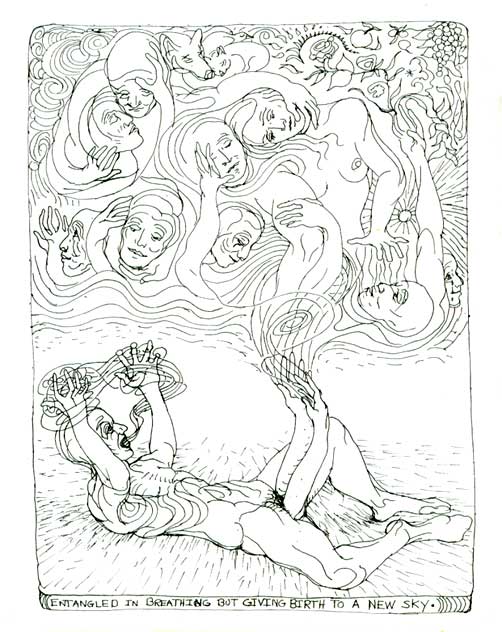
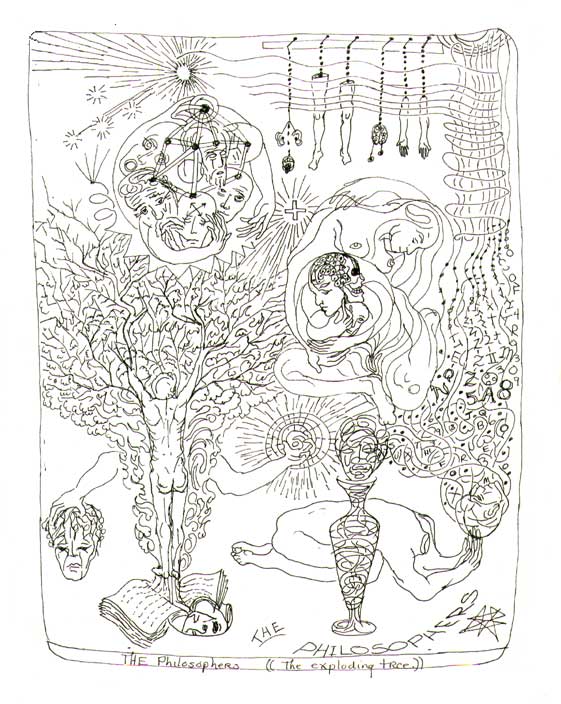
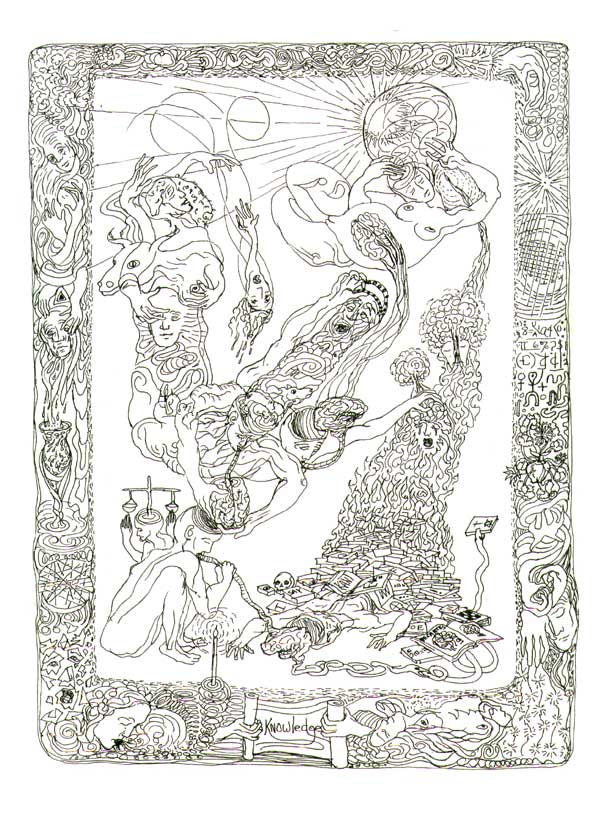
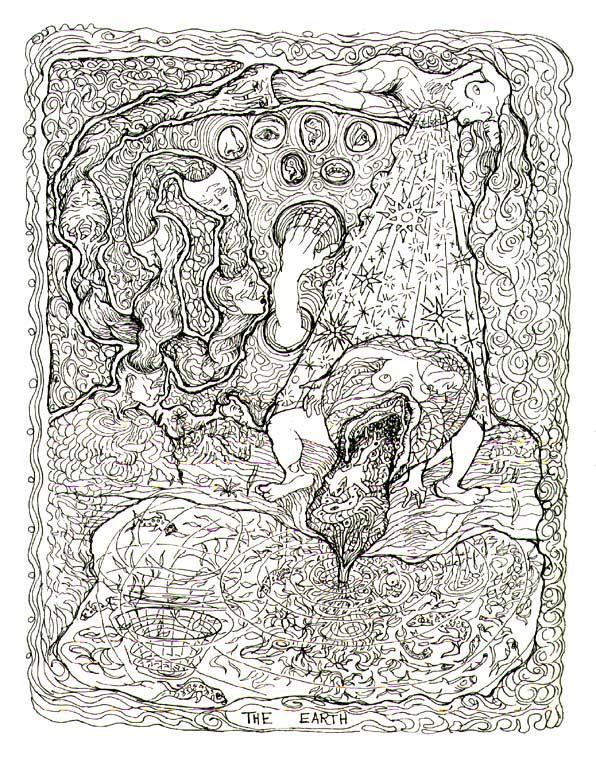
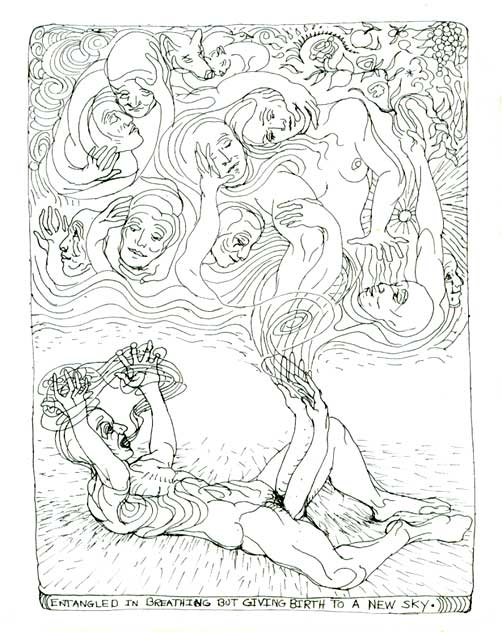
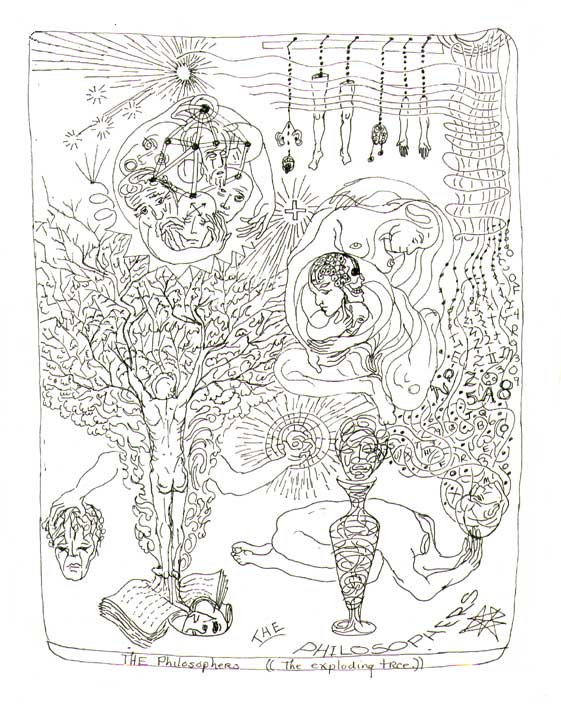
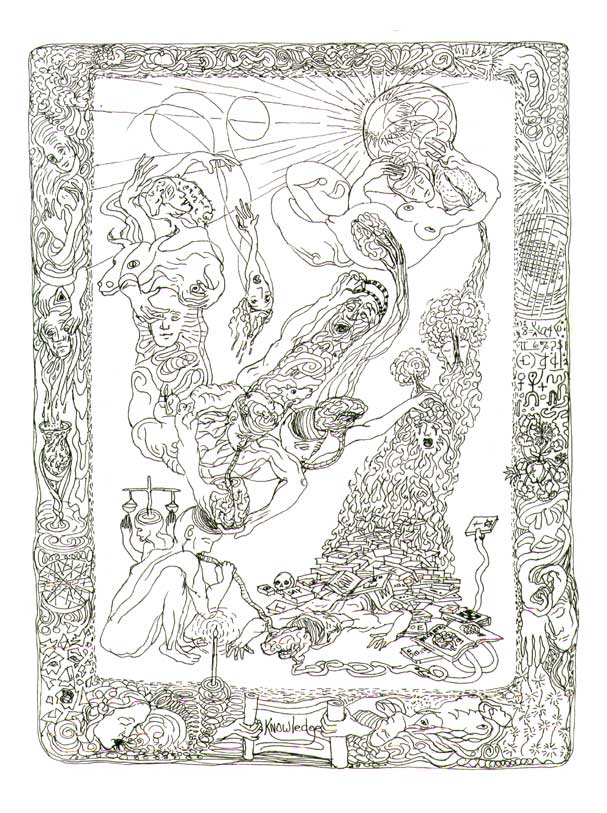
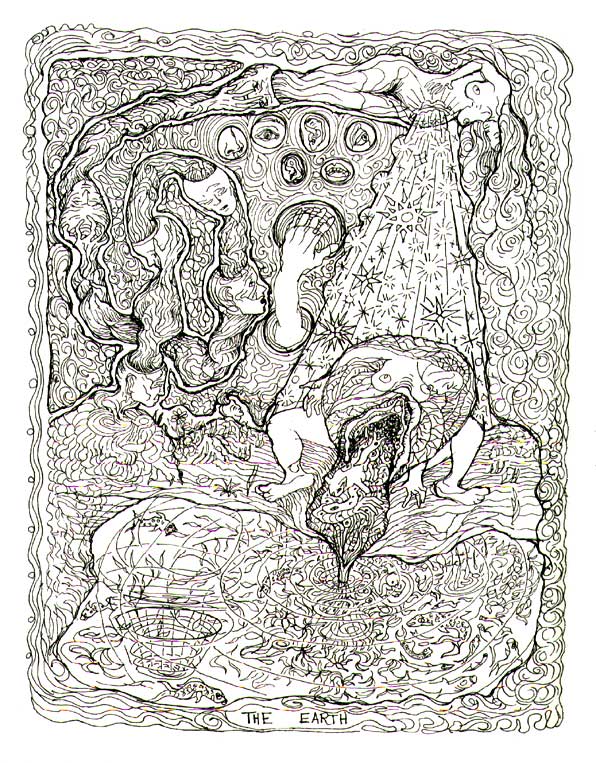
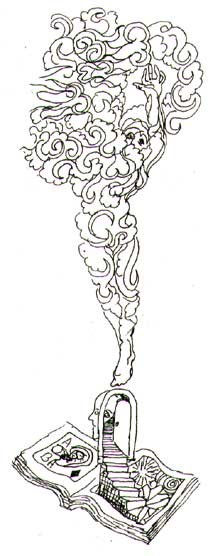
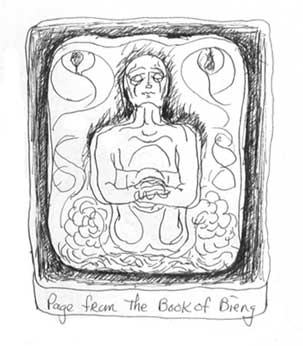
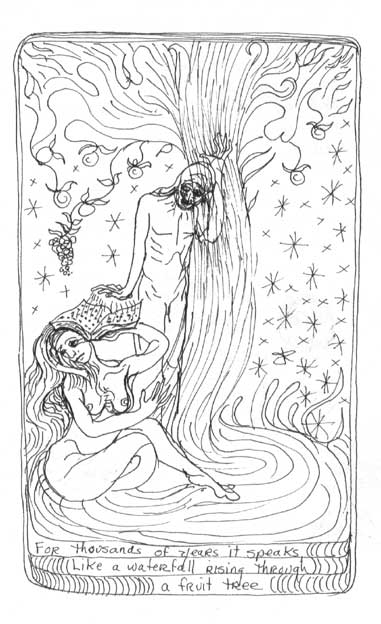
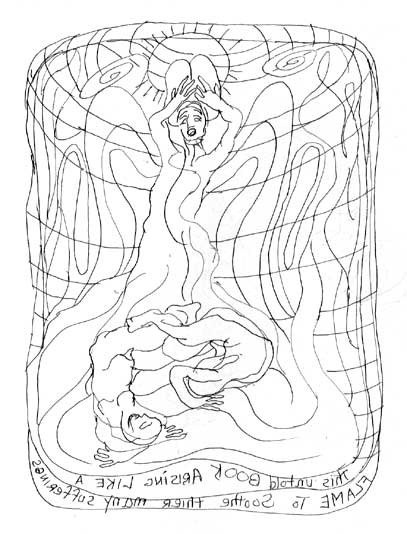
I do not have such a high regard for the mythic Moses with his dictatorial "Tablets of the Law". After Kafka's writings about the The Trail, the Tables of the Law and The Castle I doubt anyone would be wise to take Institutional religion seriously again. Kafka was right, religion is a labyrinth of horrors and the the Laws of Sinai are instruments of bodily torture. And indeed, I now the read the drawing opposite as an image that show the murderousness of the Bible and the laws of religion. Those are corpses of Israelis and Palestinian falling down around Moses and the Law.
But concern for people and for nature is important. I would be quite content if I could just console and delight or offer rest or friendship to a few people through these works I have done. Maybe inspire one or two people about the wonders of a world that is threatened. Maybe bring just one person back from the brink of suicide or despair. It might be worth it if I could reach just a few hearts and teach them to love this world and abjure imaginary next worlds. The miracle of a single live bird outshines all the dead gods and myths current and past. Maybe one or two people will stop contributing to a destructive society because of something I have said, drawn or painted. That would be something to make me proud. Such a book might be worth spending day after day writing and writing and writing.
I have spent most of my life either reading or making books of various kinds. But of course the making of books is not quite the same as reading the books of others. Obviously the one influences the other. But making books is far more involving and satisfying in a deep and lasting way. Reading is still a little too far away from real engagement.
I started making books in my teens. My early drawings were conceived in series and most of the work I have done since then usually ends up in some kind of book. Some of the books are very large, some were wrapped in fine woven and embroidered cloth. I am not sure how many books I have made over the years. Some of my books are books within books. Some are long series of essays. Some are related to paintings , books of drawings, books of poetry. A few books of philosophy. Some books were made with thread and needles sewing "registers" together. I made a few books to be put in elaborately painted and carved wooden boxes. I carved a man laying the harp into the cover in addition to other figures of an old man and a young woman. All around the boxes I carved or painted elaborate designs and borders. I painted pictures on it. Another box for a book I inlaid with velvet One of these boxes with a book in it was a kind of personal bible that I wrote some years before the Philosophical Drawings. I was then trying to make a book as a treasure holder of my personal fantasies of eternity. I was young and wanted to put my expanding love of infinite fictions inside the covers of a book. I wanted to make a book as a perfect garden of my being. I wanted a book of pure golden light or bluest twilight to hold my most beautiful loves and perceptions in between the binding of permanence. I dreamed of pages of flower filled landscapes of saturated beauty. A book of eternal glass; a book of diamond essences; a book with a body that was always beautiful, a book with a mind that was always true; a book that would give others anchor and harbor; a place where they could find a truth that would change the world and make it a better place,. I wanted to make books to cure the world of its suffering. A book of fragrance and music to soften the heart and cure the soul of sorrow. How lovely are the dreams to youth!, but how true are these yearnings? How quaintly idealistic I was in those days. How silly it seems now!!
Why did the book form appeal to me particularly? Certainly there was an interest in the self-protective nature of books and their covers. The enclosed world or the pages, intimate and secret and meant only for those willing to undergo the effort of the journey through the ocean of words and pages. Book offered a harbor and place of safety and way to have my own vision of the world where others could not molest or harm me. The world between my books covers was and is my world. Those who might wish to harm me have no real purpose of reason here. Those who care for me will find generous comfort and a love of humanity and nature in my pages. But those who hate me and sharpen their knives will find nothing for themselves here, except a mirror held up to their hatred.
Early on I thought of drawings in a series extending over time. Like tree rings inside a tree I wanted to make books that would grow and be a memory of my life. I couldn't see how one drawing or one poem could express what needed to be said. One drawing leads to another, like roots or branches of a tree. One dimension could not possibly express the way things really are. Nor did the cubist cutting up of reality appeal to me. I was early attracted to arrangement poems writings or artwork as series. I tried making films and I still make films, but the film medium seemed much better to me as a means, as a sort of sketch book, than an end. Moreover film is expensive and because of this even the the most devoted filmmakers are soon confronted with having to compromise their vision to attract investors and advertisers. This makes film much more permeable to propagandistic and power influences and concerns.
I have always sought freedom and intimacy in creativity. Pictures hold a special and paradoxical relation to the world that is both definite and indefinite, intimate and unknown. Pictures they tell truths better than words do, in ways I hard to express. Pictures actually change with time. One sees things in them one had not seen before, because perception itself changes as one gets older. And there is an objective element in visual art. One is not always diving in an out of the abstract element of words, an element that I find vague and inaccurate. Words certainly have their own magic, but reality is better expressed in pictures. Words inhabit a dimension once removed from reality, a little too abstract and alien. That is why I have made allot of books with pictures in them. I don't want people just to think about what I am saying. i want them to try to see it with their eyes.
In the next drawing. I have drawn a book underground. A man is buried with the book, somehow.
The man seems to be clutching to the book while he is being tossed in an underground stream of waters, or is it a river in the desert? It is difficult to tell if the viewer is meant to think of the river as either underground and seen in a cross-section or as a river bank eroded in a desert. In any case, The book is by no means submerged under the waters and appears to be safe. The man is clutched to the book in a gesture of peace or inner certainty. The book is giving up itself, in the form of two women who are buffeted on secret wind that raises them out of the river and the threat of the waters into the empty landscape above. The title of the drawing, the Buried Book Gives Up its Sorrows, seems to invoke the idea a lost book, a book that is somehow unknown or not understood. The only literary example of a buried book that I can think of is in Shakespeare's play the Tempest, in which Prospero, the magician, buries his book at the end, perhaps as a symbolic gesture meaning that Shakespeare himself has come to the end of his career and is burying the beloved book of his art. But if the drawing is alluding to Shakespeare's book and his buried art, then why has the book given up "sorrows" and why are these sorrows pictured as female? This drawing is something of a mystery to me. I am unsure why i did it or what it means. Could it be an attempt on my part to overcome the sorrow that I saw in knowledge and finally affirm what is good in knowing?. Could it be that I longed to be done with the sorrows of my search to understand the world I had lived in? Could it be that I longed to released from the inward looking life of knowledge into the real the world of landscapes and nature? Could it be that the sorrows referred too are women that I had loved. Or was this somehow related to Rilke and his personification of sorrows as female "Laments". He speaks of these lost women in the tenth Duino Elegy. But I always thought that his idea of the wandering female Laments as being somewhat contrived. So I don't think this is what the drawing is about.
I think it is probably about my love of my own books, and the fact that for most of my life I have worked and struggled and have felt like I was an outsider, living underground, just outside the rim of the world. The loneliness of my years of work has been heavy and without much respite. I keep doing the work because it is what I do and it comes natural and relatively easily for me. But it brings suffering and this drawing is probably an attempt to imagine an end to this suffering, my sorrows finally coming up to the surface of the earth where they can be seen. Maybe someone will come to me then and my sorrows and I will be less lonely. Maybe one day my books will at last lead me out of despair into a world worth living in. The fact is, they have done this on occasion, and increasingly in more recent years. That is the best I can think of , at the moment, as to what this drawing may be about.The above drawing is about expressing my sorrows by digging deeply inside my own deepest hidden caverns and bringing up my life's breath from out of the depths. This is the hard task of writing and making art . The inner archeology of the creative life can be painful and like birth giving.
The Another drawings that expresses something about the nature of creativity is below, " The Invading World", where the artist is struggling to withstand and sustain himself against the powerful forces outside him which seek to undermine or even destroy his work. It was done after I moved form San Francisco to New York.
I was worried that New York City would destroy my creativity. The man in the drawing is trying to sustain his concentration despite all the threats that surround him. The threats have even reached into his mind. I large fist threatens him form above. But he listens to his heart and not to the outside world. I am still absoutizing the idea of the "Book", which here is capitalized.
The Invading World Cannot Unwrite the Book of StruggleThe next drawing has a similar meaning and is a self portrait and also was done when I was living in New York City. It was 1980 and I had just moved there form San Francisco. Though I had lived in New York before, I was shocked by living there. I was trying desperately to understand the times I was living in. I was reading allot of books and trying to understand. The philosophical investigations and search for orientation that I began my youth would continue for many years and throughout many travels. I really only began to achieve some reconciliation and peace with myself in the last few years. But it this drawing I am overwhelmed by New York and language, books, my compass and sextant all seem to have failed to keep me in equilibrium. There is a strange sort of alchemical alembic which is attached to the books which is curious.
The Broken Compass of Thought: the Mirror and the Books: The Unthinkable CityThe Mirror in the drawing is not just something one seeks to know oneself in, but is also something that a writer seeks to reflect the times in. Art is a mirror in some ways. Books are reflective but not exactly like mirrors, rather they provide novel angles and insights that one might not be able to imagine oneself. The compass is neither a mirror nor a book , but a way to find out where to go in a time of confusion and conflict. All these symbols pile up to try to express my frustration, in fact, my growing horror with what New York City was and is. I hated living there, for the most part. I could see how much pressure the wealthy put on the poor and how the pursuit of money there was used to excuse degrading treatment of homeless people, poor women, prostitutes, and families. I was desperately reading philosophy, studying art, poetry and museums. I was on the street, trying to figure out what it all meant and why so many were clearly suffering. The entire time I was there I tried to write or draw myself out of the depression the city threw me into. I never succeeded in doing it. I had to leave the place. New York is the most depressing and horrific place I have ever lived. I went back to visit a few times, but am glad I have never lived there again.
The book is shown in these drawings as usually something that provides me with comfort or solace. It was perhaps a natural association to see the image of the book as something to identify or or suggest is similar to a woman.
There are a number of other drawings. The next one is called The Woman of the Book
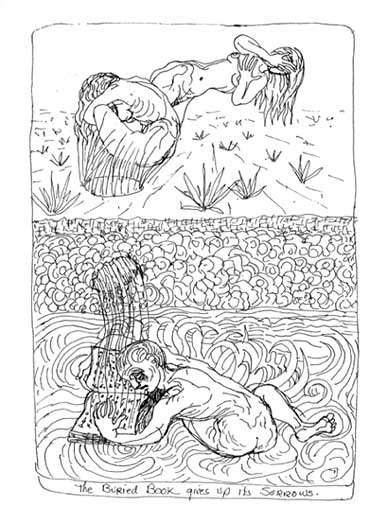
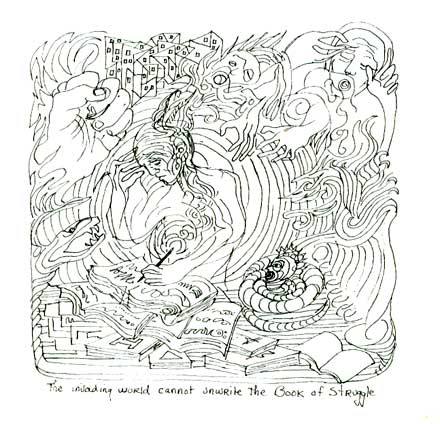
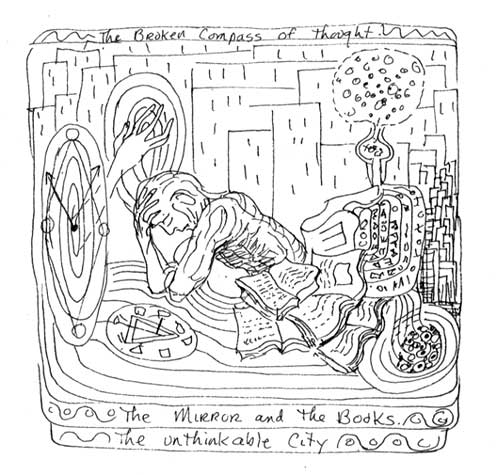
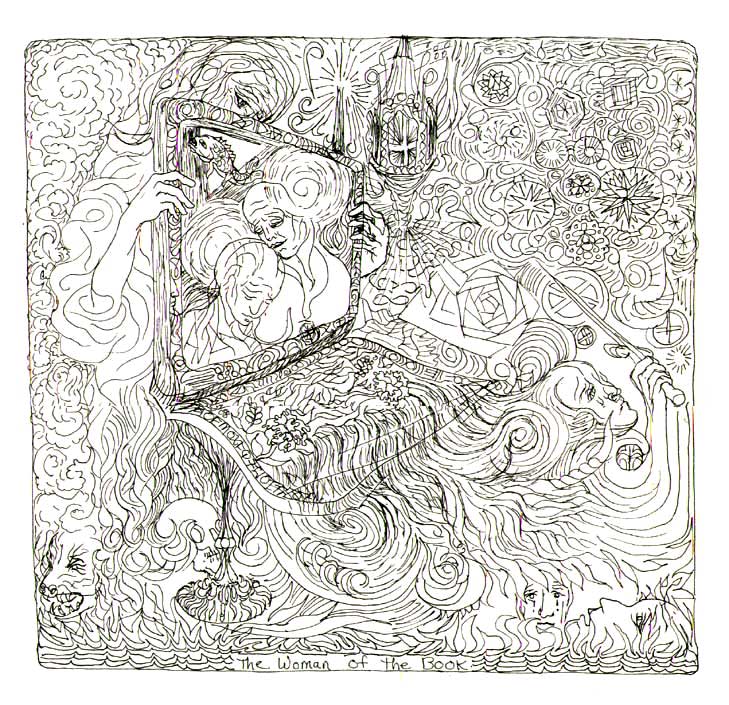
The Woman of the Book shows a book that is not just a book, but a living part of life: a living book and not just a book about life. Indeed, the part of this drawing that still amazes and charms me is the cascade of life that pours out of the book. The opened page in the book pictures a gathering of vegetation and some flowers, perhaps roses and from under these flowers water is pouring forth from out of the book. I imagine the flowers are red and the water a vibrant deep blue. The fish on the upper page of the book seems to be part of the books magic, as do the couple embracing above the flood of flowering water that pours out of the book. The book seems to be a book of nature, a living book made out of flowers, water, love and nature. In short, the Woman of the Book appears to be nature itself and she is pouring forth the wonders of the natural world out of a book of love. This is not a Platonic book, seeking to hoard immutable forms in an eternal abstract space. This is a vital, living book, pouring for a love of life in all its messy variety. I like this drawing.
The upper page of the book is interesting. Two people who are embracing each other in a gesture of love and care for one another. It is hard to determine their sex and very probably it does not matter. There is a fish on the page. There is no particular indication that the fish is meant as a Christian symbol and I don't think it is. I often used fish in the drawings and generally I did not mean them as symbols of Christian subjects. More likely the fish is there because the book is magic and water is issuing form the one side of the books as a fish swims in the other side..
Under the book a death's head hides behind a candlestick. In front of the book is a poet's head looking upward beyond a man who looks at the viewer and is crying. There is a geometric rose, a man with a sword who appears to be touching the stars and a rather ornate lamp resting on what appears to be a threaded veil or perspective landscape grid. There is a lion growling in the lower left corner. I really don't know the meaning of all that is taking place in this drawing. But it is a drawing that is about the book of nature, of that I am sure. And it is a drawing that is about the joy I find in nature, then as now, and which I have tried to put into books. I think the simplest thing I could say about this drawing is that it is a drawing done in gratefulness to the women of my life. I did it years ago. But my present memory is now and so I see love in it for the woman I am married to now. It is, to conclude, a drawing of praise for woman and nature.
Another drawing that explores the relation of woman and books to nature is this one:
A woman is reading or looking at a book about roses. The woman's face does not look particularly young and is wrinkled or care worn. But interestingly, she does look youthful in the happiness she shows in her face as she sits, naked or nearly naked, in a field of wildflowers, looking at a book about roses. A woman who is much larger than the lover of flowers is bending down to encourage or fondly touch her. I wonder: is the woman who is much larger a goddess? , or is it her mother?. It could be "mother nature" who is reaching down to lightly touch the woman sitting in a field of wildflowers. Or more likely, I was thinking how lovely is this lover of flowers I drew. How lovely is her love of flowers and how beautiful is her care for them. I imagine a larger being, not exactly a parent but like a parent, who sees this love of nature. Maybe it is how a older woman or a mother might see this tender and childlike love of flowers as beautiful. Or maybe the larger woman is just closer in perspective, so that is why she appears larger? I imagine a child who loves flowers so much that her mother in moved by this love and bends down to stroke the hair of the young girl who loves flowers. Anyone who loves flowers this much deserves to be loved in return. This is probably what the drawing was meant to celebrate when i did it. or , it is what I mean the drawing to celebrate now that I think about it, twenty years later.
Similar in theme to the Woman of the Book is this drawing called Listening to Her Endlessly Speak.
Perhaps I was imagining Shakespeare and his notion of Ariel, again from the Tempest, who I imagined as female. But once again I do not think I was thinking of Shakespeare here. I was quite aware, at the point I did this drawing, of the Kabbalistic notion of the Shekhinah, which I had learned about from Jack Hirschman and from earlier readings as well as from Gershom Scholem's books on Kabbalah. In any case, I did not need Kabbalists to teach me that wisdom might be expressed as a female image. I don't know that it is wisdom that I am trying to picture here. perhaps. But what the drawing actually seems to indicate is that the author of the book is petitioning the spirit of the book itself to come closer to him and tell him what should be said. He is motioning to her to come closer to tell him the truth of what he needs to know. More than that he is listening to the sounds of the wisdom inside a book that possibly he himself has written. Or if not that, it may be that he does not understand something in his life and he has sought the answer in a beloved book of his, and the book is giving him sweet knowledge. Or, yet again, if it is not sweet knowledge he acquires, maybe it is a knowledge of the sweet succor to be found in the depth of his own heart and mind that the book is teaching him. Or again, maybe it is an image of what I always wished books would really be, but which they aspire to become but never quite reach. Maybe the woman of the book is telling him, " I am the honey of your own heart, seek out the books that are sweet with my taste and follow them until you reach the meaning of your real life. Beware of living too much between the covers or books". But this is too sentimental, I imagine she would be more down to earth say something as simple as, "try to open your eyes to the truth about yourself before you die, because after you die there is nothing: love the world you live in because there is no other".
The drawing intrigues me, despite the rather spiritual design of some elements of the drawing. It speaks of a knowledge that is born of an intimacy close to love. My friend Jack Hirschman, whose beliefs I struggled with over some years, since he was also a teacher, had taught me to try "get in touch with the 'other' inside of yourself", and for Jack, the 'other' was woman, or the communist other, or maybe some notion of the other as Kabbalistic mystery. I grasped the meaning of Jack's idea on various levels. There was some truth in it. I am sure that Jack meant that the other was the communist 'other', though he often played with religious and spiritual imagery as a kind of "texture".
I agreed with Jack that the notion of the "other" had some validity. Of course anyone who cares for others should try to see their humanity within oneself. I struggled for some years with the idea that the other could be god. But finally I rejected that idea, There is no god. Finally I could see that the other is all that is not me, particularly those left out of the society in which I live but also the animals and birds and elements of the earth. Jack had little understanding of anything outside the city, so Im sure he could not imagine all the animals as being part of him. But if the imaginary "woman of the book" would teach me anything, she would teach me that the whole of nature matters and not just people, Marxist or otherwise. Yes there are others, including plants and animals, and yes, there is myself, and in some sense I am an 'other' to myself, as Rimbaud said. There are no absolutes: neither 'I' nor 'others' are absolute. These selves, me and others, are related beings, and it is in the interplay of beings that meaning is created. The earth is about our relations.
I few years before doing this drawing, in 1978, I had down allot of drawings of faces on rocks. I wanted to try to express the idea that everything has a voice, if only we would listen to it. A poet is a vehicles of voices, I thought then. The drawing Listening to Her Endless Speak is about the love of the voices inside books, and the next drawing is about the desire to give ones own voice to others. I have always thought of books as a kind of offering, gift, a sort of potlatch of ones deepest innermost self. Even in this essay, I am offering some of what I have learned about knowledge and books. At one time I thought of the offering as a spiritual offering a sort of prayer or petitioning, like the early Chinese offerings of writing down ones wishes on prayer bones, but more recently, I think of making books as a way of giving what one loves and lives for to others. I do this in the belief that there are those abroad who will care and listen. I hope that, in turn, they well seek to give of themselves to others. Books are part of an effort to heal a sick and ailing society. If the only world that we have is this world, we need to hold to each other and honor both natural and human rights. He need to be critical of those who would destroy us and natural world in the name of religion or business. Books are a way to keep alive the resistance to powers.
So the next drawing is an image of the book as a gift given to others. It is an image of me giving this or other books to others, in the desire to please and to care.
Jack Hirschman once said to me that "art loves art and poetry loves poetry". This is both true and not true. It is not true in that art about art can be tiresome and narcissistic. Poems about poetry are of limited interest. One wishes for a poetry that is about something, that has real content of lived experience in it.
But on the other hand, it is true that art loves art. Books are gifts passed from authors back to readers and then from readers back to the world where authors got the stories. Books are not an eternal "Word" born from an authoritarian god. Books are fragments of a conversation that is ultimately about nature. Books are an image of love between readers and makers. And all love means difficulties and struggles leading to renewals and reassessments. Relationships are what life is about. One suffers in the work on bad days and gives oneself to ones work on good days. When the work sings--- the lines flow with ease--- the heart is open. One explores the relations and the connections between beings. There is peace in learning and reaching out to others. Art becomes like wildflowers growing in a spring field.
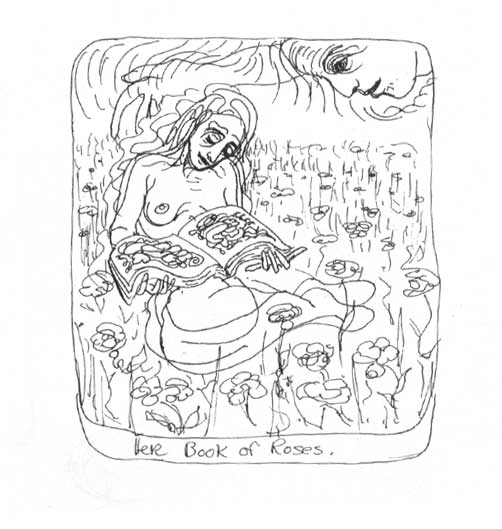
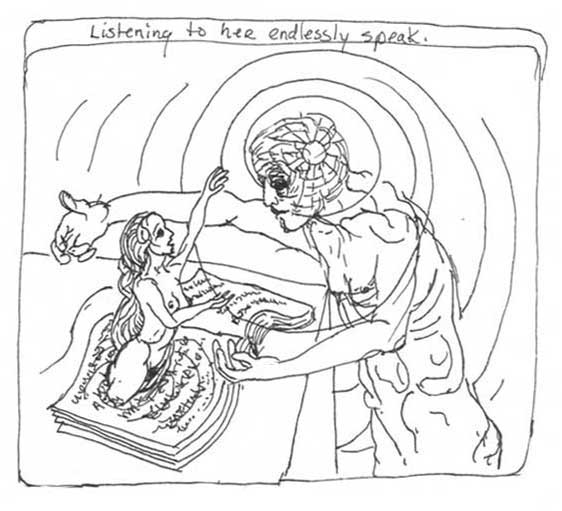
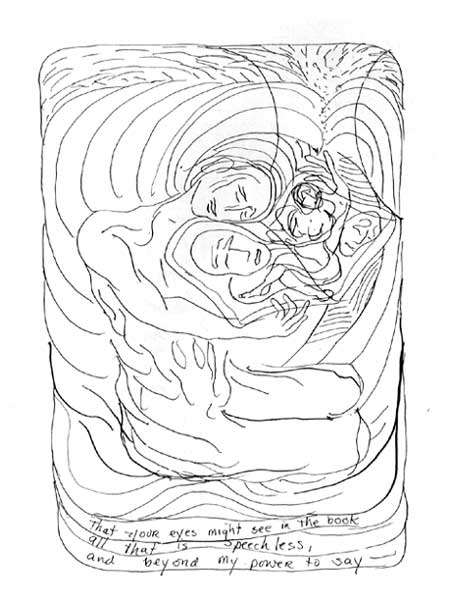
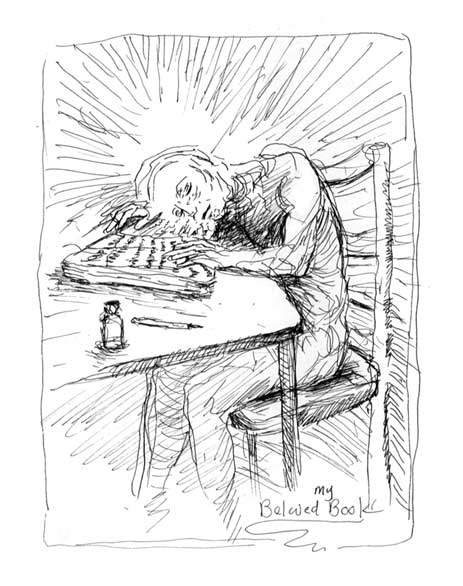
This is one of my favorite drawings in this group of drawings about books. I remember doing this drawing. It was done in a time of loneliness and struggle. I was going through a break up with a woman that I loved. She had moved awayrather coldly, choosing New York City over me. I was writing a long elegiac poem called the Nameless One, that was, strangely, a kind of premature farewell to an earth I believed might soon be destroyed. This drawing is a literal self-portrait, meaning that I was drawing what I imagined I looked like when I was sitting at my desk and embracing my beloved book in just this way. The book I was embracing was probably my journal, in which I was writings notes for the Nameless One and doing drawings like this one. I am expressing a deep love for my work, a love I still feel for it. I have put most of my life in it. I have always loved art and the search for meaning in a world gone arwy.
I love the way the hands gently touch the pages, almost like a lovers hands. What I appreciate about this drawing is that it expresses very clearly the emotion of love and peace that my work has given me over the years. Indeed, besides my wife, and living close to animals and nature, the only real peace I have found peace in my life is in my writing and art. My beloved books have been dear sources of solace and comfort to me on many days when people were not there for me. Books have often helped me return to the hidden sources of my own life. On the other side of this love of my own books is the way in which they have contained my loses and sufferings. This next drawing is about all that my books have attempted to hold, but which has been lost despite my efforts. People I have loved who I lost without intending to. People who died. People that I loved but who left me, or who I left. In the final end, all those you have loved are still with you. Even if they are buried in a book somewhere, or lost in your fading memory.
Under this Book She Sleeps
Never Again to AwakenI have written books or poems for others and they have not been read or not been understood or they have been cast aside or despised. I have written poems or texts meant to achieve peace and high purposes and they merely achieved being ignored or created contention. I have devoted years to writing books of hope that ended up sitting on hopeless shelves in the dark, behind a bookcase curtain. I have written books that did the opposite of what I hoped. I have written testaments to my love of others and then lost those people, when they died or went away, without my ever learning if they knew of my love or understood what I wished to say. I wrote Love poems that were given but never read, or love poems destroyed out of malice by she who I wrote them for. Love poems spit on, burned or rejected by those they were intended for. Love letters destroyed by those who should have known that the human heart should not be wasted and words truly spoken by an honest heart should not be thrown in the fire or the garbage. I have poured myself into certain documents so deeply that only I know how much of me is hidden in the depths of these texts. Imagine pouring the depths of your heart into a book of ones love and then he or she dies, and all that is left is the book, like a memorial of a lost love. But it is also true that I have written love poems that pretended to be about the person I thought I loved but actually were just about myself and my selfish need of transcendence. I am not blameless.
The drawing above is about the sorrow of having written about what one has loved, and what one has loved has died or left you or gone away. It is a drawing of the Blues. The man is the drawing holds his book of love poems on the body of his dead or dying beloved and the book is not enough. The book means little without she who is gone. In some sense, every book is about a love that has died. Every book is already past its truth before it is even finished. Every book seeks to hold the world in its pages but the world eludes it. Every book is a testament to the illusions and misbeliefs of the author, a testament to human fallibility. I have sought to say to the depths of what I can reach in myself who I am am what life has meant to me. This knowledge, this provisional truth, I put into a book. The book is done and goes out and means nothing until someone opens it and reads it. Every author offers the flowers of his life to the reader. One hopes for a reader who will go feelingly into the flowers of its pages with a mind and heart. My books are all books of dried flowers, waiting to be opened so that they will come to life again in someone's imagination.
In a certain sense, the drawing above is backwards. It may be that the woman who has died is myself, and the book is my life and my books and the person who embraces my book is a future reader. I wrote this sad book full of invisible colors for you, whoever you are. The only hope of my awakening is in the hearts of those who love what I have created. I made all this for you, mysterious other who I do not know.
On the other hand, the drawing could also be an announcement of my awareness that something about romanticism itself has failed or died. The gnostic dream of total possession of the beloved, the 'eternal feminine' of Goethe--- wasn't that a selfish dream? Wasn't that a vanity? Wasn't all that self interested idealization of women somehow unkind towards them? Why burden women with this impossible idealism. There is something ridiculous in Dante's Beatrice, or Rossetti's ponderously humid veneration and idealization of poor Elizabeth Siddal, who was a fine painter in her own right, but not terribly well treated by her lover. In the end I have given up romanticism out of respect for the actuality of real women. They are not images on pedestals. They are in many ways the more reasonable and important sex. Men are embarrassing fools of testosterone, obsessed with status and position. What matters in life is respect for life and most women understand this very well.
Books are receptacles, mirrors, pale photographs of all that has been lost. I have been keeping journals for years, vainly trying to stem the inevitable tide of all that must be lost. My journals have followed me now for 30 years. A few of them were lost or stupidly destroyed by me in moments or narrow mindedness when under the influence of people who were harmful to me. Some of my writings were destroyed because of a religious cult's influence, burned by a woman under a cults influence or tossed in the trash by someone who did not care. But besides that, I have clutched to my journals and books like a life-buoy, or a tree in storm. This drawing explores the theme of a hidden book, or a "Lost Book" in a storm. But if ones reads the text carefully the book is an offering given to nature, in some respect, by a man who is himself of nature, so that in some respect that book that the man sings out of the storm is given back to the storm. The heart is not just a strong pillar that enables one to withstand the storm, it is also itself a part of the world that makes storms. My books exercised a sort of magic that both kept me like a person lost in the storm at the same time as they allowed me to find my way out of the storm.. My books are both a wild voice lost in the mists far from home, and a voice from home that calls me from the mists of the wild.
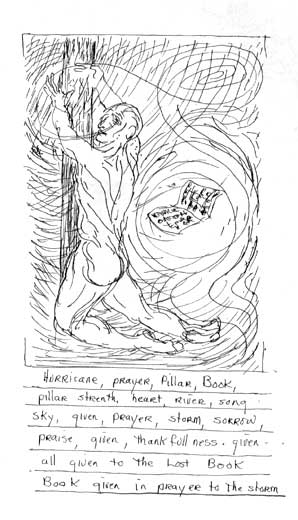
On one occasion I left one of my journals on the steps of the Metropolitan Museum of art in New York and walked some blocks away. I realized my mistake and ran back at full speed, desperate. Probably a few thousand people had walked by or over it and no one touched it. I was over-joyed. Months of my life was saved form the tourists and crowds.
On another occasion I was carrying my journal by the ocean near San Francisco and was hit by a "sneaker wave" which are anomalous waves much higher than other waves. Sneaker waves sneak up a person and can tower over them. Such waves can drag people out into the ocean in some cases. In my case, I was standing on a dry beach at the edge of the water and turned around and a high wave hit me in the face and knocked me further onto the beach. My journal was wet. It was my journal more than myself that I was primarily worried about. My books have been very dear and important to me, like trusted friends or children. The following drawing echoes some of the drawing above, except that it suggests a story and a mythic theme of the long journey through the imagined or real wasteland. I carry the beloved book which is finally finally brought to a place of completion and delivery. The book is not going to be lost, but rather will come to rest upon and rock and achieve some solidity in mysterious progression of changing times. I don't know why I have written books all these years. Sometimes I think it was so I could hide from life. Sometimes I think it was the opposite: I used my books to try to concentrate on what seemed to matter in life. My books were the iridescent distillation of what i have love in life. Indeed, my devotion to my books helped keep me free of many dangers that I otherwise might have succumbed to. My books were friends and silent partners. That is what these drawings about books collectively say to me 20 years later: books and knowledge are both a source of sorrow, and books and knowledge are a source of joy and wonder--- my books are the effort to share the rainbow iridescence of my joys and sorrows. My own books have been friends and loves that saved me from suffering, and they have cost me dear and made me suffer. But in the end they sing the song of what has been foremost in my heart.
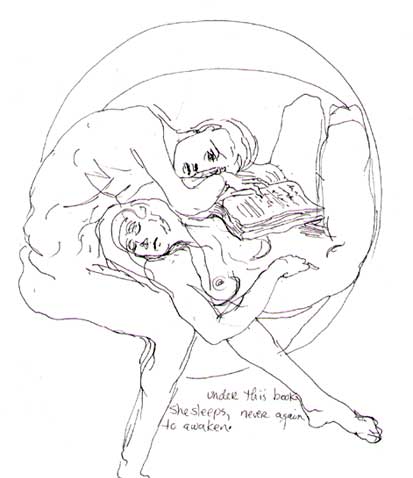
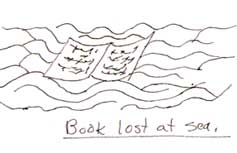
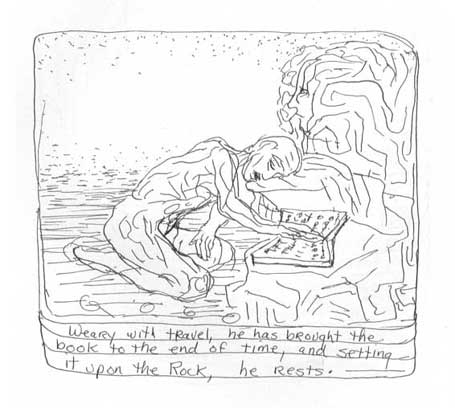
The next drawing is one of many drawings that treat the subject of gratefulness. I had a notion then about the ocean as a kind of sea of infinity that would somehow bring us all back home. A romantic notion no doubt, perhaps arising from my brief life as a sailor, or perhaps arising from my mother and her very romantic notions of the sea.
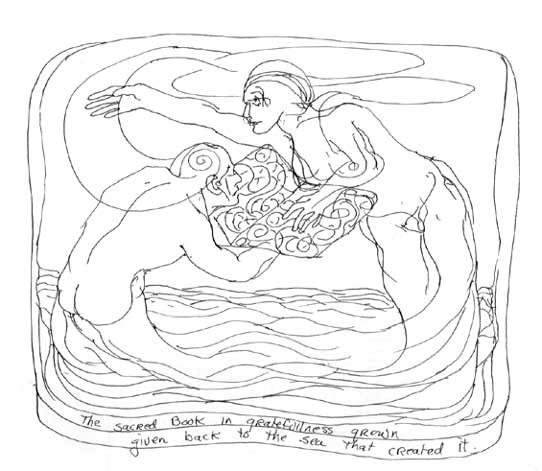
In any case, this has a lovely and vivacious line that dances on the page and creates expressive forms with a minimum of flourish and bravado. This drawing identifies the 'woman of the book' with the sea, and the book, perhaps, itself an Ocean Book, may be akin to The Ocean Book I wrote in 1978. The idea of a book that represents the sea is one that I may have originally got from James Joyce who planned to write a book based on the ocean but never lived to do it. I had tried writing my own Ocean Book, and here, I am returning the book to the woman of the sea, who seems here to be very proud of me, and is giving me a kind of creative spark that spirals into my brain. Her certainty in the midst of the wave tossed seascape is notable. She seems to have an understanding of what is given that is beyond the understanding of the giver. She receives the gift with knowing encouragement. I remember a line from a poet friend Jack Mueller, whose poems of praise inspired me on occasion. In his poem "Boxwork" he states "I will obey the spiral in my blood, I will converse with everything". Yes, let a book be an ocean of conversation, let the pages be clear with the radiance of water.
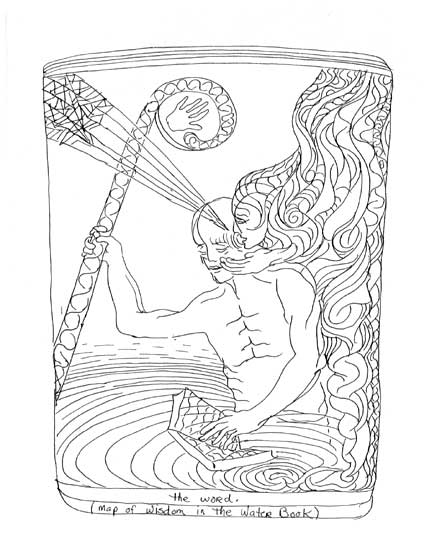
My friend Jack Hirschman once said to me that "wisdom is the map of the world", an interesting comment with some truth to it. But I think Jack wanted me to read more diversity of newspapers and understand the interplays of geo-politics. Good advice. But I got to thinking about the map of wisdom in other contexts, less political perhaps, less governed by the News-- and so because I love water and had envisioned a book of water, maybe the map of wisdom could be read in the book of water. Certainly there is nothing in the universe quite like water, and certainly really understanding water, not just drinking it or knowing its scientific formula, but really knowing it in every context, in deserts, in oceans, in the rivers from the Amazon to the Saco River of Maine: water as rain and arctic ice, water in the body and under water, water in clouds and on the wings of birds. To truly know water might be wisdom. So I imagine the spirit of water, whatever that being may be, raising up out of the water and whispering to a young man what water really is all about. Maybe something of the sky would combine with the voice of water, and together air and water would explain an earth troubled by the destructiveness of humans. Maybe I would learn to read the Book of Waters, and the language of soils would seep up through my fingers and I could eventually talk the talk of sky and tree and the song of birds and snow sighing in the mountain passes. Maybe not.
Another drawing that is basically a drawing of Nature as a book is this one, called the Eagle Book
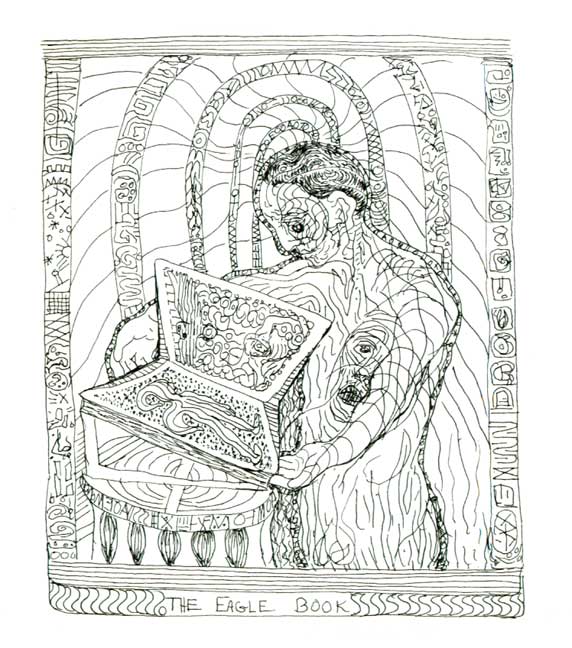
It shows a man looking at a book in which and eagle rises up over a man who appears to be caught or crawling forth out of something. On the facing pages is another man who has a strange body or costume. The decorations on the walls of the interior of the building are apparently Mayan or central American. i did spend some time studying what Mayan and central American art I could find in the Natural History Museum or New York and other museums around the time I did this drawing. Inside the man who views the Eagle Book is a face, about where the heart of the man should be and the face is crying out for aid or comfort. The man's face looks very mask-like, perhaps reptilian--- so much so that it may be that the face inside the chest of the man is the actual man and the man who looks at the book is really just a prop or imposter. If that is the case, it would raise the question of what the Eagle Book is actually about. The man in the book is trying to get out of something and the man who looks at the book appears to be locked inside himself. So it would seem that the eagle books is perhaps a book that teaches escape from a false self or from the persona of a false mask. Perhaps the Eagle Book is the Philosophical Drawings themselves and i was hoping these drawings would lead me to my true self. In so far as I have a 'true self' I think I have found it in the last few years. The true self is not an absolute thing as I once thought it was. It is merely the acceptance, as much as is possible, of who one is. Who one is is all that one will ever be. there is no total transformation of self that is preached by religions, the life that one has on earth is all the life that one has and one must make the best of it, whatever that may mean. there is no escaping death through religion or by any other means. this too must be accepted. I have not yet accepted this, I must admit, but I am still trying. I am a fragile being who will die one day. I am essentially the same as all the other animals of the earth with whom I share a primary kinship. If this drawing has a meaning for me now it is that I am the man inside the man's chest and I don't know who the man is looking at the book. He is not me. I have been frightened for some years. I wish I had an Eagle Book to tell me which way to go.
But the truth is that I have no such Eagle book. I have what my eyes can see and my hands touch. I try ot face being of the earth with a certain measure of happiness and joy. But it is hard and every day brings new difficulties. Nevertheless, I have lived my life loving to know what I can know, and I thank books for helping me learn about so much that I could not have known about otherwise. I was a young man once full of hope for future enlightenment, and now the future is here and what Have I learned of life except that much of what I once thought was true was not true. I am not like the apparently wise and wrinkled old man that this drawing shows, lifting his hand to the sky in a gesture of thanks. I have no gods and do not want them. I have the earth and the sky of real stars above the earth and do not imagine mythical worlds anymore. What there was on earth worth knowing had to do with actual beings and things. the years I spent unraveling myth and religion were good years in that I was able to molt my skin like a snake or gain a new shell like a crab. Curiosity still leads me and a sense of wonder about what is real.
The next two drawings belong both in this chapter and in the next chapter on language and creativity. But since books feature prominently in both of them I will include them here as well.
The drawing below is a drawing I like very much, It is a fantasy of an author or writer, myself, perhaps, who wants to give back to the world all the the world gave to him and that he put into his writing. So in the drawing a man has magically reversed the creative process. Authors struggle to put their whole selves into a book. The author in the drawing has done just this, but he has decided to reverse the process of inspiration. He is not putting his world into a book, but rather letting the world go from the book. He has let the words go like a flock of birds that fly out of his book, returning to nature and the world from which they came.

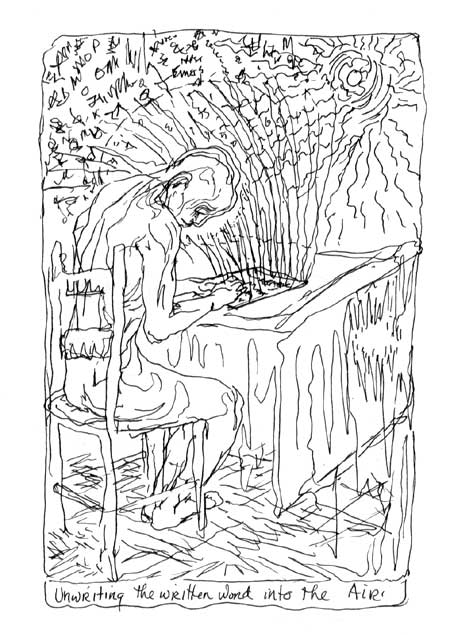
Unwriting the Written Word into the Air
A writer tries to let his mind or heart dwell or hover, as it were, hidden between the words he has written in his book. The writer hopes another will come and feel his words and take them into him or herself. But here, in this drawing the writer has reversed the usual flow. The language and its meanings fly back into the world that it came from, emanating like a fountain of light or a geyser of meanings and letters. The man looks strangely satisfied with this event, as his beloved meanings return to the world that they came from, like children finally leaving home and going back into the world from which they ultimately derive. The man looks wistful, as a father or mother might look, watching their children disperse into a larger world outside the family, graduating form college perhaps, or going forth to meet new lands and new challenges. In a similar way an author's works travel into the wider world and become a new sort of pollen to create new sorts of flowers, blossoming in the hearts of those who might take in or embrace the artist's or poet's works. Let the work give others a sense of the fragrant meaning of life on earth, the author wants to say. The author in the drawing is happy that the meaning of his words has escaped from the covers of the book and has rejoined the world of wonder and being. The author seems to be saying--" let the meanings fly free, let others not waste time reading books unless the books help them savor the life of each minute, the life of a peach's growing, the life of a day of sunshine, the life of children playing with paper airplanes, a life of leaves on water." This is the only world that exists--this earth-- and here we are upon it. Let us savor the moments, and love the many beings who life here.
The last drawing 3 drawings above about lead me into the subject of the next chapter Language and Creativity. The drawing below is a detail of the drawing called The Vegetable Crucifixion of the Languageless Word. This drawing is very complex and I won't discuss it here. suffice it to say that it is about the mystery of knowing and the desire to unwrite books or to unknow knowledge, or to return to a pre-linguistic sanity. The notion that the world has meaning without an anthropomorphic insistence on language is a notion with some merit. The desire to not speak of things that are beyond words is also of some value. Nature is mostly non-linguistic. Animals speak a different sort of language than human-animals. What could I say if I could speak without speaking? But language or the limits of language is the subject of the next chapter so I will stop here and move on.
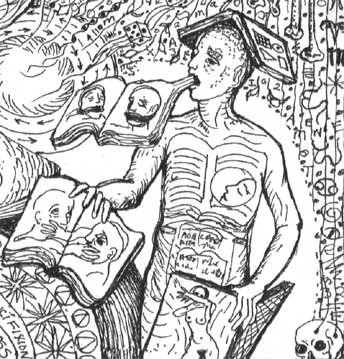


Copyright © 2003-2007 Mark Koslow.
All Rights Reserved.