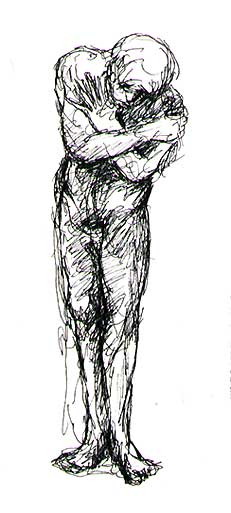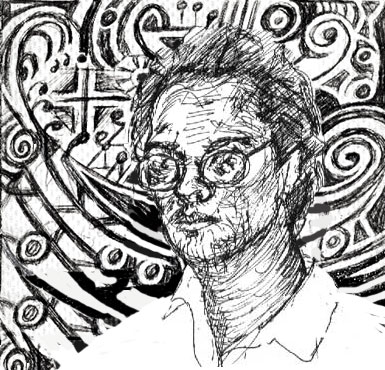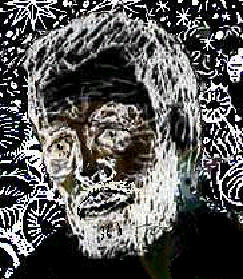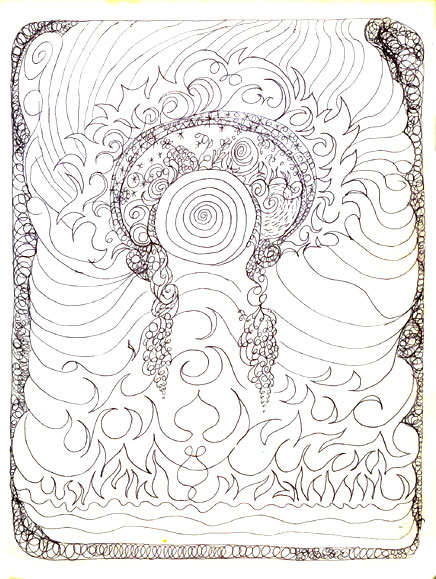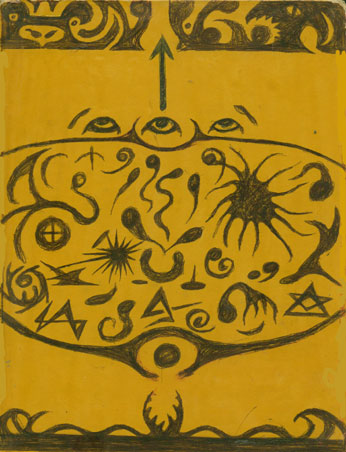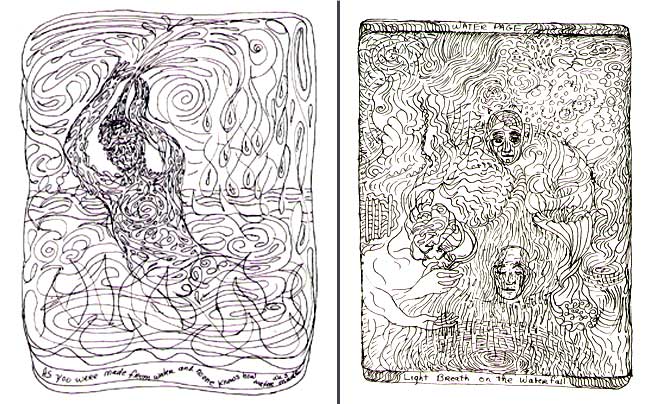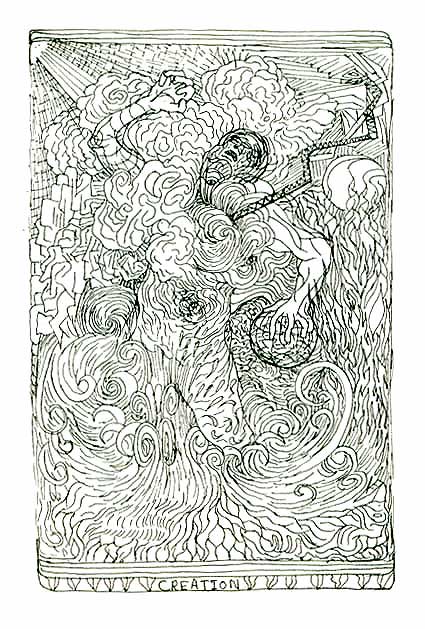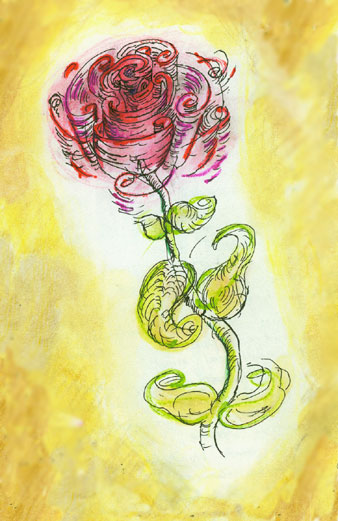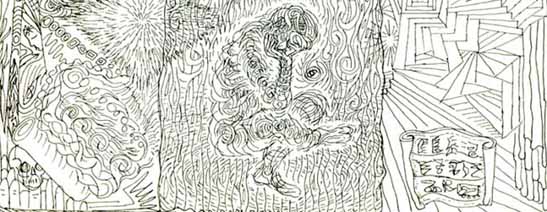
Self portrait detail of "Veil of Unanswered Thoughts"
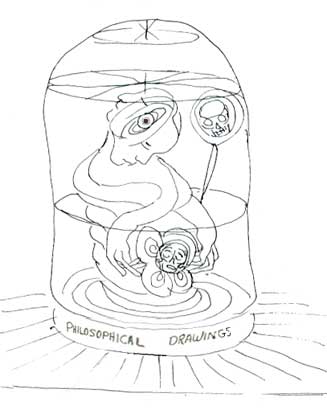
Philosophical Drawings
Self portrait detail of "Veil of Unanswered Thoughts"
Chapter 1
Introduction:
About the book itself: Drawing Style, Origins, Veils and Characters
Charles Darwin suffered badly from panic attacks evidently caused by stress and fear. The man who did more than anyone to bring religion into question was a man who was terrified of public speaking. He was prone to vomiting and terrible seizures of anxiety and fear. Having seen something of the narrow minded malice and ignorance of which those who are inflamed by religious superstition are capable, I can understand part of what Darwin was up against. I don't have the depth of bravery or genius that Darwin had. But I am aware of how much Darwin's search for truth actually cost him. The whole Christian world was against him. There is no doubt the truth was on his side. He wrote one of the most important books ever published, far more important than such atrocity producing books as the Bible or the Koran. But he writes about his great book, The Origin of Species, that ""You ask about my book, & all that I can say is that I am ready to commit suicide: I thought it was decently written, but find so much wants rewriting. . . . I begin to think that every one who publishes a book is a fool"
I have no desire, at the moment, at least, to commit suicide. Moreover, I am hardly Charles Darwin and the book I present here is nothing comparable to Darwin's' great book. But that said, I agree with Darwin more and more as I grow older and my researches and understanding of nature deepen. But besides admiring the facts of evolution I agree specifically with what he says in the quote that "everyone who publishes a book is a fool". So, let me state at the beginning of this book that I am a fool.
Putting ones inmost thoughts out into a public arena is foolish, not just because the public is fickle, superstitious, untrustworthy and often cruel, but because few individuals, myself included, can deal with the stress of making a public document. Im not sure but that my father was right that I should never write down my private thoughts for a public audience. But what will be learned by future generations if at least a few of us don't try to be a little honest about what life was actually like in this generation?
I want to tell these stories. And that said, I have always thought of myself as a kind of fool, mime, or at least a person of sincere intentions who may not be quite up to all he wishes to do. Let's say that I am not a great fool like Marcel Marceau, the great French mime, but a failed fool. Or if not exactly failed, certainly a comprised person, whose aspirations far exceeded my actual accomplishments. But let me qualify this by pointing out that those who are "successful" are busy destroying nature, polluting, exploiting workers and harming the earth. We live in a time where success means failure and thus to some degree to fail is to succeed. At least I have tried to measure the meaning of the times I live in, and be a foil for its fears and injustices. All life is loss and failure and learning to accept and affirm this fact--- that is what real success is all about. To feel with all those who fail is to begin to love life on earth and how earth came into being. I feel much closer to animals, geriatric patients and young children than successful business people, presidents, churchmen, cult leaders or professionals of any stripe.
Being a fool is to be irreducibly human and thus to claim no election, no superiority. As Erasmus pointed out, life is folly and learning to love folly is very hard. I am a humanist, and thus to some degree a fool. A humanist can only write in "praise of folly". This book is a book about praising folly and fallibility. While this is not a sufficient apology for putting forward this book, it is a fact that, as Darwin said, writing a book is a torment, and however pleasurable a torment it may be, I do it because I must, and that is that.
Actor Unmasked
That said, I admit that these drawings are those of a young man and are full of the implied mistakes and misapprehensions that go with inexperience. Moreover, I have hardly looked at these drawings for years. They sat in notebooks unseen. I'm surprised that I even did these drawings some days. Some days I remember why I did this or that drawing. I remember a woman I loved, a dog that I cared for and petted, a homeless man in New York City. Memories of drawing these drawings come back to me. I sat in cafes in North Beach, in Manhattan, late nights sitting at my desk in Cleveland, sometimes working on them all night long, or walking down the street in Minneapolis, Paris, Point Reyes, London or the East Village holding my ever present notebook. More than twenty-five years have gone by since I began them and 15 years since I did the last of them. At the time I was like the young man in the drawing at the top of this page. He is thinking and thinking, trying to understand a world that did not makes sense to me, trying to read the barely decipherable script of life. I knew, there was more to life, a meaning not yet grasped, a language I did not yet understand, if only I could decipher the unintelligible text of life, if only someone would hold me and ease the pain. The drawings came out of me like I was giving slow birth, pushing them out, trying to ease the pain. They were not still born children, but stayed quiet and hidden for years, until now I decide to let them out.
This is the story of the birth of broken dreams and longings that collapsed. How few were the birds that are flying free from these years. How brief was the rainbow that shone on me. I cannot return to the past and repair the damage. I wish I could. I wish I were still in high school. But I am not. I can only tell the story of a beautiful failure that blossomed just at the point where the truth was lost and the lie revealed itself to me. I thought I would reach into the heart of reality and lost myself in hopes of what could never be. I always thought that I would find the answer jsut around the bend and never did. I don't know if I can represent my life with any accuracy. Probably not. I can only try to do so. A full return to the past is impossible.
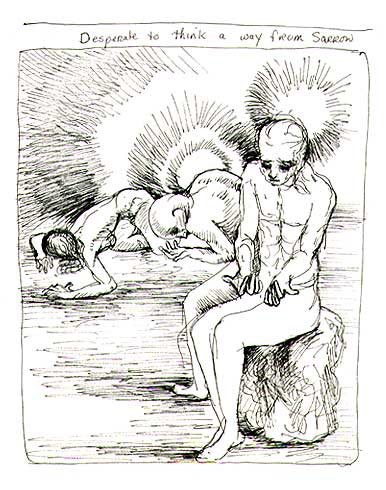
Desperate to Think a Way from Sorrow
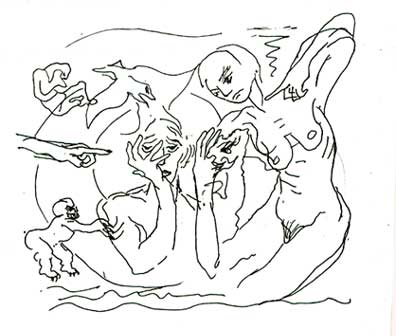
This, then, is a book of imaginings and reflections on failed longings, chimeras and veils of dreams that fall down, like stars in the dust, still glowing. Yes, that sounds a little more accurate. This book is the story of idealistic youth broken and brought down to earth by my more realistic middle age. Yes. That too. Philosophies were made and then deconstructed: religions were entered into and collapsed in chimeras. I watched the huge ambitions of wanna-be great poets and prophets shatter in a glass menagerie of lies. High metaphysical truths were shown to be nothing but manic delusions of grandeur. Poetic vistas were seen in visions but revealed only mirages. Sad eyes that looked into emptiness were lined and marked with age but still had a slight flame of love. As in the drawing opposite, hope is still alive, but barely burning, fragile and holding on to what must eventually die. The man looks at his hands and wonders who he is and why he exists. His hands seem helpless to answer the depth of his need to find a way form sorrow. A woman weeps, another man is in despair. This book is a celebration of losses and the acceptance of failed aspirations. I am not who I was and am struggling to remake myself out of the ruins of my own shattered past.
OK, maybe I am overwriting this introduction. I've been writing all my life and still feel like the mastery of my craft is not yet accomplished. My writing, like my art, has always been a labor of mistakes and rewriting, starting over every year, everyday. I go on creating against the odds, despite unkind critics, my own criticisms, my own altered mind, so different than it was twenty years ago or even last year. My work is under constant improvement and yet is never complete. My life is about slipping into something different than what I thought I was. My writing records a strange change in myself over the course of 35 years. I admire writers who can come to an end and feel they have said what they wished. I am amazed at them. I can't do that. I am always in doubt about what I wrote and realize later on that my doubts were well founded. I've written this introduction over twenty times and it will not be done even when I am dead. My writing is a process that is never finished. When it is finished I will have failed, and to some degree every work, however beloved it was, becomes my next failure. I am often loathe to say anything is finished because once it is done, it is past tense, no longer living and breathing out of my heart and mind. It succeeds if it lives in someone else's mind and heart. So long as I am alive my work still trembles with expectancy, waiting for me to work on it some more or waiting for a viewer or reader to take it in. My paragraphs are little essays that never quite escape from the time they were written in. I seem to be an encyclopedia of moments, an uncertain humanity enclosed within a restless thought. I am as far as you can get from Moby Dick, the book that celebrates murdering whales and a metaphor for U.S imperialism. I celebrate self questioning, the undermining of power and empire. I celebrate self-doubt, changing ones mind, searching. Do not call me Ishmael, or anything biblical.
I originally wanted to call these drawing assays. That means explorations, attempts. The Philosophical Drawings are like my writing, they are stories about assays, attempts, above all, they are stories of the restless effort to express in drawings what is so hard to say any other way: the story of a restless search for a perfect musical line, an art born of my heart, a quest for the source of the fire burning bright in the depths of the of the cave of creative possibilities....
Is that what they are?..... partly, partly it was a journey for the young man of 23, naive, blown by many winds, caught in the fashions of the day, equally draw to Kandinsky and Sheile, Rembrandt and Duchamp, finding my way between Lorca and Rumi, Ginsberg and Blake, caught between China and Wyoming, California and Amsterdam, Africa and Canada. Finally I abandoned all romantic forbears and strike out on my own into the unknown facts of existence and nature. Who was I going to be, what was coming out of me, how was I to identify it? Or to put this differently, I was drawing the times I lived in, caught between the radical left leaning tendencies of the 1960's and the post modern exploration of alternative, traditional Eastern or Middle Eastern worlds of the 1990's. The philosophical Drawings run the gamut from radical modernist Marxism to Buddhism and Iconography, questioning each thought and theory along the way, settling on nothing but the human experience in nature that outshines all of the theories.
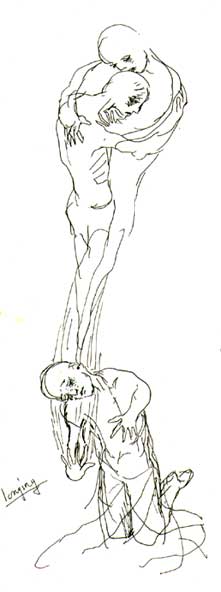
longing and projection
What did I think I was doing back then in 1979-91 when I did the Philosophical Drawings? When I began them I was 23 and when I stopped I was 31 or 33. 10 or 12 years. So much longing, so much projection. Every life burns up like a flame of longing never achieving the security and certainty one longs for. I can't stop thinking about that. Life is loss.
This drawing for instance, to the left, where a young man longs for union with whom? What memory or projection rises out of him?--- is it a brother, a lover, a lost father, a lost mother, a god, or the self he was but no longer is? Is it a dream of being comforted, a wish for completeness. Is it Rumi's curious longing for the character Shams Al Tabrizi-- is that a homosexual longing, like Jesus for John or Ramakrishna for Vivakananda? Aren't most "major" religions basically anti-female, anti-nature and hinting at homosexuality. Yes. I think they are. Most of the religions are male centered, patriarchal, hierarchies based on testosterone competition and positioning.
In this drawing the young man conjures this vision out of the depths of himself. Why? It seems to comfort him for the moment to conjure this dream of two who embrace with one of them comforting the other. But for how long? Is his dream merely a lie he is telling himself? His youth wants of imagine some final comfort, some completion he can attain. Will he ever attain that, does anybody attain that? No, I am an older man and can see that completeness is not what life is about. No one achieves totality. The religions that claim to have attained this are lying. There is no ultimate satisfaction or enlightenment. Life is change and suffering and the on going effort to live better and embrace yet another day of mitigated happiness, another day of sorrow accepted or at least managed, the desire to die held at bay.
That is me there in the drawing, making up figures to express my feeling of lostness, or rather, my desire to be comforted. Look at the satisfaction on my face. The little person at the bottom of the drawing is me, hardly able to hold my head up, dreaming up a world that does not exist. I even record my happiness at creating what, in fact, I did not have at the time I did the drawing.I wished to tell the story of what I loved and why I loved it. But i was doing this while living in at least partial absence of the love I desired. That is me, the small one, the one barely able to stand up against the critics and competitors, the Kangaroo Courts and the hypocrites who protect the common decency. That's me, exposed and still seeking peace against those who would mock and deride. I like that song by the song group 'REM' that says
Life is bigger
It's bigger than you
And you are not me.....
That's me in the corner
That's me in the spotlight
Losing my religionYes. I was out there, trying to find reality, trying so hard I lost reality altogether, more than once. Stuck in a corner trying to think my though it. Trying to deal with the fact that life is big and impersonal and the world we live in cares little for individuals. I did 'lose my religion', thank goodness, but that was only the beginning of the struggle to deal with reality and face what life is......
What is it in these drawing that still attracts, enchants and disturbs me? I love their loneliness, thier restless changes, their fallible lines, their imperfect, mistaken look of doing it over again and trying to get it right but never quite succeeding. Why have my attitudes toward religion, art and language changed so much since then? I will explore such questions in the following chapters as:
What was the "Veil" symbolism that I created all about?
When did I begin to question systems of knowledge and power?
Why am I still debating with myself about the aesthetic use of disturbing or violent imagery?
What mattered in my life that might bear thinking about again twenty years later?
What matters in any life that is worth speaking of again?
What is life?
I was a different person then and I want to find identity or acceptance with the person I was. My purpose is not to replicate myself as an art historical persona, a constructed entity made up for art galleries. That has never interested me. I have never wanted to be defined by a market, a gallery system or an art world that strangles or exploits the artists it claims to love. I am considering actualities, the life I have actually lived. I question the person I was, indeed, this whole book is a reexamination of a part of my life, an accounting of some of my mistakes, an admission, even a celebration, if not a confession, of fallibility. This is a book about being wrong and going on to learn why one was mistaken n why being able to be mistaken is a good thing.Who does one trust in this society? Which way should one go? Confessional poetry or literature, like catholic confessions, give too much authority to untrustworthy, hidden powers. I do not wish to tell my inner most secrets to either a church or a state. History tells me they are not the friend of the ordinary men and women and cannot be trusted. Nor do I wish to die a martyred witness to the fascism of the art market as Van Gogh did. Nor do I wish to die a victim to the cruel world of big business ( Rimbaud, Hart Cane) or some imagined utopian society ( Mayakovsky, Lorca), some imaginary "other", some god or some Marxist or capitalist state. I will not be suicided for a society, echoing Artaud's excesses. So no, I am not writing confessional autobiography like Augustine or Sylvia Plath.
Neruda rightly complains about the whole idea of poet as martyr. In his Memoirs he writes that that an unwritten dogma has "made this road of thorns the poet's inbred requisite for the creations of the spirit". Certainly in my youth I accepted this self destructive dogma of the artist as martyr. Neruda rejected the dogma of the artist martyr. Now that I am older I see the wisdom in that. I don't want to be a martyr to art. Suicide and suffering once seemed a way to protest the money experts and their greed. Even now I can sympathize with those who blow themselves up for a just cause, even while I agree that suicide bombers merely aggravate conflict. I see the need of radical change, but I don't want a poetry that exploits the despair that capitalism creates, using other people's suffering as a weapon of propaganda, only to end up creating more suffering. We don't need martyrs, we need a strong confident, educated opposition.
Nor do I want to escape from the world into imaginary spiritual systems and states. I don't want to write autobiography as part of a self-promotional style, nor create Barnum and Bailey dog and pony shows, poetry slam con-men, rapper gangsters, nor to belong to the Buffalo Bill school of spiritual salesmanship, so much in vogue these at poetry readings days. The self promotional style goes back to Whitman , with a dose of Dale Carnegie.
Which way should I go?My own origins are more on the side of the Beats, in part, though Ginsberg certainly had a strong desire to sell himself as a product in a spiritual "marketplace". But I like some of the Beats for their questioning of the American success ethic. I have promoted myself a little here and there, so I am not condemning self promotion utterly. But in a society where success seems to mean manufacturing lies dressed up as truth and this leading to destruction of various kinds, what option is there but resistance? Writing and art are not so much a career as much as a way of being and surviving in a contrary world. I create not to be successful but to keep a little lamp of sanity burning in myself. I create because I need to to exist and if I didn't I would die. That is the deep reason, but more immediately, I'm very interested these days in telling histories of those who would be utterly forgotten otherwise, myself included. I tend to ally myself with the neglected and lost: animals, dead relations, nursing home vicitims, slaves and birds.
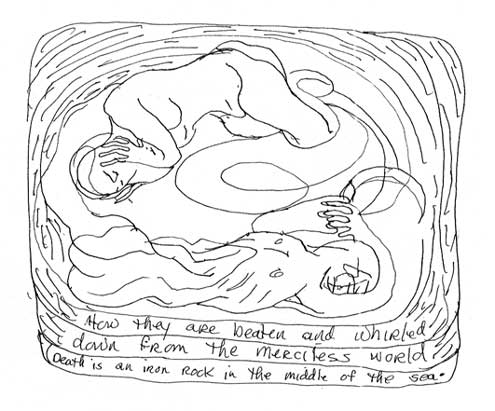
How they are Beaten and Whirled Down from the Merciless World
I am not too enamored of the Whitmanesque style of self aggrandizing autobiography. I question Native American autobiography too, for a similar reason. Black Elk Speaks is a text that is mostly a sort of bragging. That was common in Native American culture, where a certain male braggadocio as well as a tendency to look down on women, was a norm. I don't want to pound my chest in the tepee and tell my friends what a great warrior I am. I am against war.
So I do not want a autobiography as a form of spiritual delusions of grandeur such as occurs in Augustine, Rilke or Black Elk, and nor do I want to destroy myself in an act of literary martyrdom, like Rimbaud, Artaud or others. My life is not "A Season in Hell" nor an approach to the orthodox insanity of the "City of God": these are two sides of the bloody coin of a schizophrenic history. We need to transcend the transcendent and accept the obvious. No martyrs, no saints, no suicides. I want an art of reason that denies sublimity, casts away the prophetic mandate and tries to be real. Ideally, I'd like to join with others to face and solve our problems. I want to rise out of the despair and challenge capitalism with a celebration of sadness and joy and challenge it with a certain love of life and nature. I want to announce the joy of accepting only this earth and this life.
Of course, the truth is that I aspire to this ideal but have not yet achieved this poetics of joyful acceptance of life. But if I can help it, I will not let my life be a sign of weakness to justify the powerful either. Nor will I ever say it is hopeless to care about the small and the ordinary beings of the earth. Admitting ones mistakes is a token of strength, not a confession of weakness. This book is not so much a confession as a celebration of learning from mistakes. It is about failing and going on, about being human. I am trying to show how a person changes in time, breaks down and gets up again, until at last I shall breakdown utterly.
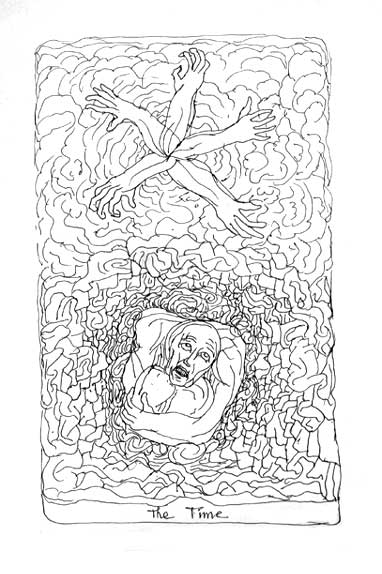
Autobiography has always been a primary interest in my work. Behind all autobiography lies the question of time. There are two kinds of preachers of time. I have suffered from them both. There are those who promote the past as a panacea and those who promote the future as a panacea. My own life has turned out to be a better teacher to me than either of these preachers. One of my teachers, who I will discuss in a chapter to follow, the poet Jack Hirschman, had a Marxist, Stalinist notion of future. The future for the Marxist is a god that is never reached but always yearned for. The revolutionary sees the future as a realm to be achieved by killing. Killing those in the way gives power to the program, or the "plan" as Stalin called it.
Those who kill for the future are no more trustworthy than those who kill to preserve regimes of the past. I also encountered a group of traditionalist writers who promoted an idea of "Tradition". They wished to return to the days when power to was in the hands of the now discredited religions of former centuries. This return to the past was a kind of 'spiritual fascism' as I have explained elsewhere. These people were willing to see whole sectors of humanity die in horrendous blood baths just so their little idea of an archaic god would hold sway. They nurture fantastic dreams of bloody apocalypses that will kill off and plunge their many enemies into the vilest hells. My studies showed me that the regimes of the revolutions and religions of the the promoters of the future and the past were equally murderous. The past is not what the 'traditionalists' claim just as the future is never what the revolutionary imagines. I did not find myself able to accept either of these alternative views of reality. I reject the extremist reaction of the the traditionalist just as I reject the violence of the revolutionary. The "Conservative Revolution", or "third way" as someone has called it, is not for me either. I refuse to make any variation of the drive for power the basis of my way of seeing the world.
The present is where the future adn past meet, and thus past present and future and all equally important in the present. My own life is the present. What I truly know is now, and the now includes what I can remember. Remembering factual parts of ones life is not an easy task. It takes work to remember clearly and without too many mirages born of the tendency of the memory to create mythology. Mythology is falsified memory, ossified into a shape that serves a social, religious or political purpose. I once once was able to watch as a group of people make up a mythos in the present about their cult leader, whom they worshiped. It was interesting to see how a group of people can fabricate falsehoods about a man, believe them, exaggerate them, extrapolate falsehoods form misread facts and then accord the corrupt cult leader all sorts of powers that they would have been much better off not to give him. This happens with leaders of many kinds. Myths end up justifying or excusing unjust leaders. I'm sure this is exactly what happened with whoever the man named Jesus, Muhammad or Buddha may have been. Whoever these men actually were is lost now, and all that remains is falsehoods and myths, fabrications and justifications of power. Myths are ossified gossip. Gossip made 'gospel' by convenience and the propaganda or an interested group of men seeking power.
In my own life I can see the future has been sometimes used to deceive. When I was a kid the men on TV, echoed by teachers in school, solemnly said cars would be flying by the year 2000 and we would live on Mars by then. None of it has happened. The future is partly the realm of the con-man,, the cult leader, the pie- in-the-sky promoter, the seller of "the grass is greener over there", the fear monger, 'the hoards are coming over the border' preacher, or the Christian barker who screams 'you are going to suffer in the next world' as he holds out his hand for your price of payment to heaven. In a capitalist society, only those with large banks accounts get "redemption".
Of course there are legitimate reasons for hope on occasion. I'm not denying that. But I don't think the revolution is going to happen tomorrow. The Chinese and Russian revolutions created horrible blood baths. The capitalist revolution is no better. The question is, based on a realistic appraisal of the mistakes we made in the past, what can we do today to make the world a little better for ourselves, our children and all those we care about, be they human animals or in nature. Snake oil will not make you better in the future. The future that the liars on TV and the Marxist press promise will never come. The capitalist con-man, revolutionary propagandist or religious guru are long gone when you figure out you've been duped. I have been duped by religious con-men and capitalist flim-flam artists. Communists I have known talk big talk about "mankind" and how happy we will all be someday but then treated me as a person pretty shabbily today. Capitalism thrives on exploiting what will be, and lying to you about all that will be "new and improved". The perpetual improvement does not actually happen. The point of it is to make you felt that all that you have now is inadequate, you are inadequate, and unless you buy the new one you are a loser.
Religion thrives on distorted myths of what was as well as lying about a mythical life after death. But both religion, communism and capitalism have made the world worse in many ways. They have threatened all of nature, created an unequal war between animals and humans. Thus it sometimes seems the past is littered with corpses and the future is a lie told to sell you something you best not want. that leaves the present, with its often terrible uncertainty and its fears....
Is it hopeless to look into the past ? The Austrian writer Thomas Bernhard, who wrote about nothing but the past says:"All you see when you look back is this gaping void. Not only your childhood, but the whole of your past, is a gaping void. This is why it’s best not to look back. You have to understand that you mustn’t look back, if only for reasons of self-protection, I thought. Whenever you look back into the past, you’re looking into a gaping void Even yesterday is a gaping void, even the moment that's just passed.". "
There is some truth to this, but it over states the case, which is usually the case in Bernard's novels. The past is not entirely lost, and indeed, given Bernhard's life long obsession with telling his own story, (a five volume autobiography!) his words about the past are not lacking in ironic self mockery. But my attitude towards my own past is very different than Bernhard's. I used to wonder what happened to all the dead, especially, say, of my grandparent's generation. They are all gone now and so little is left of them. Now that I am nearly 50 myself, I can see that time closes over us much more quickly than I thought--- like a trap door that will never open again. My dad, dead over 30 years now, for instance, is already a distant fading memory. My mom, who has had Alzheimer's but is still alive-- I saw her yesterday--- is less and less the person I knew as my mother and more and more, my child, like my daughter, except she is in a nursing home where I visit her 3 or 4 times and week and whereas my daughter expands and grows every day, my mother shrinks and caves into herself, even her eyes no longer see, or rather her brain can no longer see out of them.
It is the nature of time to swallow us up, figuratively speaking. But these analogies of swallowing, burial and devouring are not accurate, really. What really occurs is that the body ages and begins to atrophy. People and animals are lost and new ones come into being. Life is a progression, made so by genes. So rather than images of devouring, my own past is more like the photos and art I have of my life. So that is why I have perhaps a thousand or more photos of my family going back three generations. My mother gave me these and I love them. I have wanted to slow down time, or even stop it, or create an illusion of stopping it. But I now realize that is not possible. So I caress time in these writings of the last few years, caress what is doomed. I love my photos and art images. I talk to the past. I cherish the moments I have and had.
One rather lovely drawing about sex is called "All the Dead Held by Lovers in One Grasp" ( see chapter on Couples) and that is about trying to recall those who came before in the midst of those we are creating now. There is so much death on the earth it is very hard to grasp it. feel it, or bring comfort to those who suffer form it. But there is also the little deaths of memory itself, the loss of recollection of what happened earlier today, yesterday, last year, 20 years ago. Time does not devour exactly. It becomes, morphs, changes, wilts, fades and begins again in a new form. Yes. it is true. I didn't understand just how much time changes us when I was 20. But I see now that we it not for genes, there would be no memory on earth. Art is pale compared to genetics. Genetic recreates lives, sustains all living things. Art merely remembers back a few thousand years. And even this it does without much clarity. No one knows exactly what the animal painting of Chauvet Cave are about, exactly. But this is what we have to work with. Genetics only sets up the conditions of living, the parameters of an organism. The organism must live its live within those parameters. Art is not genetics. Art is a way of celebrating and reflecting on existing on earth.
There is very little irony in the Philosophical Drawings. They fail in that respect too, since the fundamental necessity of most post modern art is to be ironically conceptual, a mentalist tongue-in-cheek that maybe be satire, maybe not. In an age of modernist cleverness and Duchampian irony, these drawings were done in quiet notebooks without any real hope of anyone looking at them in my lifetime. I wasn't fooling anyone. I've done little work with my tongue in my cheek. I drew what I needed to draw, felt I had to draw, trying to find the lines in the depths of my own heart, never mind who thought it mawkish, too intellectual or badly drawn. In the rather odd, sincere and allusive way that I was prone to in those days, I was trying to tell the truth about being human as best I could. They are strange efforts to listen to the wind of imaginary timelessness, swirling inventions of my own mind. And since timelessness is an illusion, the wind of my own mind created a series of very ardent self deceptions, hopes and dreams that fail to come true. I tried to find the truth by engineering elaborate fictional escapes. This had some value in that I dredged up faults and fissures in the edifice off myself and my own culture that eventually made me able to see through many of the illusions that are foisted upon us as children.
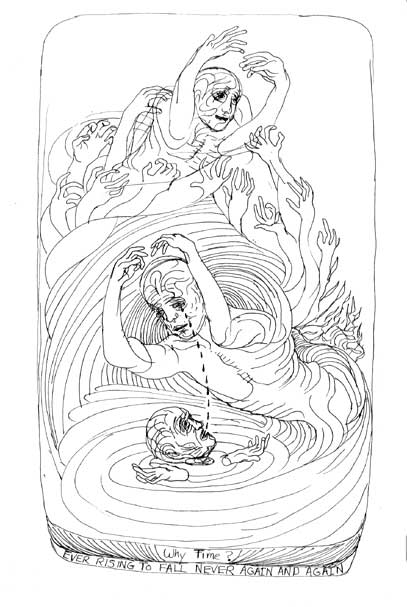
The Philosophical Drawings a memorials of collapse. I was showing the process of myth creation even as I was undermining the mythology. The drawings spring up out of the imagination and show a way of seeing that is ardent and archaic, personal and universal. But at the same time they are time bound and express a point of view that was only possible during the years I did them, between 1979 and 1991. They are drawings about searching and they fail in their objective, and the failing that they do has a strange success in it, unintended and not at all ironic. The yearning they exhibit is a yearning that wilts and collapses in disillusion. The aspiration did not end in a disaster exactly, but in the continual need of reassessment, rethinking, looking at reality again and again. As in this drawing,----- where there is an hopeless effort to transcend suffering and time. Others reach up and try to grasp on to the Hero who is struggling upward. But he fails. tears fall from his eyes into the mouth of those who aspire. He rises up again towards nothing, towards self defeat, the fact of human suffering that cannot be escaped, transcended or overcome. The hero is no Hero. The very fact of his aspiration makes his defeat all that much worse..........
Why Time?
So then, putting Bernhard and Proust aside, I can say that the past and the future are not entirely trustworthy. The present can't totally be trusted either though it is the tense that matters most. The past of my own life is to some degree an extension of my present. The past that I can know, I know only by looking at my own life. I can know this with some certainty. My past can be reflected on to allow me to learn and change. The past was never a state of nostalgic perfection, as religions try to maintain. The future is not an ideal state either, as the Marxists claim, but something one is adapting towards. Ultimately the future is death, at least as far as I myself, is concerned, even if my child or art lives beyond me, as I hope.
This means I have to give up the standard view of the self as an unchanging entity, or as a incorporated "soul", better than animals, that our society wants us to retain. I am an animal, and I can change myself only within limits imposed by my biology. Perhaps if I can look at myself honestly and with minimal fabrication, those that follow me can do the same. The future is the reality of our children and the earth's children, to whom we owe our present care. It is how we live in the present that matters to our children in the future. Perhaps we can tell the truth about ourselves and stop the destruction of our children's future.
This book then, is about looking into my past from the present, using the methods I learned in in the study of history and biology to study my own primary documents, my drawings and writings, in an effort to try to tell the truth about my own history. This is not really a book of nostalgia though there are nostalgic moments. Though I recall that the concept "nostalgia" was originally a medical term designating a physical illness experienced by travelers far from home. I am closer to home that I have ever been but still not close enough. My whole life has been a wandering. Digging under my own roots has been a process I could not avoid. I was forced to radically reassess and deconstruct my own life and my deepest beliefs in the 1990's. This book continues this reassessment. In a certain way this reassessment is an effort to get closer towards home. I am hoping that my accurate manner of studying my own past might make me better able to understand my mistakes and accept and thrive and love the world that I live in. I hope it will make me a better person in the present and help create real improvement for my future. But I want no false hopes. A certain feeling of rootlessness or seeking and re-seeking, searching and researching is inevitable in life. If life has a meaning it is inquiry and creativity. Creating security in the midst of change is home, finding a small measure of certainty in a sea of the uncertain. These drawings were one of my creative attempts to do that. This book is another attempt to do that. I here join my past to my present, trying to refine the motives of both into something better than either.
Who knows when I will die? Certainly a fear of death is part of what inspires this book. Understanding why I am alive has always been the most important concern. No one could possibly know my life as well as me. Why do I exist, why does nature exist, and what sustains our sense of existing? This book is not the story of an education, so much as it is the story of and ongoing re-education. In and out of school, I was always a rebellious student. I even rebelled against myself when I found that the authority of my own insights could not be trusted. It was not rebellion for its own sake, but rebellion in a desire to know for myself. There has been so much I had to unlearn, so much I forgot, and so much I have to reopen myself to again. Indeed, just as I have started to think that i know myself pretty well, old age has started settling into my brain and is beginning to make me feel a little dizzy and addled.
Why is there no aesthetics of self-doubt? In a society that exterminates whole ecosystems and drives species to extinction, just so a few ridiculously rich men can amass even more ridiculous wealth, questioning where and why humans went wrong has some meaning. In his essay "Heroism and Humanism", Edward Said wrote that "Humanism is disclosure, it is agency, it is immersing oneself in the element of history, it is recovering rationality from the turbulent actualities of human life, and then submitting them painstakingly to the rational processes of judgment and criticism." Yes, I have become a humanist after all, painstaking and self critical. I think it is time we learned to value failure and question success. Let me learn to be glad I have tried to learn and made mistakes along the way.k I am a human who has lived inside difficult questions. Why not record some of the difficulties?
Here I sit then, in the house where my spouse and I live. Outside there are birds which I feed every day. The deer in the woods out back had two fawns this year. I'm sure that the three legged deer I tried to nurse last year has died. I feed my beloved hummingbirds every day. He and his spouse come for flowers I planted for them. When I first wrote this paragraph our new baby was just showing herself in my spouse's rounded belly. We have a child who was born now and is 2 1/2. I've been editing and reediting this paragraph for three years now. Years of thinking about the past. I thought these drawings were more universal when I did them. They do not seem universal now. Though aspects of some of them do generalize about the condition of humanity and nature. These are drawings of a time and place.
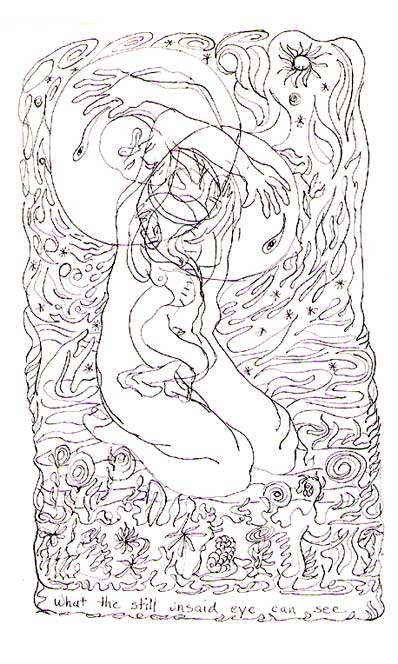
They are the drawings of a young man trying to understand and sing songs about the world he loves but does not always understand. For instance, one of my favorite drawings in the series is about our intimate relationship to all of nature. A man thinks about the woman he loves and sees all nature open up around him because of this woman, who opens his heart to all the small things of the earth.
I did this drawing as I sat in a 'chain' ice cream store across form Washington Square Park on Columbus avenue. It was near the bus stop. Bums came in there allot because it was one of the few places to get coffee on Sunday. I remember doing the drawing and after doing I thought it was a real breakthrough drawing, one of my very best, because I have finally expressed something basic about what it is to be human in the midst of nature. That was a moment of triumph and elation. I look back on it now and think the drawing very good for its time, though a little idealistic. It is lovely and romantic, but perhaps more a picture of an elated young poet than a picture of what life is like for me now. I wish I could enter the romantic mysticism that this picture draws attention to. But, what I see in it now is how this mysticism changed and became a real love of real nature, actual woods and plants. The love of 'woman' became the love of an individual woman, my wife. I became much more aware of suffering as I have gotten older. Death is much closer. The world seems less the place youthful promise that it did in those days. Now it seems a place of closed doors, narrow minds, hard work and little understanding. What matters in the world is not the vain, puffed up world of money, men or power; what matters is babies, neglected old men and women, the health of life on earth and species continuance. Now I must face reality. The self I was then could dream up ideals and perfections. Part of me envies who I was. But who I was then needed the man I have become.
Now I sit here in our house, writing and thinking everyday: The past opens up to me, even as it threatens to close behind me, never to be heard of again. The present is a time of beauty and recollections, as well as sadness over the fact of time passing. The present opens up into the world of my child, my daughter, growing up. The past opens up into the world that my drawings sought to depict. In this book the present meets the past like two old friends who have long been separated. I wish the hummingbird visiting my flowers outside my window now could fly in and enter into one of my drawings and fly into my past, and visit the places of my early days. I wish I could go back and talk to myself then. Tell myself not to strive and worry so much. Stay to what is real. Cling to beauty and wonder. Trust love. Be wary of symbols.
In the early 1980's, when I was in the midst of the ideas, projections and perceptions that provoked the Philosophical Drawings, I tried to write a number of introductions but gave up or crossed out what I wrote. I could not write about these drawings 20 years ago. Interesting I can write about them now. Why, I wonder? My memory of doing specific drawings is vague in most cases, though there are a few, like the one above, that I remember doing specifically. But in addition to vague memory after 20 years, there is the fact that at ages 23-30, which is about my age when I did these drawings, I simply did not have enough experience to understand many things that I put into the drawings and that I understand better now. At the time I would have said that I understood very much indeed. But youth is not much aware of itself and how little it actually knows of the world. The fact is I was still groping towards understanding. I was exploring. I was not just exploring the world of New York, Europe, San Francisco, and Cleveland where I did these drawings. I was also exploring my own imagination, trying to reach the depths of my own mind and heart and letting that issue into my figures and through my pen. I was exploring the limits of what I could feel and envision and the limits of what my culture had given me. But at the time, I could not quite get my mind around what I had done. I had given birth to something whose meanings sometimes escaped me. Many of these drawings come from beyond the scope of what I could grasp at the time. I was unable to write an introduction and do a selection of the drawing so that others could see them. All these years they have laid unseen in notebooks. I did not even know why I left them waiting and unseen by others all those years. I kept them secret, like so many other things I have created, and left them waiting in the dark wondering if a time would come to bring them forth.
I have been looking at these drawings for months now, after scarcely paying any attention to them for twenty years. These drawings are youthful, idealistic, full of feeling, at times naive, but restless and willing to try almost anything. I was very open minded then, more nimble and less ponderous than now. I was willing to reflect brightly on everything around me. I was taking the world in in gulps. I did not have the deep fears and doubts about human beings I have now. I was less wary, less convinced of the corruption that power that institutions, religions and ambition create. Now I ask myself what emptiness drives adults to spend their lives in pursuit of empty prestige, position, social approval and conformity? Why foolishly accept religions when their history is so obviously bloody and unjust? But then I asked different questions. I was just beginning to explore, and find my way through the maze of cities, religions, and bohemian outbacks.What amazes me about some of this old work is how adaptable art really is. I realize now that in some cases poems or artworks might mean something quite other than what I thought it meant at the time I made them. The drawings do not have the fixed meanings that I thought they had when I did them. My interpretations of them now are a new kind of creativity. There is not merely the self then and the self now-- there is also some other person who I did not know then or do not know yet--- a future person that grows out of my current persistence and not giving up. In the end, I cannot say exactly just who I was or am or will be, and those who claim to be certain about who I am are probably mistaken to some degree.
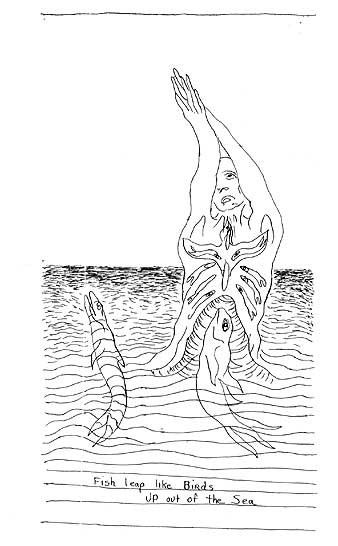
Fish Leap like Birds Up out of the Sea
Life is creative and meanings are neither fixed nor eternal. These drawings emerged from me in a strange dream and hovered like lost birds in my notebooks for twenty years. Here, I am letting them go, with their strange and uncertain meanings, their "intuitive transparencies" their groping and uncertain certainties. I give them to any who wants to plummet down into the depths and questions. There is an ocean of meanings here, if you want to swim. I've been swimming in them for nearly a few years, writing this book. Indeed, the drawings swam in me when I did them, like fish that swam out of the world into my heart and out my pen again: fish that swam out of my dreams and turned into birds. It seems like I somehow re-evolved back into the sea to be with fish and from the waters I learned to fly again, out of the sea, like a seagull.
In the various attempts to define what these drawing are about, my earliest attempt to introduce these drawings was written in San Francisco in 1979. It states:"The drawings and writings are not meant for museum walls, nor the publisher, nor even the "public". They are meant to be loved--- they are for the heart, for people, for the mind, they are my desire to share, to he or she who cares"
I still agree with this statement, 25 years later. This defines a politics of intimacy, a politics of inwardness and being human. It is a humanistic politics that goes back to Tom Paine, John Steinbeck of the Grapes of Wrath and the Civil Rights and Anti-war activists of the 1960's. I wanted to bring my heart out into the open and share with others the deepest aspects of who I have been. I imagined art as a sharing of what is most basic and intimate between humans. It has always been painful to do this, like a birth giving. It seems the way to the future lies through a deepened understanding of the past: bringing forth the past out of the present into order to create a new future. Creative art is transformative and a good work continues to offer new meanings long after it was created. These drawings are creative, and continue to be creative years after they were made. I know they also contain meanings beyond what I think now. Others will see more or something different in them that I do. When I made them these drawings they were an adventure, like a traveler under the sea or into depths of the mind, like a love story. Something in them holds in a shapeless mirror the imaginative evocations of the deepest realms where we live our secret lives.
I could say, perhaps with a little conceit, echoing R.B. Kitaj , that I am ".. a scholar only of my own pictures. I read a helluva lot for them.” But I am a scholar about things besides my pictures. But certainly I find the study of my work, as a scholarly pursuit interesting and illuminating, as well as frustrating and embarrassing.
These drawing were done without any hope of profiting from them in terms of money. Every artist would like to support him or herself. But in this society, it is difficult to do anything meaningful in the arts and make a living at it. In a society that values nothing but money, all that is devalued by money becomes a source of the deepest opening to life and the heart. A moneyless art like mine stands a chance of telling something about the truth about us. I am a lowly worker in the fields of forgotten beings. It has never been very pleasant to be this. One gives ones deepest self away with little or no hope of anything ever coming back. I have always been wary of institutions and the power of those who claim to be "authorities". I prefer to live a humble life, outside the academy of the wealthy and the art world that caters to corporate emptiness.
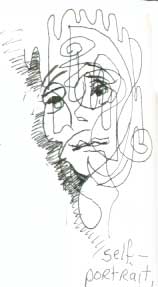
When I did the drawings I was too close and unable to fully assess them. Like the tiny self portrait I did in 1979, I just could not quite see myself or quite explain what I felt. So I draw myself as having only one eye open. There is the well of swirling lines and the rhythmic dance of thoughts growing out of uncertainty and not yet knowing and not yet understanding. Yet nevertheless there is an openness, a willingness to feel the depths of my life spinning in unaccountable being deep inside me. Yet there is no real reconciliation between my inner life and my outer life as yet. The confused lines are ardent and seeking, like a eye trying to see through a question mark.
I put too much into the drawings without knowing why. I'm not sure I entirely understood what I was doing then, and even now there are aspects to some of these drawings remain mysterious. But this groping toward some notion of the self or truth is largely what the drawings are about. My current assessments are far from definitive, but clearer than what I understood when I did the drawings. That is part of why they still enchant and fascinate me, they continue to create new meanings. there is something alive and vibrant in them, like an animal or bird that one has yet to understand. Living beings will always evade any total understanding.
Moreover, there are many aspects of these drawings that I intellectually or ethically question or disagree with now, yet, at the same time, there are many things in them that still thrill, endear and enchant me. I still love many things about them. But I also have been afraid of them. They reflect some aspects of my own distempered confusion as well as the general insanity of the 1980's, and this insanity has not gone away. I was trying to find my way though the conflicted field of contending ideologies. Capitalism, Christians, Marxists, Islamists and science all fighting for ascendancy over culture. And me ?--- I am a small man in the midst of contending tyrannies trying to find a way to speak about other small men and women. How could I reflect my hopes by drawing simple lines on a page. How could I give birth to new life between the lines?
Yes. I can see them from much further away now. I can see they are alive with a living presence and a time on fire. There is real beauty in some of these drawings, not just beauty of form but beauty arising from the beauty of the heart. In other drawings there is perplexity and seeking without respite. These are complex works which while being very interesting and suggestive, are both sometimes disturbing even while being marvelously various and creative. I do not say this out of some vain and self serving immodesty, but merely to record what i think of them, both positive and negative. On the negative side, they are often in error or based on ideas I no longer agree with and maybe did not agree with at the time or they were based on ideas I wished to try and they failed. Because I never used any objective reference for them they are also often poorly drawn, or the perspective is wrong, or they are just very naive and provisional.
Since the drawings are in many respects autobiographical and at the same time try to generalize from my own experience to the experience of others there arises the question of "what is the self" or what is the function of autobiography in this book. My view of this question has been crafted over the last ten years. I discuss this question in the Language chapter and elsewhere in this book. But here I will just say that my current view of the concept of personhood is opposed to any notion of symbolic individuality. A corporation is not a person: Jesus is not a person: the Hindu idea of Atman is not a true "self". The Marxist state is not the "supreme individual" that Marx called it. IBM is a pseudo-person, a fraudulent person in fact. The Church is not a "mother". Gods are not real persons: they are fictions. In contrast, I am a real person, a blue jay and an ironworkers are real beings. Plants are beings in a way that corporate or spiritual entities are not. No individual animal is a "species"-- the idea of species is in part a demeaning essentialization made to serve human purposes. I take my stand with real beings and persons, with nature's and human rights, against abstract, institutional notion of a fraudulent self. So my notion of the self is neither the notion of the self as hopelessly narcissist and tragically destined to be suicided. My notion of the self is that I have the right to be proud of my humanity and my equality with non-human beings. My working belief is that I have the right to write about my life authoritatively, not in a way that makes me a confessional martyr--- I am not and have no wish to be Sylvia Plath--- but in a way that assumes my life has value, apart from systems of power and exploitation. I am not a victim, and nor am I one who does harm. I am like a Mountain Lion or a Seagull, a Coyote or a Raccoon. I will not submit willingly to self destruction, and nor will I give in to powers and systems of knowledge without resistance.
Many of the drawings are suggestive of self portraits and implicitly explore the conflict between various ideas of the self I have just spoken about.. But there are few literal self portraits. Consider the following drawing.
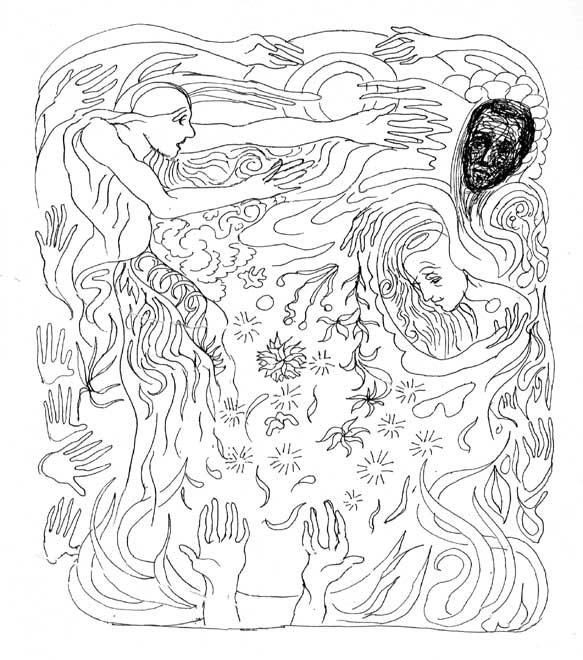
The dark portrait on the upper right is a self portrait. Not completely accurate, but pretty close to how I liked at 24. This drawing disturbed me so much that right after I did it in a hotel room in New York City, I ripped it up and threw it out. I did this to many drawings, but this one I fished out of the garbage, pieced in back together and glued it into a sketchbook. Something about it seemed worth saving. Why did I want to destroy it? At the time I was shocked at the realistic portrayal of my face set amidst the hands reaching toward me, the stars and flowers glowing for my sake and the offering of all this to my eyes. There were two realities in the drawing: the reality of my own existence and the actual New York City world around me, and the imagined world in the white page I had created. While I sat in the 9th floor residence hotel room listening to cars honk in the Lexington Avenue darkness down below, and the city lights all around in the tall building, my girlfriend asleep in the bed before me, this shock of seeing my own characters, stars and flowers turn toward me and recognize me inside the drawing, as if they were truly alive, was too surrealistic. It shocked me and made me rip up the drawing.
But let me try to define more carefully what I was ashamed of that made me rip up the drawing? What was I drawing for, if not to stir up exactly this kind of learning experience? Yet I felt I had violated some unseen and unexplainable integrity inherent in my work. I thought that the realistic portrayal of myself was the portrayal of a lesser reality. Or so I thought. The inclusion of my actual face into the other and seemingly purer world of my imagination had betrayed some notion of purity or artistic integrity. Why the horror of realism? Why did I feel that too much realism would harm me? I did not yet understand the importance of the impure. As I study the drawing now I can see all the figures in the drawing are showing me wonders, reaching for me, trying to motion towards the sun, trying to cast down flowers into the hands of the needful and the unloved, trying to celebrate the existence I love. I am the silent witness of all this. Here my imagination is creating a world where the characters I have created are offering stars to the forgotten. It is a wonderful drawing. Look at all the palms of hands on the left of the drawing.... It is as if I were witnessing the man or women that made the elemental mark of the human hand on the ancient cave walls, the gesture of basic species recognition, the palm of the hand like in the caves of 30,000 years ago. There is a strange shock of reality that I feel when I look at those ancient hands on the cave walls. There I am too, among the Mammoths and Saber Tooth Tigers roaming over the cave walls. This is the real world--- the world where ancient men walked the earth with Pleistocene mammals, the same world where current man has polluted the seas.
In my drawing there is a woman below who seems to be orchestrating my world for me, and flowers and stars float down from her hands. What shocked me was that there I am. A foreigner in the world I had myself created, but yet a world far beyond me, a world that comes from something deep inside me, that reflects a reality both inside and outside me. The shock of the real. The seeming unreality of the real. In this drawing, all of a sudden, reality enters into my fairy tale. All of a sudden my dreams and wishes, hopes and visions are exposed as merely the states and frailties of an ordinary person, projections, stories, contingent artifacts of my temporal being. I am no better than anyone, not higher or lower. I am a human animal, a man, a being like other beings. This shocked and frightened me and made me tear up the drawing. But equally well, a need of truth, a willingness to admit my mistakes, made me pick the drawing out of the garbage and paste in a notebook. It is true that I am all these things.
I could not see it then as I can now. I could not face the flowering failure of my dreams then, or the precious reality of my fallible existence. But in fact, I was a foreigner to the drawings when I did them. They came out of me like dreams on the wind and drew themselves in the billowy and cloudy whiteness of the pages of my notebooks. I gave birth to them is a strange trance most of the time. I was listening to the wind of the imagination, the void of creativity. In the drawings was contained in my humanness, my ability to try and fail and try again. The drawing held my humanity is a feathery illusion of permanence, a creative illusion I made as a gift for others to share. Indeed, I doubt these drawings would be worth preserving except for their sense of the fragility and wounded struggle of men and women to be human. We continue living and existing and despite the tragic and unspoken hardships that occur everyday in our world without comment. This attempt to give voice to the silence of human struggle and fragility is what I still love in the drawings.
The drawings show my weaknesses and fears and reveal me as imperfect. They are especially strange and foreign where they explore things that are most intimate. It would take me twenty years to learn that my visionary excesses expressed both wild dreams of false hopes. Visionary ideals were questioned and in some cases shattered. The beautiful lies would be tested and undone by reality and experience. But not all would be lost. Some drawings would hold up to time. Some of the drawings told the story of a fallible and ardent young man, trying to grasp a world of wonders and disappointments. I would have to face the fact that my face has aged and my past is dissolving. I now see that I saved the drawing above because the drawing pictures exactly the condition I am in now. It is me now that looks out of the drawing from over 20 years ago. It is chilling and exciting to realize that the drawing told my future. Now the drawings of my youth reach toward me and searches for me, it holds out flowers for me and shows me stars. I see my youth is largely gone but still my drawings hold out flowers to a forgotten time. I have to face what this drawing said I would have to face. I have to face my own mortality and still try to love the earth and soil, the flowers, faces and stars that exist around me.
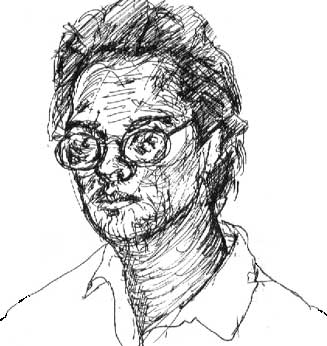
The picture opposite is more or less what I looked like at 23, when I began the Philosophical Drawings.. I is a bit a caricature perhaps, with my slightly crooked glasses making me look like a somewhat geeky, wide eyed fish peering out of a fish bowl. I am becoming an old man now, not yet like the old man in the drawing of me at 60 below. But I'm getting close to that.. Some of my first drawings were self portraits. In the end the self is not a strong and indelible agent, but a changing tissue of possibilities, dreams, hopes and a few factual and concrete accomplishments that one can make firm only for a time.
The life well lived is a flower, and perhaps its perfume will help inspire others preserve the earth as more beautiful and better place. I doubt I have had a life well lived despite my ardent wishes. But I have dreamed of a better earth. To tell the truth as best I can, even if if shows me to be much less than perfect, that is a major purpose of my art anyway.
self portrait 1979
The Philosophical Drawings are all self portraits of sorts: since no artist can avoid picturing himself and how he sees the world. But though all of the drawings together imply a self-portrait: many of them are also a picture of the life of others, a picture of ideas and a picture of realties in the world and in nature. I was very permeable in those days. I had a weak sense of self, or rather, I had been trained by my culture to value myself very little, and to think myself something that could be dispensed with if only I could gain enough wisdom. Wisdom for all systems of power and knowledge involves self-destruction. The scientist and the monk want to destroy themselves. They want to destroy nature, as I will discuss in the chapter on Myth and Religion. But that is why the wisdom of the ages is not wise. It took me many tragedies and hardships to learn that the self and nature is really what matters. Sacrificing the self for a larger social cause is rarely justified. Our bodies and minds are all that we have. We need to be aware of the dangerous myths and ideologies that would ask us to give up all that we are, to destroy nature in us for some abstract system of power and intellect.
Imaginary Self Portrait at 65There are various other drawings that are self portraits that deal with the hard to face issues of existence and mortality. Some of these I will discuss in other chapters. But there is other self portraits I will discuss but as they concern experiments and innovations in anatomical drawing, I will discuss anatomical drawings first.
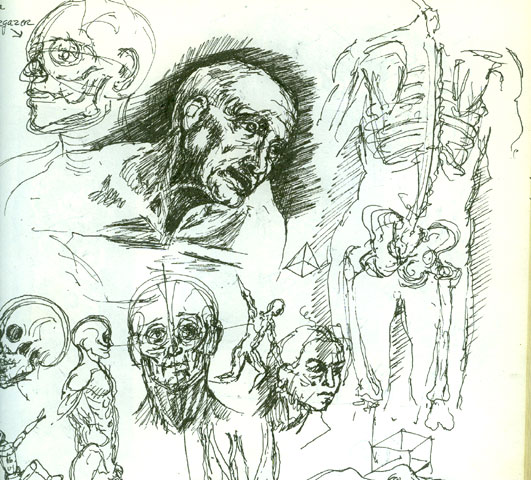
In 1979 I was again studying Da Vinci. I write in a notebook that "I have long desired to make or find a book that contains inexhaustible treasures that can not be worn out in one lifetime. The book would embody all knowledge, art, truth. religion and science". And further "I want to learn anatomy so I can draw a human figure from any position or in any gesture". These are rather inflated statements, recalling Da Vinci's own notion of art as a key to universal insights. But putting aside the ambition of these statements, there is a point to them. Drawing anatomy in the 20th century as Da Vinci did no longer made sense. I had studied anatomy somewhat in art school as part of drawing courses, and had gone to visit corpses at the medical school. Later I had poured over anatomy books for artists and had tried to study Grey's Anatomy. In the drawings below I was trying to teach myself to draw somewhat accurate anatomical studies without using references. In the midst of this there is a drawing of Leonardo's St. Jerome painting, which is an interesting work, because though it employs accurate anatomy, it is primarily concerned with expressing emotion or ideas. That is what I was concerned with and wantd to learn how to do.
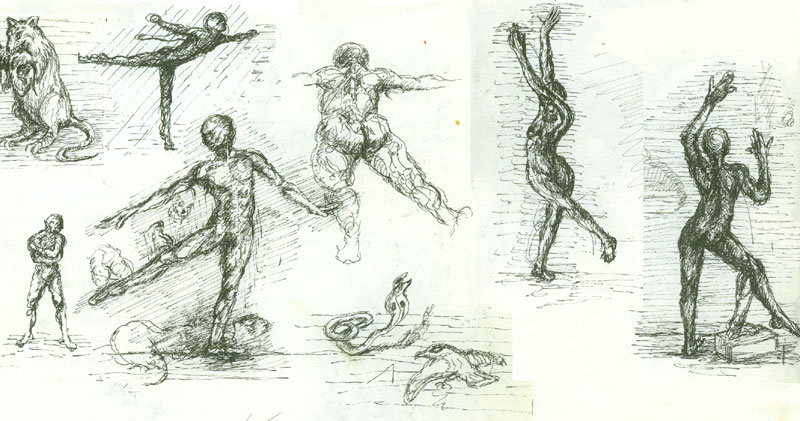
Here are some more anatomical studies that are further attempts to draw figures without using models or anatomy books.
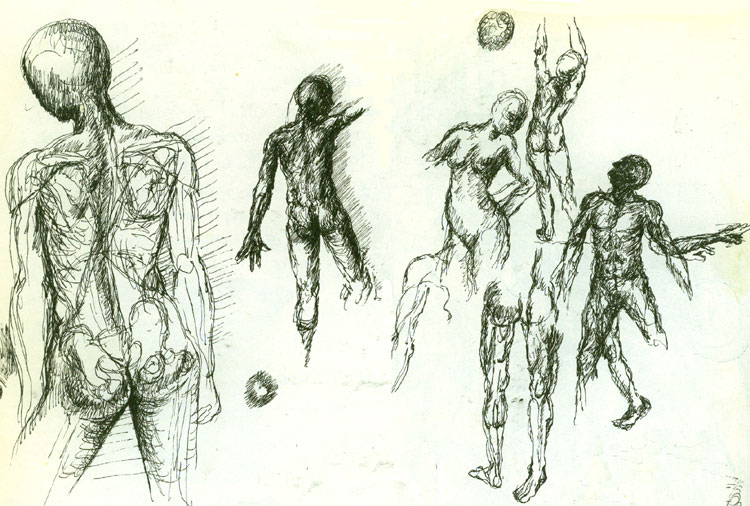
And then some more selected drawings of imagined figures. Some of these are interesting because they are partly studies of dancers. But then there is a very heavy person, hardly a dancer, who is an opposite body type of the dancers. There is also a rat eating another rodent and a snake attacking a bird
Im not sure why this image of a snake and bird comes up at this time. Some of the drawings form this period in 1979 are about oppositions and struggle. There is another series of a few drawings about a dog and a snake fighting. The drawing at the right implies the usual symbolisms of bird as purity and snake as lowly being of the earth. I think such symbolism misrepresents nature now. Animals are not symbolic of anything. They are each unique beings who live i their own world's having they own special needs and qualities. there is no hierarchy among them. The Lion is not better than the Mouse and the Eagle is not more "noble" than the Armadillo. I went though a period where allegory interested me and even wrote some allegorical poems. It was an aspect of a fascination I had with medievalism of various kinds: mystery plays, Dante, symbolism and Jung. For a time symbolic thinking offered simple answers to complex questions and thus allowed me a certain escape that seemed like freedom, but wasn't.
kl
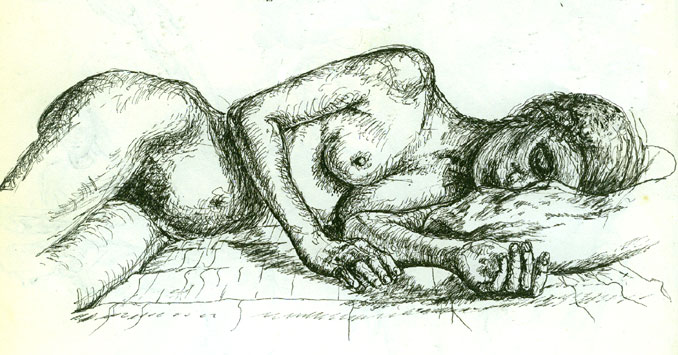
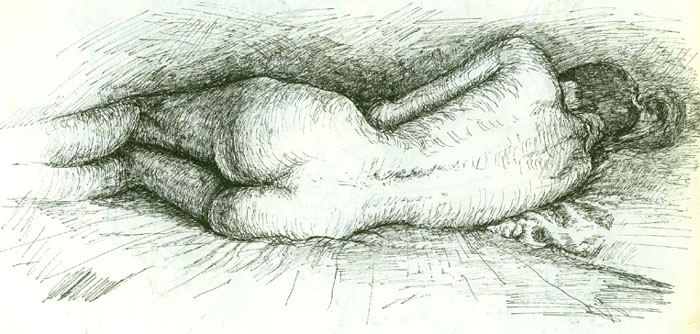
I did do some studies of figures from life as well, though I have not saved most of those. Here are a few from1979 that i think are pretty good.
But as much as I admired medical illustration as descended form Da Vinci, it was not my ambition to master anatomy to that extent.
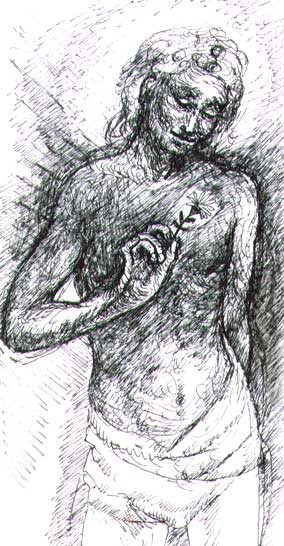
This drawing , done entirely "out of my head" is, perhaps, one of the best drawings of this period in terms of refinement and expression. It suggests perhaps some fo Da Vinci's drawings of beautiful young men. One finds many fo these in his notebooks often juxtaposed against an old man who is wrinkled and sour in appearance. This is a beautiful young man, holding a flower in a peaceful and gentle calm. He might even be slightly ecstatic. I thought this expression of a calm and silent ecstasy was a sort of pinnacle of human expression, similar to the face of the Buddha or Minoan or Greek statues which emanate a sort of beatific resolution of all life's conflicts and sorrows into a silent joy. The disciple of Buddha, Ananda, is supposed to have become enlightened holding up a flower. But Im not sure I was thinking of this, it is more likely I was thinking of Rembrandt's really lovely portrait of a woman holding a pink flower in the Metropolitan Museum, which I love deeply. Or I simply wanted to celebrate my own love of flowers once again. IN any case, I was trying to learn form these Master's how to express the deep things of my interior life, and this drawing does that.
I'm not at all sure that such quietude and beauty is what is needed in art anymore. I understand the social function of showing the suffering masses endless images of Buddha at peace, smiling as if he had overcome every hardship. But such pacification of the masses no longer seems either desirable or wise. We need to know what reality is made up of. The world will never improve by merely sitting on cushions and escaping into a Zen Peace or Hindu quietude, or for that matter the sort narcissistic beatitude that St Francis or the russian Saint Seraphim exhibited.Da Vinci's calm and lovely faces have some of this mysticism in them. But in his case the faces seem to express a less relgious and more existential mystery. The calm faces express an inner sense of being not out of discord with science. Omne finds this too in the natural mysteries that are often expressed in the corners of his paintings and throughout his notebooks.
In this period I was trying to learn how to draw the human form. My concern was to use the body as a means of expression. I wanted to be able to express nearly anything in the human form. Anatomy did not satisfy my concerns and confusions about what human beings are, or what the body is, or why death occurs. I wanted art to be able to express ideas as well as sensations and feelings. I wanted an art that could explore the world that I felt and thought about. I learned enough anatomy to be able to draw figures out of my mind with some accuracy. I was not seeking an absolute fidelity to nature however.
I needed something more than anatomy. Shortly after my studies in anatomy gave me at least a working knowledge of how the body worked and the muscles and bones were arranged, I began to distort the body in relation to expressive needs.
So for instance, the two drawings here and below, more of less self portraits, begin to voice some feeling about the human horror of the 20th century. This curious attempt to do a self-portrait occurs in the midst of my interest and studies in anatomy. I wanted to turn the obsession with anatomy taught in art schools since Da Vinci on its head. I wanted to know how to anatomize and question those who need to cut up the world for their power and profit.
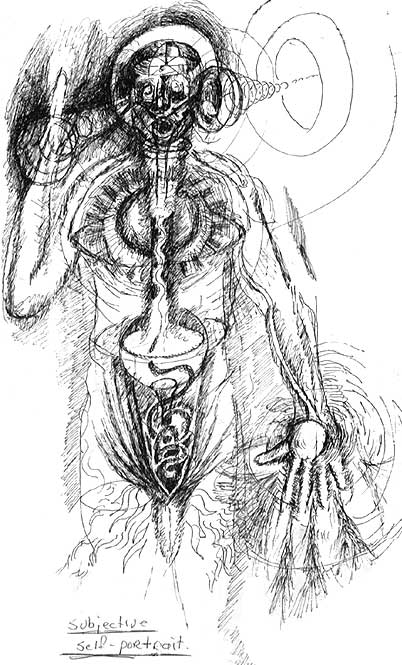
My concern with anatomy was not about anatomy, but rather about a wish to extend my range of expression as far as I could go. This self portrait assumes anatomical knowledge only so that it can negate the concern. I did not look in a mirror or copy a photograph. Instead I tried to draw what I felt like from the inside of myself. I called it "subjective self-portrait". It is a subjective anatomy. The drawing resembles some of Da Vinci's anatomical drawings, which I was then studying, But it is Da Vinci inside out, or Leonardo in reverse. The drawing completely turns its back on purely retinal vision and tries to look with the organ of human feelings at the inside of a man's conception of himself. It tries to picture subjective anatomy. So, for instance, the hand shows feeling of itself extended in space and it glows with an inner life of blood flowing. It the warm feeling of creative extension--- the wish to move and manipulate and hold. The sexual area is fiery, rhythmic and undulating. The heart is like a sun or sunflower glowing. The mind is geometric and the feelings glow in the stomach area like a warm globe. The ears describe the feeling of spatial extension and radiation from a distance, as well as the ability to concentrate and direct ones attention.
Subjective Self PortraitThere are a number of drawingsin in this style in 1979 and then this more highly shaded style disappears for a few years. One of the other drawings from the same time is the following, which also expresses something of the horror of the 20th century.
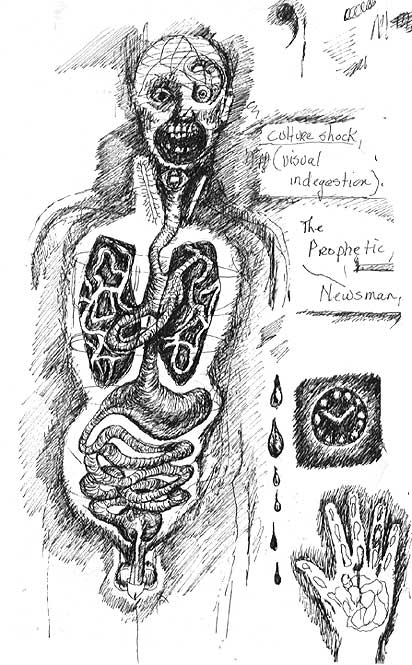
It is not a self portrait, though I suppose it could be. It is a satirical drawing, or rather a drawing done with black humor. It is called the "Prophetic Newsman", and it tries to show what horrific visions and feelings anyone who is trying to be truly objective about the 20th century might see or feel. The Newsman can see the inner suffering of others deeply, and feel their suffering in his flesh. I suppose on some level I am creating an image of cynical humor about the atrocities that our media systems allows or neglects to report. The daily horror of the world under capitalist systems of inequality and racism. There is little news that reports on the atrocious psychological numbness of the national news in America. Newsmen on the major TV channels seem like Dorian Grey hypocrites, mouthing lies to sell advertising, reporting "balanced" news that always balances in favor of elite interests and against the interests of those who are poor and in real need.
Of course Allen Ginsberg sometimes embodied a dark prophetic vision of the 20th century, as exampled in the Moloch section of his great poem Howl. Other poets and artists tried this too, as in Rimbaud's Season in Hell or some of Jack Hirschman's Arcanes.. Among artists the horrific but disturbingly beautiful works of Francis Bacon come to mind. But in the end, what was I trying to say with this image of a newsman who appears to have been dissected by Da Vinci? I'm not sure, exactly, except to say it is an image of fear about where we are going as a culture and how hard it is to report the truth in such a corrupt world. But at the same time, the drawing is a satire to some degree of the cultural reporter as victim. It is a satire of the whole notion of the "prophet" who claims to represent everyone, but who is actually far from perfect. I will talk about the poet as Prophet in the chapter of the young philosopher-poet.It is already twenty years and more ago that I did these drawings. Those days are long gone, and there would be no interest now, or at least no ability to reproduce them for others, if it were not for the fact that I left so many archives and reports of what I was thinking and feeling. I was living out the theatre of my mind on paper. And it was a theatre: not exactly a theatre of cruelty as Antonin Artaud called the modern world. But it was a cruel world I was reflecting in which I sought to create a theatre of surreal joys and gentle sorrows. On some level too I was trying to create a world I did not live in, a world that was better than the world I did live in. I did not then know it, but I was seeking an end to apocalyptic thinking. I was seeking a way to sustain the world, not destroy it for some religious, Marxist or capitalistic mania.
There are writings from that period that show that I had not just gone into the mentality of other times and cultures like an anthropologist, I had, in some ways, become the person who lives in the mentality of those cultures. I had occasionally managed to cross the boundary between mere study and actual being and identification, and in some important respects, I left the culture that I grew up in and adopted various mentalities. At one point my writings try to enter the mentality of a homeless man, a schizophrenic living on the streets of New York City. At another point I wrote as an Indian ignored by the people who stole his land. For a timeI entered the mentality of a medieval Christian Irish poet or a Persian poet and rug weaver, singing songs to his absent love. No doubt there were "orientalist" tendencies in my view of the world in those days. No doubt I was a romantic, a "natural supernaturalist" as M.H. Abrams called the romantic poets . I eventually outgrew this gnostic romanticism of my youth. But I have tried my hardest not to abandon the caring and humanity that was the basis of it. My search was ardent and inspired by both the desire to understand the world I was born into and the desire to help those harmed by it if I could. Ultimately I gave up trying to be someone form another culture or another time. I only want to be myself and live in the world where I live. But I had a long way ot go to reach this beginning of acceptance of myself.
I was trying to confront the age of atomic weapons and the greed of genetic and computer industry with a simple human heart. How could I have done otherwise but to have made many mistakes. I came across a passage that I wrote in June 1980 that expresses something of what I was facing. I wrote, ""It is possible that if I cannot answer the desperate demands of these questionable times then the only possibility open to me is to abandon myself to the divine and transcendental. This would amount to a defeat of all the aims of man since the Renaissance and the Enlightenment. This [would mean] that our understanding of religion, art, science and technology have all failed. If this failure of culture is true, as it seems to be, only two things can help us. One is the intervention of the divine, and the other is a complete reordering of world culture. Both these alternatives may be the same at bottom. The fear of the atom bomb and the longing for the transcendent should be thought of as inspired and expired in the same breath."
This is a complex statement, misguided in several ways. I was sometimes as much in doubt about religion as I was about science. I did not want to "abandon myself to the divine". I knew that would be a defeat. And it was a huge defeat when I did finally explore religion. I suspected that the transcendental was somehow closely connected with the atom bomb. But I was only beginning to dimly understand that the religions became as questionable as science after Hiroshima. All powers, power as knowledge, become questionable after Hiroshima and Nagasaki. Yet I also was able to recognize that something essential about the enlightenment project had failed, a fact that, as I later learned, even the great Noam Chomsky was unwilling to face. I spoke with him about this issue and he could not see outside the box of human centered rationalism. Chomsky is right that we cannot abandon important aspects of the Enlightenment, such as the need of reason and evidence, the importance of rights, and the search for scientific truth outside institutional control. But while the Enlightenment produced wondrous things such as the concern with human rights and concern with nature, it also produced harmful conquests, oppressions as well as degradations of the world environment, and some of these harms derive from science. This has to be faced. We need a science that protects nature's rights and does not harm human rights.
But the central question remains: how was I or anyone else to face the injustice or powers and systems of knowledge, the threat of atomic weapons and the environmental rape of the earth? How could I face the injustice of religions, governments, politics, science and business retain some faith in the worth of being human? How was I to understand the violations of nature's and human rights due to Islam, Christianity, Buddhism, science, communism and many other ideological powers? I did not yet understand, as I do now, that this intuition concerning the need to be radically skeptical of both religion and science and any other system of power, knowledge and social control is essential if the earth is to survive. It took me many years to understand that it was not an either/or question of religion versus science, or Marxism verses capitalism: it was a question of the nature of power and knowledge themselves and their relationship to injustice. The powers and authorities that prolong harms and create injustices must be questioned, changed or remade in the name of human and nature's rights.
The passage above defines alternatives, and I pursued in my own life these alternatives after 1980. The "divine" failed to give me realistic answers the questions posed by the times we live in. Indeed, the "divine" is a part of the problem. I realized this in a symbolic way in the Philosophical Drawings, but was unable to draw all the conclusions. I did not yet have enough experience. Thus the Philosophical Drawings can be seen as a sort of bed of pre-philosophic insight. They are about the realm of things that pre-exists formal ideas. I was trying to draw basic intuitions and feelings, as well as the realm of actual beings and how they interact with actual beings in real situations. I wanted to draw ideas as they are lived, not just as they are thought.
In the above quote I state that there are two options: one is "the intervention of the divine" and the other is "the complete reordering of world culture". I am quite sure now that the divine offers no realistic way of dealing with the world in its current condition. The notion of the "divine" needs to be deconstructed: it is merely a projection of various social, emotional, political or intellectual motives. There is no "divine" there is only culture and nature. That leaves the need to question and advocate for a change in "world culture". A "complete reordering" is not what we need. No more apocalypses. The true answer to the dilemma I posed myself all those years ago was the very lonely and harder answer that requires that I actually change how I think and live in the world. Much or my work since 1992 has had to do with reexamining everything I thought I once knew. If I have a philosophy now, it might be called the philosophy of fragility and fallibility, the right of questioning things that might appear certain. Perhaps the main tenet of this philosophy is a belief in the fragility of beings and ecologies. I do not know where else to stand but beside those that are lost. I stand with those who do not belong to 'great' powers, 'great' institutions, "Big Science" or the "world religions". I have seen the real face of power and know it to be a false face hiding corruption and harm. What matters least on earth is powerful men, the rich, the pretentious, inflated intellects that put everyone else down. Most of the beings on earth are with me in not endorsing or belonging to these powers.. Increasingly I stand beside humming birds and the homeless and elders cast aside by this society---- I stand among the women and dogs, with blacks and red men, with homosexuals, crazy poets, women, Aids victims, anyone who is thought of as lesser. What matters is rare flowers and monkeys in the jungle, insects, and a woman's tender kiss of a child's hand.
In the 1980's I was living on fire and in some opposition to my own culture, trying to make desperate sense of a world seemingly bent on destruction of itself. These drawings are about a small man trying to confront fear of powers and ideologies that are far beyond him, but which he knows are doing harm. I was seeking certainties and security in a world that appears to have destroyed the possibility of both. I go back into these notebooks, thousands of pages of text and drawings, with some fear and trepidation, the mentality of my current state of mind is so different. I scarcely know myself then, yet, at the same time, I remember almost everything, and in some ways, I feel like Gulliver returned from the land of the Lilliputians, or better, I feel like Krapp in Beckett's Krapp's last tape. In that play an older man confronts tapes of himself he made 30 years earlier, and he is at once drawn to the idealism of his youth and embarrassed by himself at an earlier age. But I am not Gulliver, and not Krapp. Not that I am so much better now. Indeed, as one ages much is lost, ones youth is gone, one's face begins to sag, my teeth are bad, many of those I loved have died or moved away. Old age is about losing. So this aging, fallible person I am now looks back at the young rather foolish and idealistic person I was then. I find that I both love, fear and do not know who I was then. I became a different person. I wore a different mask then and the mask became part of my face. It was painful to take off the mask, which I did, some years ago, and now I look back and see who I was then with a certain amount of shock and embarrassment, but also love and sympathy.
It is the magic and madness of poetry that it is able to enter into other worlds, other minds, other cultures in the imagination. Art has the magic of being able to render even oneself as another, at once an alien and beloved stranger. I have changed, like a molted butterfly, and it is hard to look back at the shell or skin that was my caterpillar. But there are redeeming features in what I was doing, and it is worth saving, if for no other reason, then as a record of the organic changes that my being underwent, a view of a torn and conflicted world and a mind and heart starving and suffering in the midst of it. I was willing to live free of the schools, free of power, and think outside the drive for money and power. There is something of value in that uncertain, precarious freedom, that wish to be among the outsiders, walking with the unheard and living with the marginal.
There is something frightening in the imagination. William Blake called it a "tiger, tiger, burning bright, in the forest of the night", and that is accurate. There is something wild and untamable in the imagination. Nature is imagination. Ones own mind is a fearful thing, and I am full of apprehension going back into this time when I did these drawings. It is a cave of secrets I have kept closed for along time, another world I knew once and have tried to forget, an Amazon of my own imagination that I descend the river of..........
Poet Lost and Seeking Across the Sea of Modernity
(detail)
Was it was all a dream of living in a world that mattered? Was it a dream of wanting to make the world less broken, less consumed with consumption. I made up a poetry-world that was my own religion, an aesthetic dream of colorful Byzantine mosaics and Sung dynasty mists. I had been doing it for years already. I dreamed up my own philosophical wedding cake made for my marriage with the invisible. It was a luminous mirage of hopes and beloved images. It was a mirage of a marriage, a marriage that never happened, and that was mostly in my head, a delusion born of loneliness and an ardent heart, a longing for a completeness and peace that is simply not real, because it depends on the denial of the actual. Like many poets and artists, thinkers and monks before me, I created a beautiful lie, and then I tried to live in it. The lie collapsed. The garden of lies died of disbelief. I wrongly came to believe that the world does not matter, as various mystics thought. And now, what do I have from it except notebooks and drawings left behind me, like maps of a failed explorer, a man who never got where he hoped, a sign post that days, 'do not go this way'. A house falling down. All my books exposed to the rain. Is that all there was?
No, that is not accurate. I am not indulging and a hopeless cynicism or self-pity here. It was an adventure of the mind that I learned from. I have not forgotten all the beauty of it. I am a new kind of existentialist who loves reality. I have climbed out of the fear and trembling, dread, angst and nausea that concerned Sartre and others. I admit my failures, but I am not looking to make a principle out of them.. I remember that I was seeking the truth, and part of such a search is the willingness to admit one made mistakes. I made mistakes and lived to tell about them. That is something. Let me not disparage the past so much. I am not totally other than who I was then. In any case, I am here going to try to tell the story of the Philosophical Drawings. I will begin talking about the book itself and how it came into existence.
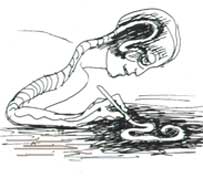
Writing with Light
About the Book Itself: Drawing Style, Origins, Veils and Characters
Is it crazy, immodestly egotistic, conceited or vain to write a scholarly study about one's own work? Perhaps, some will say. But it is time to stand up and tell the truth about my life. These drawings have no relation to the art world at all. Indeed, R.B. Kitaj siad that''When the artist deviates and drifts away from the abstract formal terms of the actual picture itself -- its purely visual aspect -- to any great extent, he's going to be vilified, which I have been.
I knew this years ago and never tried to appeal to the art world at all. I could see that self referential art work was a metaphor for corporate culture. Art was rendered meaningless to reflect the aridity of corporate control and money over our lives. Andy Warhol or Richard Serra are the ideal artists because their work says nothing other than its own materiality or reflection of media and corporate culture. I was making images saturated in content that did not refer to their own materials at all. So I was accepting of my status and marginal or even invisible artist, at elast, as much as I could manage to be.
But writing my own criticism about my work, by what right am I doing that? Well, it is hardly an enterprise that is easy or likely to get me on the cover of People Magazine. On the contrary. Never mind the critics; "nagging shadows" as Neruda called them. Whoever might wish to accuse me of immodesty or conceit has not walked in my shoes. The truth is: it is hard to look at myself this closely, hard to be my own critic, hard to look at my younger self with a clear eye. This level of self criticism is only possible now that I am much older and have gone though years of suffering. It is painful to try to tell the truth about oneself. It is not about a literary show off, falling in love with how much I know of have read. It is more like a excavation of a cave I lived in for twenty years and have finally gotten out of. I has been hard to write this book. The fact is that there are many things about these drawings that I am unclear about myself, and writing about them helps me to clarify aspects of my past. It was a journey to draw them and a different, harder journey now to write about them.
It is true I was a desperate young man, looking for ultimate answers perhaps because I was not strong enough to deal with some of life's very difficult and unavoidable facts. My father died when I was very young and was not a great role model in any case, though there were wrose fathers than he. I had only my own mind and heart, such as they were, and what teachers I could find. What way I could find in the world was always precarious, and my one anchor and security has always been my art and my studies, buffeting me against many of life's hardships and leading me beside the still waters of my own being. I mean the still waters of reality, real still waters, not the other, mythical Psalm 23 waters mentioned at funerals. I make this book because I owe it to myself, and I owe it to other weary and poor wayfarers. I want share the bread I have gathered, and give what little clear water I have for others to drink. Not spiritual waters, but celebration of real waters, not non-existent mystical bread, but care for the actual world of which bread is one part. There are secret vales of wildflowers and hidden springs in these drawings, if you will come and look. I only offer a small cup, but you just might have an insight about your own nature or see a vision of nature itself, at the bottom of the cup.
I have always been an autobiographical artist, to some degree. Suffering from the chronic loneliness and disconnected alienation that visits most American intellectuals and artists, I am in a unique position to assess work that hardly anyone has ever seen and which I alone, very likely, know anything about. Indeed, given my rather weak heart, I might well die one day soon and no one can talk about these drawings but me. I have spent most of my life writing and creating in a vacuum. I have shelves of books I wrote no one has ever read. I have some respect for a voice that arises out of the emptiness created by the oppressive market place of corporate culture. I am proud to not be part of that culture and to have lived a life largely in opposition to it. One accepts the loneliness and poverty that art brings as best one can. After all I have some respect for myself and though I have created extensive works in a vacuum, I have established close relations to the intimately human and natural worlds. I have some pride in being famous among ducks and geese, chipmunks, raccoons and deer as well as nursing home residents, where I have spent much of my time these last 5 years, and children's playgrounds, where I bring my daughter.
I confess a certain tender love for these not-always-easy-to-understand drawings. There is nothing that gives a writer more cause to write than being able to write about something that is loved. I must say, moreover, that the challenge of writing about myself as if I were someone else, or as an object of interest other than who I am now, is an irresistible challenge. At least I will not be writing ambiguously ironic chapters like Nietzsche did in his Ecce Homo such as "Why am I so Great", or "Why I am so Wise". I am not great and what little wisdom I might have is probably of more recent origin than these drawings. Nevertheless there is light and breath and life in a few of these drawings, of that I am sure, and moreover, there is scope, the aroundness of things curious and involving and far distant things brought nearer.Someone could say, perhaps I should say, these drawings express tensions, conflicts and anxieties that border perhaps on mental illness, my own illness no doubt, though not necessarily just my mental illness. But they are also quite sane, evenly lovingly sane, like a best friend is sane and good and cares about you. I was never particularly crazy, though I had some sticky moments, but I did have some long conversations with a psychiatrist more than once. One of the psychiatrists I spoke with was interested in putting rats in mazes and driving the rats insane to study their developing psychosis. He thought I was strange because I was quoting Keats that "truth is beauty and beauty is truth". He thought torturing rats was not strange at all. Someone who tortures animals to impress his colleagues and get a paper is a scientific journal is the one who is truly insane. More accurately, this psychiatrist was a symptom of an insanity in our society that harms nature and exalts sadistic powers. As Allen Ginsberg said "I have seen the best minds of my generation" go a little mad, or at least strain with passion after a truth that is derided and ignored by those in power. I know what it means to stand against the wall of power, to be pointed at with a gun or a finger of hate. I know what hatred and prejudice is, having stood against it more than once. I want nothing but to live to tell of the lives of the poor and the ordinary, my own life included. The art world of recent years in New York and elsewhere, has reflected the increasingly economic inequality of social relations. Some of the art coming out of New York has a flavor or the Louis the 14th period, for instance: it reminds me of ignorant and arrogant wealth of Marie Antoinette. There is a real attempt to propagandize for inequality as a norm. This is the opposite of what these drawings are about. These are drawings of searching, trying to find a way out of the madness.. I am not really interested in art for art's sake, or art form power's sake. I am interested in art being a medium for learning and knowing, science and sympathy
Yes, a lot of art in the last century evokes madness. Nothing new in that. But the madness that inspired some of these drawings was to some degree outside me, in the cafes of San Francisco or the streets of New York, . Whose mental illness was I expressing? In some cases the illness may have been mine, certainly the circumstances of my life have put me over the edge of rationality more than once, but in most cases I was expressing aspects of a distempered and agonized culture that killed 3-4 million people in Vietnam: the madness of a time of mass-killing in Iran and El Salvador, a time of American crimes committed against Nicaragua, a time of grave nuclear threats and proliferating technologies that increasingly served the rich who exploited and abused the poor. I was interested in reflecting on the history of and finding ways to restore a self destructive culture. Some of these drawing are about violence and fear and the abuse of humans against each other. Some of them are hard to look at, some will shock some people. But they try to tell the truth,. however this truth might be distorted by my own shortcomings. But it should be understood that these drawings are drawings of protest, attempts to hold a mirror up to the nightmare of the times and to find a way out of the madness.
The Invading World Cannot Unwrite the Book of Struggle
But it must be said that the majority of drawings are not about horror but a love of beauty. The drawing above, for instance, done in New York City, expresses the idea that the artist must listen to those who are poor and who suffer. The artist is writing from the depths of his heart, despite the threats that surround him and the people who want to attack or harm him. It is the nature of power to hate those with a conscience and a real love of truth and beauty. The artist must ignore or resist the malicious attempts of the powerful to destroy work done for good and just reasons, in service of those in need or oppressed. On the other hand, there is this drawing which I discuss at more length in the chapter about my friend Cody Maher....
Accused by his Own Creations
The artist not only struggles with the world outside him or herself. The world within myself also poses dangers. As I have learned, no one is perfect, or even close to perfect and one makes mistakes, writes things one regrets, does paintings or drawing that mislead. Passions lead one astray, one says or does something regrettable, or as I have done, one tries out belief systems which return to haunt one with the beautiful lies one once endorsed. Some of my creations accuse me, turn on me, reproach me for stupidity or failed insight. Sometimes I took the wrong road, said the wrong thing, allied myself with the wrong person, trusted a fraud, gave myself to a liar, hung my hopes on a hopeless dream, loved someone who did not love me. I was human.
But there is not just my own awareness of the weaknesses in some of my works, the works get misinterpreted, maligned or are misunderstood, used for the wrong reasons, or used by enemies to distort, slander and abuse. There is also the fact that often what one creates shows one to be better than one is, or worse, and then one must deal with the consequences. I have created some dumb things in my life, as well as beautiful ones and I'm responsible for the mistakes as well and the beauty. Having an art is like having children: one does not know how they will turn out: but at a certain point one must let them go off on their own.
Facts about the Drawings Themselves
So, to consider some of the facts about these drawings.
The Philosophical Drawings are spread through a series of 10 or more large notebooks, some of which also house essays, reflections, notes and poems both short and long. Not all of the drawings in these books are part of the Philosophical Drawings. I put together two other books of drawings called the Saint and the Blindman and Mother and Child, both from 1981.
The Saint and the Blindman book contains 198 drawings and an introduction. It has ten chapters, such as
"Pregnancy, Creativity and Birth",
"Man Woman and Child",
"Hymn to Women"
"Suffering"
"Mountains and Rivers",
"The Veils",
"Waters and Oceans"
"Epiphanies and Ecstasies" and others.
Each chapter is organized around "intuitive clusters of meanings", I say in the introduction. So for instance the chapter called "Waters and Oceans" is organized around such clustered means as"water pages and water songs--- water thoughts and burning water--- the ocean of being---water births and water deaths--- the face and the faceless--- appearance and disappearance--dying in the sea---the unbodied ecstasy---"
The books as a whole is mystical and and the arrangement is poetic as meant of create intuitive suggestions and meanings between the drawings.
The Mother and Child books was done for my sister upon the birth of a niece. She didn't like the book and gave it back to me. It has perhaps 50 drawings. There is also a collection of drawings I did in conjunction with William Cody Maher in 1979, because Cody wanted me to illustrate some poems he put together. There are somewhere between 50 and 100 drawings in that collection. The particular arrangement of the drawings in these books are interesting and reflects what I believed were some the main themes of the drawings in 1981. Those works of are of interest as far as my personal history is concerned. But they were a kind of trail attempt, and represent a certain point of view about the drawings that was current in 1979 or 1981, long before the cycle of the drawings had come to an end. The idea of the Philosophical Drawings came later than these other books, and in some ways subsumed or supplanted all the other books. I put together an unfinished book of Philosophical Drawings in between 1981 and 84. In this book there are 73 philosophical drawings. But this is hardly the whole book, indeed, it is just a fraction of it. I didn't stop doing Philosophical Drawings until 1987 and some of the more 'spiritual' work I did between 87 and 91 can be considered an extension of the Philosophical Drawings. In sum, the drawings in my notebooks, which go from 1979 until 1987, are all more or less studies for the Philosophical Drawings.
I don't agree with the idea that these drawings have some srot of intergrity based on the time in which they were produced. The early collections of these drawings, Saint and the Blind Man, the Mother and Child and the drawing with Cody Maher, as well as the first collection of Philosophical Drawings are not at all an accurate reflection of what the Philosophical Drawings are. All these works seem incomplete and dated to me now. These books do not have the scope or depth of the Philosophical Drawings, nor are they able to see the shortcomings or amplitude of the complete set .
Certainly all the drawings are part of the development. I put these collections together before I finished the whole series and before I had a real idea of what the series was about. The selection I am making here is also not the only possible selection, but it is a selection that takes into account the whole scope of the drawings from 1979 to 1987 and further up to 1991. It also reflects on some of the changes I have undergone since I did these drawings. What I present here is a view of these drawings that I would not have been capable of 20 years ago. But it is also, for that reason, not a point of view that is in agreement with some of the purposes of the drawings when I did them. I am revising my own history to some extent. I have a right to do that. I have grown since I did these drawings and my current view of them is much deeper and richer than I was capable of in 1987, when I did the last of them.
So, what I refer to when I call these drawings the Philosophical Drawings is all of the drawings I did between 1979 and 1991 including those that were part of the Saint and The Blindman and the Mother and Child, as well as drawing with Cody . The Philosophical Drawings thus consists of some 1500 drawings, some finished, some less 'finished', some merely sketches, some of which of which I include here. Some of the drawings are quite small, same are larger and more detailed. None of them are larger than 10x12 inches. The current arrangement of the Philosophical Drawings contains less than half of the drawings, 700 or more. I include over 100 of the drawings in a selected catalogue at the end of hits book so that the viewer can see the drawings without my commentary.. Other drawings not in the catalogue can be seen in the text of this book. But in any case, I will not be placing all the drawings in this book, just the ones I think are important to my purposes here. But I am including a substantial number of drawings that I think are worth preserving.
In addition, there are various attempts to do the Philosophical Drawings in color. Some of these attempts resulted in finished works, and I have a chapter here devoted to some of these works. Some of these paintings are collected in the chapter called Paintings in color, as well as the Emperor's New Clothes, which includes various iconic style works I did between 1983 and 1991. There are also a few sculptures that I envisioned that are part of this series. I may include a small chapter with some of these in it.
Origins of the Style
The style of the Philsophcial Drawings, aesthetically speaking, is fairly uniform, though with some exceptions as I will explain. For the most part I used a pen that had a metrically sized nib that created a line of consistent thickness. I used better papers for some of the more complex drawings. I liked doing the drawings in notebooks and went all over looking for notebooks that had better quality papers. I found some such notebooks in Paris, London and New York. The drawings were intended from the beginning to be part of a book format and not to hang on a wall, though sometimes I hung copies of them on walls.
The style began partly out of doodling, going back to my early youth, and my style was already one of an undulating or rhythmical line, and a fascination with spirals and involutions. If there is one thing that characterizes the majority of the Philosophical Drawings it is a creative play of geometrical and spiral forms, patterned in both organic and mathematical permutations, almost like a visual music.
By the time of my teens I was drawing often and my style was largely expressionistic, akin perhaps to Van Gogh and Kathe Kollowitz and influenced by Da Vinci and Goya, all of whom I loved. The drawings of Kollowitz were an important influence in my teens. Van Gogh was an early friend, whose letters helped sustain me. I loved him deeply and still do. The interplay of his letters and paintings fascinated me. The drawings of Van Gogh are quite amazing, especially those done in Arles and Auvres. In the nearly aboriginal style of Van Gogh I found the undulating patterns or spirals and flames that could express the substance of nature and life. I had done drawings in a similar undulating style before I looked at Van Gogh. Van Gogh himself derived important aspects of this style from Japan and China. I would learn more of this dynamic "animistic" or so called "animal style" from India and ancient arts from Persia to Crete, Ireland and indigenous cultures from Hopi petroglyphs to the Maori. I was using linear and undulating lines in my drawings as far back as 1972. Da Vinci also often drew in an undulating line, or in spirals and sinuous lines. I believed as I was doing some of these drawings taht I had found a universal style.
My natural inclinations were disrupted or altered by art school. But after few years of being on my own I returned to myself and began doing drawing "out of my head", in 1977. These often had an automatic tendency somewhat like surrealism, but with a more expressionistic and conceptual tendency. The drawings of 1977 and 78 already have a veil like feeling. For instance here is a drawing from 1977, entirely abstract, which moves between letter form and organic forms without blinking.
At the time I called these drawing organic drawings. There is some truth to that designation. They are images that suggest fire, worms, seashells, sperm, mathematical forms, DNA, musical notions, clouds and much else. Another drawing form the same time is surrounded by a dark border dn suggests cellular activity, or a sort of organic encrustation. This particular drawing reminds me of some of Jean Dubuffet and the Art Brut movement he started
The Philosophical Drawings are sometimes unpremeditated, even unconscious works that explore my own psychological response to the world. Other drawings are quite conscious, and were worked up form complex sketches.
By 1979 I was influenced strongly by an early friend and teacher, Jack Hirschman, whose expressionistic work had its origins in jazz and Abstract Expressionism as well as what Jack called "Kabbala Surrealism". I loved Jack's artwork, his free and ideographic surrealism. But I was more influenced by Jack's diverse and global intellectual interests than by his drawing style. I will speak of Jack and Cody in later chapters. Here I wish to point out that Hirschman exposed me to some of the European artists of the last generation, aspects of whose graphic works intrigued me in one way or another. Rico LeBrun, Leonard Baskin, Hans Bellmer and a few drawings by Ernst Fuchs come to mind. Later, I came across a copy of Charlotte Solomon's wonderful paintings done during the period of the Jewish Holocaust. I loved their personal style and intimate honesty. Solomon's attempt to picture the her own life in paint also moved me, as did Edvard Munch's "frieze of life", which also was an attempt to picture what he thought of life as a whole.
But my earlier influences were probably more formative. I loved Rembrandt beginning in my teen years and a few or my early drawings are copies of his work. One was of Christ mocked, a theme that was of concern to me as an adolescent when I often felt shamed and shut out. I also did a variation of one of his old women which I gave to my Grandma, who apparently lost it before she died. But the influence of Rembrandt is evident not so much in the style as in the humanistic treatment of the faces and figures as well as the need to tell stories. Rembrandt's work is all about telling sad stories. In my drawings there is an acceptance of the aspect of humanity that Erasmus calls "folly" in his In Praise of Folly. Although I had watched humanistic art reach some unpalatable extremes in Performance Art, and had explored some of those extremes myself, by the time I was doing the Philosophical Drawings a less apocalyptic or visceral humanism had again come to the fore. Rembrandt's humanism is a mild appreciation of human suffering, as opposed to the anguished and gnostic violence against beings and matter that one see in Soutine's paintings of the art of Herman Neech or the apocalyptic narcissism of Odd Nerdrum. I remember seeing some of the bodily distortions in the work of the 'neo-expressionist' Francesco Clemente in the early 1990's, which reminded me of some of the things I had done a decade earlier. But I was doing something different. Yes, I was inspired to some degree by a gnostic humanism that sought to express profound alienation. That is something any creative person in the 20th century could not avoid. But I was not trying to create narcissistic displays so much as flights of feeling, a meandering line that might draw out a loving relationship to natural and human worlds endangered world by an excess of greed and organization. I would later realize that the origin of human rights has to derive from a recognition and honoring of nature's rights. One of my difficulties with a strictly humanistic or anthropocentric perspective, as I will discuss in the Chapter about my friends Cody Maher and Jack Hirschman, is that humanism without an understanding of nature easily becomes an excuse to harm nature and other humans.
But there were other influences besides the humanism of Rembrandt and Erasmus.. I was influenced by my own researches in the history of the graphic arts. Goya's graphic series, the Disparates, Disasters of War and Capricios are amazing works, perhaps unsurpassed in graphic art for their rich humanity, creative suggestiveness and their value as protests against ignorance, superstition and social cruelty. Goya is the first great artist to show the complete inanity and brutality of war. Indeed after Goya, anyone who lauds war and considers it justified is revealed as a monster.
Of course, Goya was restrained by the brutality and threats of the Spanish Inquisition, which questioned him about his art. But the enigma of his art kept Goya from being imprisoned. The Inquisition did not know what to make of it. One wonders what Goya would have said about many of the enigmatic features of his late etchings and the Black Paintings could he have explained them to us. The Black Paintings were painted the walls of his house, which was called the "House of the Deaf Man", because he lost his hearing in later years.. The dream-like late works appear to be full of acid social commentary that questions many aspects of myth, religion and culture of that time. He reminds me of Mark Twain in his ability to question superstitious ignorance. If Goya has left us some explanations it might have helped. I suspect that many of Goya's late works contain meanings different from what many ascribe to them. I know in my own case some drawings contain meanings different than what might seem to be obvious. Part of the reason for doing this book is to meditate on the various meanings as I saw the drawings then compared to how I see them now. I don't plan to explain everything. But I will explain enough that these drawings cannot be used to mean something I did not intend.
Certainly I learned from Goya, Van Gogh and Munch how to use drawings as a form of story telling. I was early interested in the use of images as a suggestive narrative and some of the drawing of my earlier teens were all gathered into a book which told a story. I was not concerned so much with literal illustration of stories as images used with text in a way that suggested wide and variable meanings across a range of analogies, rather like music. I later made other books of my art, "book-art"-- as it was later called. The Philosophical Drawings is a later version of this tendency to make collections of related art expressions arranged in a loose narrative and poetic fashion.
Further, I was fortunate to see the actual Deluge Drawings and some other late drawings of Da Vinci in New York in 1980 or 81. I had been studying the notebooks of Leonardo since I was 15, and to see the actual works taught me a great deal about drawing. I recall understanding some basic things about form and formlessness after seeing Da Vinci's drawings. Moreover, I learned from Da Vinci that art was not just surface decoration but that it could also be employed to seek out and depict knowledge or the search for sympathetic and adequate understanding. The influence of Da Vinci on me was profound. He taught me tht art can be used to as a store of much of what one has come to know in life. I admired his encyclopedic curiosity: is devotion to knowledge; his condemnations of war; especially after he himself had been involved in inventing war machines. Eventually I came to admire his vegetarianism. The idea of dedicating drawing to knowledge of the effort to understand the world and reflect upon it, which is central to the Philosophical Drawings, comes partly from Leonardo.
By 1979 I think I began to acquire enough skill that I could use line as a musical instrument, as a jazz-like medium for the expression of feeling. This began, somewhat crudely, as far back as '73, but I think my study of Klee in '75 furthered this understanding. Paul Klee's drawing and paintings are strongly grounded in nature and such works as his 'Botanical Theatre" among many others, explore a use of line as a means of imitating natural processes. Klee is a great poet of nature. I was influenced by him in many deep and untellable ways. His statement in his Diary that that he "lived a little closer to the heart of creation than usual, but far from close enough" inspired me for years. He talks, in his Diary ,or in his teaching notes about of taking a line for a walk.... Early drawing like this one form September1975, called Astronomy, are precursors to the Philosophical Drawings. I am not trying to draw only physical attributes of things, but rather, ideas, interests and things I want to know more about.
Besides Kollowitz, Van Gogh and Goya, Da Vinci, Rembrandt and Klee I was also influenced by or at least impressed with the the Apocalypse of Albrect Durer, an amazing series of woodblock cuts, and also a few of Durer's engravings such as his strange and fascinating "Melancholia". I had done a copy of "Melancholia" while still in my teens. One of my fascinations throughout my late teens and through my twenties was the Faust story. I read and reread, thought and rethought this myth in various versions. I tried in the end to "deconstruct" the myth. Deconstructing Faust is one of the unfinished books I wrote at the time I was doing the Philosophical Drawings. Durer's drawing of "Melancholia" also has an Faustian ambiguity about religion which I admired, and imitated to some degree. The desire for religion that ultimately fails and the seeker is forced to fall back on his or her elemental humanity. I had to find in the ruins negated life a pained affirmation of what is fragile, fallible and struggling. Or to put this less cryptically---religion and capitalism negated life, and ultimately I found a pained affirmation of life in the negation of religion and capitalism and the affirmation of nature and art. This has been part of my story.
I suppose if I had to characterize these drawings in art historical terms I would say that they were inspired by three or four different factors. First they aspire to express the concern with of knowledge. Da Vinci sought this too, though one can only see art used to express knowledge in Chinese art, in a different way. Secondly, the drawings aspire to the liveliness and emotional truthfulness of Van Gogh and Kollowitz. And they seek to express the childlike and mystical biologism of Klee. I could be said also that I was trying to draw what I thought was the ancient indigenous "animal style" of cultures raining all over the world. I believed that I was resurrecting and redefining this ancient style. But at the same time, I would say that they try to do none of these things. Each drawing tries to say its truth and suggest its meaning and ambiguities as best it can.
The linear style of drawing--- the lattice works of lines that form a kind of "veil" which characterizes most of the Philosophical Drawings developed, as I said, 1977 when I made youthful books that combine poems and drawings or prose and drawings. These works are a sort of 'book art'. I created works like the Poet's Garden which is part of a book I did called the Creation Cycle of 1978. I did a little book of nine drawings with commentary in that year that I called "The Poet's Dream: Nine Dreams of Eternity" which employ combination of Blakean surrealism with a biological mysticism in drawings that are veil-like. These drawing already contain the basic elements of what would become the Philosophical Drawings. Here is one of them. This one is about gardens:
The 9 drawings of The Poet's Dream constitute part of The Creation Cycle . Here is the cover of the Notebook in which some of these drawings occur.
It is a cellular style, midway between symbolism and biology. The Philosophical Drawings enter into another domain in a way, There is still a mystical biologism. But they became a much wider in scope than my earlier work, as well as more confident, freer, and more conscious. The Philosophical Drawings, begun in San Francisco in 1979 are sustained and deliberate style which continues till 1983, and intermittently till 1987, and finally collapses in nearly sterile iconography by 1991.
By 1980, when I moved to New York City, I developed the style of the more complex of the Philosophical Drawings out of the less complex drawings I was doing in San Francisco in 1979. The two drawing below indicate the style change, or rather the increased tendency to complexity the drawing attained after my move to New York City in 1980.
As You Were Made from Water and No One Water Page: Light breath on the Waterfall (1980)
Knows How Water Was Made (1979)
Both drawings are about the mystery or wonder of water and are about the same size. The stylistic change involves an increased density of imagery and a wider use of graphic means to indicates textures and substances.One of the drawing which excited me enormously at the time that I did and , and which I felt was a new height of my craft was this drawing. The graphic means have expanded considerably. Water, earth, rocks, clouds and fire and motion are all concise and expressive. The meaning of the drawing itself is also expanded with the newly expanded graphic elements. The spiral or animistic style has become complete. The drawing is telling a personal form of a creation story, and in fact, this drawing is a culmination of years of nature mysticism. I still think it is a marvelous drawing, and expresses something about the excitement and self-ravishment of creativity.
Allot of my early work is about creativity in one way or another, and this drawing shows a man, (me perhaps? or some primordial person?), both creating and being created out of the basic elements of earth, air, fire and water. Somehow seeks to unify the conflicts of nature into himself. I now think the drawing is marred by an anthropocentric view of nature that derives from the fact that I had not yet escaped from certain transcendentalist or Christian notions. But on the other hand there is also a notion of growth through conflict implicit in the drawing, which comes form writers I read like John Dewey, Alfred North Whitehead, Whitman or Nietzsche, as well as Lucretius, whose On the Nature of Things had impressed me. I had also read some Henri Bergson, and I imagine the mystical notions of creativity I had in my teens and early twenties resemble him in some ways. I was using ideas about creativity to spawn intellectual theories and ways of seeing the world. But in the end I abandoned these ways to thinking when I become aware that nature simply was not transcendental.
In any case, it is a fact that human beings are a result of such basic forces as earth, air, fire and water having helped to create us. This drawing was a hiatus point for me, since it both expanded my graphic means and allowed me to express some rather complex mystical or philosophic ideas at the same time. The drawing combines graphic conventions taken from both China and Da Vinci. In addition is shows something of the human pathos of creativity, the feeling of being taken out of oneself, the pain of birth, the sexual mystery whereby the human body is part of the permeable membrane of all nature.
Creation
This interest in museums goes back to my childhood, but began in earnest in my teens at the Cleveland Museum. The museum become very important to me I studied of the art of various periods in Cleveland, San Francisco. Minneapolis, London, Amsterdam and especially the Metropolitan Museum in New York. To digress for a moment about museums: I think that both museums and even more, nature, are important to humanity and learning, as well as important to creating an educated population. But, unlike nature the museum world is somewhat distorting. It distorts because it tends toward a certain upper class elitism. This is partly due to the fact that the objects preserved in museums tend to reflect those in past centuries who could afford luxuries. Most museums are prone to be prejudiced toward effete and mandarin tastes. Mostly museums are supported by wealthy and corporate individuals and they reflect their interests. They enshrine an aristocratic Platonism that I now find not just elitist, but, for the most part, distorting and false historically. Museums were born out of the caste system of Europe and tended to be repositories of the history of privilege. Museums should be reformed to reflect social histories and to be less servile to wealth. I think I was adversely influenced by some of the presuppositions implicit in museums. It took me some years to unlearn many of the things I learned in these places.
That said, there is no doubt that the museum is a marvelous place of amazing objects of all kinds. I have spent days and weeks and large parts of my early adult life wandering around the Cleveland Museum, the Met, the Tate, the British museum of the Victoria and Albert, the Modern, the De Young. The change from the simpler to the more complex style of Philosophical Drawings, like the one above, was partly the result of this study. My studies in the history of art, both in books and in museums, were done in an attempt to synthesize the simplest, stylistic, visual means to express nearly anything I wanted to. In New York, I spent large amounts of time wandering the galleries of the Metropolitan. I was trying to find a way to delineate forms in way that was simple and which would give me a vocabulary of forms that would be repeatable and which could be varied according to the needs of expression. I was consciously trying to create a universal style.
I studied Chinese graphic conventions, such as the Mustard Seed Garden manuals. This fascinating book dictates conventions of graphic means for drawing just about anything. I did not want to just imitate Chinese conventions, but to find ways to draw ideas and images that were welling up out of me. So Japanese and Chinese art conventions, Irish illuminated manuscripts, Tibetan woodcuts, anything I could find about the so called "animal style" of early cultures--- all of these studies influenced me. I traced the animal style from the Vikings to the Book of Kells, to Hindu, Scythian, and early Shang bronzes and later Chinese art. Some familiarity with the history of Chinese art came to me through the lucky chance of living in Cleveland Ohio off and on, where there is one of the best collections of eastern art in the world. But the linear animal-style that especially interested me goes all the way back to the caves of Lascaux and Altimira 30,000 B.P. There are also hints and suggestions of the animal style in so called "primitive" art, such as from Borneo, Africa or folk arts from all over the world, such as one finds in woven rug designs from Russia, Iran or Samarkand. One sees it in Maori architecture and Celtic jewelry.
There are hints of the idea of an aesthetics of the "veil" in Islamic miniatures, in the work of Sultan Muhammad for instance. My interest in oriental carpets, which I eventually learned to repair and restore, started as in interest in the aesthetic forms used in these carpets. In central American art of the Mayan and Aztec, one sees it in the facades of building or in Mayan writing, The convolutions and involutions of the letter forms or the rock faces or friezes of intertwined and serpentine or flaming figures, animals and plant forms interconnected. One sees similar forms in Hindu aesthetic conventions, in the architecture of India, where the walls are made of living rocks and the sculptures climb up the building sides like jungles and tigers and nude bodies entwine in praises of life's energy. The following drawing is itself a sort of summa of various interests and observations of Hindu art in the Metropolitan Museum in New York, combined with some of the yearning figures and overwrought, almost cellular imagery that intrigued me in those days.
The drawing above is also an example of my having adopted in imagination a world view, in this case and Hindu world view, and adapted it to my art. The part of the drawing I like the most is the pregnant woman on the right column, who reaches up toward an eagle flying. I was trying to make a sanctuary out of my aesthetic interests, studies and emotions. As I will show later in the chapter on myth and religion, I would eventually bring Hindu beliefs, such as their idea of karma, or the caste system, into question. Hinduism, like Christianity, is a system of social control whose power might have had meaning hundreds of years ago, but such meaning now are merely cultural and subjective hypertrophies. I was trying to extract the esssence of dead of dying aesthetic systems and draw them. In the drawing above I was trying to create a an architecture of elemental living forms, quoting Hindu forms, as it were. In Islamic architecture ones sees a similar veil of forms, less life like and more mathematical, woven into the mosaics and ceilings like crystal-webs of life turning and recurring. These developments and influences would later flower into my experiments in religion, whch lasted until 1991. Some of drawings of 1980, 81 and 82 become more complex under the influence of these wider cultural interests, crossing boundaries between diverse cultures.
I'm not entirely sure the increasingly dense style that develops after I moved to New York City in 1980 is an improvement over the earlier, less dense style I developed in San Francisco. The earlier drawings often have a diary-like, Haiku quality, since I was dong them everyday. They become a running commentary, however obscure, on my personal interests, intuitions and social concerns of the time. These meanings my not be obvious to others. The more complex drawings tend to lose this immediacy and are more intellectual in scope. Moreover, the increased density of some of the drawings of 1980-82 reflects my widening study of many different cultures and their arts. I suppose it was inevitable that I would be drawn to explore the art of India, China, Islam and elsewhere, since I had strong doubts and questions about the validity and virtue of capitalism. But in any case, the drawings never quite leave the personal domain. There are differences between the more dense and less dense styles, but the one style and the other are not all that different and neither is better or worse. I continued to do less complex and intellectual drawings even in the midst of doing more complex ones.
It might be useful to look at various drawing about a given subject, such as music. In the following I will show how given drawings on the subject of music became more complex over a period of time. The earlier musical drawings have a certain playful quality, like a Klee drawing or painting. But this playfulness develops into something more complex, The line is not just going for a walk but trying to weave a little symphony of life and death.
How Music Makes Space ( 1981)
An early drawing of a woman I knew who played a Chopin Prelude for me is this drawing form 1978. I did the drawing why she was playing, letting the music direct some of the lines and rhythms.
Woman Playing Chopin Prelude on the Piano
In 1979 I did some more direct and more jazz-like, improvisational drawings of music or musicians. An example of this is a drawing done at a small Jazz concert I went to with Jack Hirschman in 1979 . Those small intimate concerts allowed me to draw the faces of the musicians this closely. There are four intimate and playful portraits of some jazz musicians...
Jazz Aboriginal Parabolic
(Cecil Taylor)Some days later, I went to another concert, this time with the great jazz pianist Cecil Taylor, which I also attended with Jack. I did this drawing which resembles three or four living, electric ghost-like masks looking in the various directions of space. These are the four musicians in Cecil Taylor's band, but they are also a sort of vision I had of concentrating on the four directions of space in Africa. The drawing has an electric animism. Taylor's music had a rare suggestive power and the following drawing also comes out of listening to him. It is a sort of vision of a the what jazz is all about, a vision of millions of people with their faces enjoying the sun and enjoying life together in a world that is better than the current sad and exploited world we actually live in.
Ecstatic Violinist (Beethoven Opus #61)
Somewhere around the same time I tried to render Beethoven's extraordinarily most beautiful Violin concerto as a line drawing. An impossible task.
It is based on the actual Violin Concerto and attempts to show something of the extraordinary complexity and joy ot the spatial world Beethoven sometimes creates in his music. It does not even begin to approach the dazzling depths and heights of this concerto.These drawings were done while still in San Francisco. Their style is simpler and the concept are not as developed, or rather are less intellectualized. The next drawing, for instance, shows a man weaving the voice of his sorrows into the music of space.
I thought for a long time that the purpose of art was partly to offer some intimations of infinity or immortality. Certainly, in music, which is perhaps the most abstract of all the arts, a numerical endlessness, or a spatial notion of infinitude is relatively easy to achieve through sound.
So in the drawing "Musical Offering" there is a reaching after an infinite line, a sort of breathing out of a desire for endlessness. The figure on the left of the drawing combines his listening with the offering of the inner self of the figure on the right and the two together make a music that lifts them up into the sky, and even up into the moon or sun that hovers over them. It is a lovely and a gentle drawing, full of a winsome longing and love of music.
This drawing is later and is a kind of hymn to the watery and airy nature of music and birds. A flautist plays to a man who is waist deep in water, Te flautist plays a melody that he hears inside himself, since his ears are covered with the water, he cannot actually hear what he is playing clearly, except in his head. A bird flies above the head of the listener or more likely, it flies out of the head of the listener. The man is tense with feeling and full of inner expansiveness as he listens to the music of the waters. The music turns his mind toward freedom and he flies like a bird in the mystery of the shrouded by sunlit air. It is a drawing of longing and attainment of peace.
Japanese Flute Music
(Shakuhachi)A similar drawing is the one to the left. It is also full of longing. Longing for kind of peace, or intimacy with others. It is the kind of longing that wolves or dogs mu8st feel when they howls. coyotes are especially musical and play duets under the twilight sky.
This drawing is more realistically based, even if it does suggest a Japanese silk painting, He plays the lovely Japanese flute called the Shakuachi. It shows a Japanese man singing a song of lost love. It evokes the loneliness of a Japanese crane flying over the pine covered mountains of the coast of Japan. It could have been equally the pine covered coast of Northern California. Japanese, Indian and Middle Eastern music all influenced me during this period. I sometimes did drawings while listening to it. This drawing for instance was done to a lovely album of Japanese music called "A Bell Ringing in an Empty Sky". If one listened to that musical and played and looked at this drawing one would see the compatibility.
I never had much musical ability myself. But I love music and perhaps to make up for my shortcomings and express this love I sometimes tried picture music in artwork.In the next example, done in Paris in 1982, I was trying to imagine music as a way out of the hardship of the world, as a kind of escape from suffering and death. The drawing is more complex, even a little too freighted with possible meanings. I stayed in a bed bug infested hotel in Paris and spent time around poor Algerian shops, where other poor people went to eat. The bed bugs were really bad and I had gone to Europe not as a tourist but as someone who wanted to get over and beyond the European heritage that obsessed American artists for a few centuries.
This is a drawing that tries to escape into the sublimely invisible space that music creates as an abstract alternative to our realistic world. Of course musical space is not real space, but rather represents a subjective or abstract space in which humans can feel sensations and memories. This drawing ahs created an aesthetic space, quite other than the actual world, in which the voices of the dead are heard by the living musical artist, who translates both the sounds of the dead and the sounds of nature into a invisible harmonies. The style is in accord with the later Philosophical Drawings, employing linear convolutions meant to suggest all sorts of natural forms and atmospheres. The aesthetic employed is that of the Rasa theory of music, which I would later learn more about from some students of Ali Akbar Khan and other Hindu musicians. From 1979 to 1982, I increased the complexity of the drawings, to the point where the complexity really became unmanageable. The following drawing which is more or less a self protrait as Orpheus for instance, is from 1982. It is very complex personally and mythologically and I won't discuss it here.
V A later drawing, form 83 or 84 is this one of a singer. It is no longer complex and symbolic. It returns to a refined poetic image without alot of encrusted imagery and dense meaning. The meaning is in the feeling. The woman is nude and singing,
Nothing adorns her or is to take way from the beauty of expression. She holds her hands together as r\she reaches a lovely high note, beautiful and sad at thte same time. The hands slightly separate over her head as if letting the beauty of the note flow into the air above her. Mayb eit Billie Holiday singing "In my Solitude" or maybe it is Joan Baez or Joni Mitchell or someone entirely unknown.
In any case, these various drawings show how my work changed over these years. The drawings acted as a kind of receptacle of my interests during the period I was doing them. In this case I illustrate how my work responded to various kinds of music. I am only using the example of drawings about music to illustrate the increased complexity of the work followed by a simplification..There are various drawings about architecture, or about dying, religion, language and many other subjects, some of which I will try to discuss in the book.
So then, form 1979 to 1982 the drawings become more and more complex. Most of the drawings after 1982 return to a simpler format. I did not want to sustain that level of complexity, on the one hand, and on the other, I began to grow in new directions. I started painting more in 1983 and by 1987 I gave up this style of drawing entirely and went back to painting, my first love.
But in the process of this intense period od drawing, I think I did touch on something that goes back to the artists of the Shang and the caves of Lascaux. I felt something of what inspired Da Vinci and what kept Paul Klee excited and interested in front of his evocative, poetic and tiny pictures. I remember moments of real discovery, breakthroughs and ecstasies while I did some of these drawings. I could feel the fire that went into the book of Kells or the miniature paintings of the Sufi Persian Sultan Mohammed, or the exact touch of some of Vincent's later work. The drawings enabled me to see the marvels of Rembrandt's drawings with new eyes, for instance,-- the incredible variety of his faces and figures and the Shakespearean scope of his effort to understand humanity. I am not comparing myself to these artists here, I am saying that I understood something of what they must have come to know. I learned something about creativity in nature. With the help of teachers like Van Gogh, Da Vinci, Klee and others, I had achieved a visual language in a graphic art form that I was able to use as a means of speaking about the world I live in. Art can teach invisible things, and I learned some of these things while doing these drawings.
There are invisible things in these drawings, not of "spiritual" nature, let no one claim that, but of a human and a natural mystery. I did think I was doing some kind of spiritual art, when I did them. Let me say that much. But spirituality now seems to me to be a cover for some other, human or natural, concerns and qualities. There are no 'spiritual" realities. All that is called "spiritual" is fiction. Defictionalizing spirituality, or rather deconstructing the chimeras of spirituality, is partly what my work is about these last 15 years. It is about time that art and poetry join get out of the 19th century and join the 21ast century.
One thing I am sure about is that these drawings, such as they are, are my contribution to the history of the art of drawing, however immodest that might sound. Yes, but they are also a portrayal of my philosophical searches and creative adventures. They are drawings of what lived in my heart during those years, and even after. Some of them are still part of my heart and sing the same inward songs I sing to myself now. The drawing below is about the excited and joyful feeling of having mastered a certain kind of craft. I sometimes felt such a joy during the years that I created this long cycle of images.
General Features of the Drawings
So then, to speak of the drawings in general, there are some consistent features. For instance, the drawings also have other things in common. Most of them have titles which are interactive with the image. The relation of images and words has long fascinated me. How words and images arrive and fit together in the drawings was often a mysterious process of suggestion and intuition. Many of these titles are poetic and suggestive rather than descriptive and definitive.
The drawings are mostly of naked people. This was deliberate and I remember thinking how odd or nearly impossible it would be to draw people with clothes on. The reason for this was not sexual, ---though sometimes it was--- but rather it was because I wanted my people to be individual people, qua people, not a specific kind of person. Or rather to be more precise, I wanted as many people as possible to be able to identify with the people in the drawings. I wanted people to be able to see themselves in the drawings not according to how they look in their street clothes, but according to how they feel in their hidden selves, in deeper dreams, aspirations and failures. The figures express emotions in a way that a clothed figure cannot. I recently read a biography of Samuel Beckett and he wanted the characters in his plays to represent a generalized humanity. I recognized my own purpose in Beckett's feelings about this.
The drawings do not shy away form sex, though it is not the main subject. But those who find naked images shocking, or who come from cultures like Islam where such images are forbidden, might be shocked by some of these images. For that I am sorry. Maybe my drawings are not for them. At the time I did them I thought this was somewhat avant-guard. Now the sexual imagery in the drawings seems quite tame and perhaps too idealistic and romantic.
In retrospect I think I should have done more to make the people even less racially identifiable than they are, though by and large, the people in the drawings are not meant of be of any particular race. I clearly identify sex differences, perhaps too much and too often. Often the figures do not have hair or have very generalized hair, and that is again for the reason that I wanted the drawings to be able to appeal to just about anyone: to be universal. It is important to be able to identify personally with these drawings, so suppressing differences in cultural and racial idiosyncrasies seemed important. In retrospect I think that the drawings are still unconsciously too Euro-American. But I can only say I am sorry for that. If I did them now, I would learn to draw more specifically Malaysian or aboriginal bodies and facial features
The body types that I tended to use were not ideal, indeed, quite the contrary. I certainly was not imitating Greek nudes. Nor was I imitating the supposedly perfect proportions which Durer and Da Vinci attempted to portray. I was aware of such ideals. The similar perfect bodies pictured in 'spiritual" art or commercial advertising are meant to set up an ideal and I was not interested in serving these ideals. I was drawing neither the supposedly perfect proportions of Playboy Bunnies or Christ. Ordinary people fall so far below bodily ideals that it is clear that the ideal is meant to create self-dislike, even self hatred, and this self hatred helps sell products of promote religions. Both capitalism and Christianity thrive on making people dislike themselves. The bodies of people in my drawings are almost never perfect, though there are a few beauties. But for the most part the bodies are imperfect or "humanistic", which is the term I used to describe them at the time. The people in the drawings are characters who one can love, if one wants to. They are not perfect. They are trying to get on and live in their world, imperfectly and getting stuck in parables and problems they do not always understand.
The people are often smaller than people one usually sees on the street. Part of the reason for this was that I wanted my people to be humble and sympathetic, not large, aggressive, heroic or threatening. The figures tend toward definite characters, though never in a programmatic way. I did not try to make the people look like the same people from drawing to drawing. These are not serial drawings such as one sees in comic books or cartoons. Each drawing is independently created. But there is a world that these people live in and to some degree the male and female characters could be the same people and evoke my relationships with women at the time, or recall relations with my parents or teachers or other people I knew. Here, for instance, is a poetic portrait of someone who was perhaps the mother of many of these drawings, who I will call B. Oceans. She was my companion throughout the years of these drawings and her portrait can be seen evoked in many of the women pictured in the drawings. Many of the these drawings were done with her as my only audience and sustainer. I dedicated the original book of these drawing to her, quite deservedly. She was a wonderful person, who is remembered with gratefulness and appreciation in may of these drawings.
Her Winged Antelope
From drawing to drawing the characters try to face situations and express what it like to live in those situations. There is an attempt to create a theatrical spaces inside the drawings which opens up feelings and emotions to be explored and expressed. Like a Samuel Beckett play the drawings suggest landscapes and stories. When combined together they begin to suggest tales and evoke aspects of our lives as we live them. Some of the drawings are frankly autobiographical and some are not. I don't always say if a drawing is or is not about my own life, and in any case, even with drawings that are not about my life, they are about someone's life. I suppose i could try to tell the tale of what evoked each and all those drawings in context and chronology, compared with the events of my life. But there are many things I do not remember about each drawing, and in any case, it would be impossible to tell all the stories that I do remember. The point at the time of doing these drawings was to try to synthesize my experiences. I was not trying to catalogue every moment of my life, but to make art based on my life.
In terms of stylistic matters the drawings are mostly about line. The line I am using tries to be a sort of wandering universal line-- not exactly a string theory--- but similar to that in a way--- though I had never heard of string theory in those days. In nay case, the line that wonders though all the drawings is a line that reaches from one end of the universe to another, traversing though molecular and DNA like structures out into the jungle and up into the human heart and brain. This was discussed in the 1981 introduction to some of the drawings where I asked the reader to imagine a primordial dot or point in space, at the beginning of the universe: this dot turns into a line which turns into other lines, the lines wander"....within the convoluted space of the skull. This skull belongs to a man who is thinking about what all of nature looks like. He sees how all the lines that proceed forth from the original point pass through air and sky, rock and water, falling with the waterfalls and streaming up with fire, rising with birds wings and up the sides of tree trunks, around the circle of the sun and up and over the craters of the moon, along the edge of a flower, down a woman's cheekbone, over her hip and in and around each grain of sand, tangled in each cell, squirming in every sperm, caught in every egg, through every landscape, through the eyes of a man on a mountain, circling every raindrop, in every atom, every star, every molecule, every gene, every forest, here on the earth and everywhere--- this is the Veil, this infinite expanse of vibrating strings. Each of the drawings in this books is conceived of as a veil of lines and words....
This is the basic fantasy of the Philosophical Drawings as I conceived it in 1981. I believed I was telling the story of the universe, beginning with a line, drawn out of my own heart and mind, and extending into the lives of the nature and humans. The lines made a veil which revealed meanings and feelings to those who appreciate the drawings. The drawings are about a young man who is in love with nature and creativity. It is the style of these drawings, apart from the content, with its endless jazz-like variety of creative line, that show this love of generative and creative natural processes. But there are various implied stories. The stories are not like a novel, but more a kind of searching and restlessness, a wandering in search of meaning and love, nature and purposes. As I did each drawing I tried to reach down into the depths of myself, into areas of my own mind and heart where I had never been before. Obviously no style is truly, "universal". Obviously these drawings have limitations due to my age when I did them and my particular shortcomings. But they do tell a story about searching. The meanings of the drawings are very different to me now that it was twenty years ago. They will mean something else in 10 more years. Those who enter into them will see yet other meanings, depending on who they are, where they are from and how much time they spend with them. I have been studying the drawings for over a year. The still offer new insights to me . I am not yet bored with them. This is the magic of these drawings. They continue to offer fresh meanings even after one has spent along time with them.
How the Drawings Came to an End:
The development of the style of the Philosophical Drawings has a beginning middle and end. As I explained above there are drawings that begin to use a linear and undulating lines as far back as 72. But I don't think I was consciously using this style until 78 and especially after 1979. All of the drawings in this style were done between 78 and 87 and after that the style largely disappears. Why does it stop?
It wasn't just the stylistic changes that undermined this kind of drawings. There were political and philosophic considerations as well. One could say that The Philosophical Drawings begins in an euphoric and experimental, surrealistic and biological auto-suggestiveness and creativity. Then they mature into an open minded attempt to describe my wonder and curiosity about the world in a book that records both my confusions and my attempts to transcribe the intricate rhythms of my life and the lives around me. Then the drawings, under the influence of my horror over the oppressiveness of New York City and the consequent philosophical and spiritual searches, begin to wither and die. Certainly I was fleeing from the Ronald Reagan influenced 1980's. John Lennon, a source of hope who expressed a desire for world peace had been murdered in 1980. That was a time where America's wealthy classes became more and more rapacious and selfish. Certainly I was repelled by the increasingly hysterical nuclear threats and terrors. I despised Reagan and Republican capitalism. The extremes of the times forced me into seeking extreme alternatives. The Philosophical drawings are seeking far and wide for alternative visions and other ways of seeing.
The drawings continue to be a strong and viable creative outlet up until 1984 and I continue to do a few drawings or paintings here and there until 1987. From 84 to 87 I went through a dark, hopeless and rather severe study of philosophy, both in the US and during a time that I lived in England. There are not many drawings during this period, though there are a few paintings I will discuss in the chapter on "Philosophical Drawings in Color". It was a time of depression and self questioning. But after that my philosophical and spiritual questions begin to undermine my art and my personal identity. Mostly, while in England, I was studying 20th centaury philosophy, particularly the 20th century philosophers form Dewey, Chomsky, Ayer, Wittgenstein and Feyerabend. I often though of studying with Feyerabend and even looked him up in 1986 in Berkeley. But he was gone already. I liked his last book, Killing Time, an interesting autobiographical work that tries to bring back philosophy to ordinary life. There is a remarkable picture in there of him washing dishes. I liked his Dadaistic attempt to take philosopher off the academic pedestal and make it real and actual. A philosopher should be able to wash dishes and take care of a baby.
I took a mistaken path in 1985 when I began to get more serious about studying religion. What drove me into religion was a crisis of belief in my own culture and a strong desire to explore other cultures. I wanted either to join a monastery, return to nature or abandon American and Western culture and live in another culture. I did all three at various points, though it was only nature that would hold my interest in the long term.
In 1986 I was close to being done with the Philosophical Drawings and consciously offered myself two choices. Either I would become a monk or live in he natural world. I choose the latter and moved to a tiny own next to Point Reyes National Park for three years. I continued doing a few drawings. But I largely gave up drawing and concentrated almost exclusively on nature paintings until 1989. This saved me in a way. My spiritual and philosophical questions had eliminated the Philosophical Drawings. they do continue in a certain respect in the study of iconography that i made between 1987 and 1991. But my art goes a different direction. I began painting nature in the early 1980's and this begins to flower in Point Reyes. My art was strangely untouched by the interest in religion. My art increasingly gravitated toward the love of nature, while my mind was exploring philosophy and religion. Only art in relation to nature was kept alive in me. I did a few religious icons, which are an extension of the Philosophical Drawings but this could not be sustained and this collapses in 1991. I will discuss this in the chapter called "The Emperor's New Clothes: Deconstructing Sacred Art". Traditional art is a suffocating dead end. The era of religious art is over and anything done in this vein is merely derivative fantasy, kitsch or surreal reactionary nostalgia. Or at least this is how I see it. Others I suppose, might have to find out this news on their own.
The style of the Philosophical Drawings died and fossilized into religion. More accurately it was killed by religion. The Philosophical Drawings were originally not a spiritual style, exactly, but a humanistic, biological, psychological and occasionally, a political style. By the time I gave up religion and my creativity returned slowly after 1991, it was painting and nature that I turned to and not drawing. The Philosophical Drawings were only viable so long as I was asking questions and undecided about many things, They are drawings of wonder and questing confusions, seeking understandings. They agre prone to a mythical, poetic and gnostic romanticism, which I gave up in 1991. As I look through these drawing I can see that the later drawings begin to lose their conviction. The drawings were about conflict and the search for peace and the subjectivity of a young man who was struggling to see find a way to live in a difficult world. They are the drawings of my youth and I could in no way return to doing them than I can return to the body I had when I was 25.
After years of study and searching I finally realized that my theory of art as a "Veil", while compelling, was not true to my mature understanding of the world. The theory of the Veil was not a product of traditional thinking, but I did eventually try to interpret the veil as a traditional symbol, not wrongly, since veil symbolism was used in many cultures. But it is true that for some years my art suffered from seeking into religion. This could not be helped. Art was a means of seeking my way in the world, a way of trying to find out what the world is and what is my place in it. My art led me into an out of various places and ways of thinking. Art had led me to reject the New York art world as a betrayal of aesthetic integrity. So I found myself not only divorced from the New York art world, with its high priced and esoteric banality , but I also found it necessary to reject the repressive hierarchical art theories of traditionalism, Christian and Islamic or Buddhist art and traditional cultures.
The drawings died because the approach toward religious iconography leads inevitably toward the repression of self , the loss of identity and a hatred of the world. Iconographic styles from Byzantine art to Tibetan or Buddhist Icons are essentially anti-natural. I slowly learned that traditional spirituality and nature could not be reconciled. I had to choose between them eventually, and I choose nature and left churches and "intelligible worlds" behind. In the end I rejected the ideology of Icons and so called "sacred art". Throughout the 1990's my interests gravitated toward Anti-iconic images---images that question powers instead of supporting it. The drawings were never a slavish submission to traditional art forms and conventions. It took me some years to recover from the influence of theories of traditional art. I studied Iconography from 1989-91, and painted some Icons. But the traditional conventions of so called "sacred art" lauded by Ananda Coomaraswamy and others, which I studied from 1985 to 1991, contributed substantially to destroying my creativity and to drying up the wells out of which sprang the Philosophical Drawings. It took me some years to learn that art is used by powers as a means of propaganda and the 'traditions" of "sacred art" and aesthetics were developed as a means of ideological control. I did not want my art to serve power in any way.
There are various reasons that religion is destructive to creativity. I studied the art of traditional civilizations to sufficient degree to judge that such art was primarily art for and about power, for and about powerful systems of symbols. Traditionalism is the last gasp of the major religions, which by now are much too archaic to have deep and abiding meaning in a world threatened by so many forms of power. When I abandoned the ideology of traditional cultures, I gained a much wider understanding of artistic possibilities. The anti-individualistic and totalistic theories of traditionalism undermined my creative capacities for some years. I eventually recovered, but not without having to struggle to overcome the baneful effects of this repressive and harmful ideology. I should probably observe that my involvement with traditionalism did give me some insight into the mind and attitudes of past cultures. But there was a cost to this knowledge. Traditional systems of knowledge are fundamentally anathema to notion of human rights, or the notion of nature as having value in itself, apart form any systems of symbols. Creativity cannot long be maintained in a traditional culture, which tend toward authoritarian censorship and the elimination of ego and individualism.
The Philosophical Drawings contain these developments of my approach to and eventual rejection of religion in germ form, and predict outcomes. Of course I could not see then that the drawings already indicated how I would develop and grow and what I would accept or reject. I was turning towards painting and nature more and more. The conceptual and emotional purposes that the style of the Philosophical drawings had served were no longer important to me. I changed and the style changed with me. The Philosophical Drawings disappeared with the way of thought that had helped create the style to begin with. This means that these drawings are now part of my personal history and I can look at them from some distance.
I suppose this book is a sort of reliquary or a bell jar in which a part of my past is now entombed.
It is true that what matters in life is life and that the trusting glance of an animal or child or the eyes of ones wife or husband is what really matters. But there is also the past, without which the present has no meaning. People die, animals die and live moves on. But the life that was also deserves praise, not just the life that is. We do not come from gods or ideas but from cells and Africa. I spent far too may years of my life fascinated by death and religion. Neither death not religion matter much. What matters is what exists and what can be sustained and preserved that is born of the earth in love and wonder. So I make this book as a loving embrace of my past, now that that part of it is gone. It was a good time then and I honor it with this book.
I originally called the drawing apposite "Astronomical Urn, Reliquary to Science" and think I probably meant it as a kind of humorous and nostalgic drawing about the marvelous science of yesteryear, such as the science Da Vinci practiced, before science became a means of corporate exploitation, making atom bombs or encouraging ecological or genetic abuse. But the title is probably also tongue-in-cheek. I think I really hoped then that science, at least in its many destructive aspects, would die. Not that a discipline like science could actually die, but rather that it would eventually change into something less harmful and exploitive.
I changed the title to Philosophical Drawings, because really the drawing is a self portrait of me during those years. The figure inside the jar looks up at the stars and at the same time holds a butterfly that has a human head. perhaps a babies head. There is a death's head in a mirror. It is a drawing about the entombing of wonder and in that sense is very sad. But this is a sad book I am writing, despite the joy and wonder that is expressed in these drawings. But it is also a book in praise of butterflies and wonder and stars. This book holds two of the people I have been in my life. There is the me of 25 years ago and the me now, and we are the same people, but different.
I certainly I do not wish to make a specimen of my own life. I do not mean this book as a kind of glass specimen case, or a butterfly box that butterflies are pinned in. I am opposed to treating beings as specimens.. But I must admit at the same time that I am no longer who I was and those days are gone. No one can say goodbye easily to the past or to a dear time in one's life that will be no more. It is worth preserving the past because without it those in the future learn nothing from our mistakes and cannot share our hopes and helpful ideas. Life is precious, and doing this book has reminded me of that. For that alone I am glad to have done it. But beyond that, I am proud of some of the work I did here and wish to save it and share it with others.
To put this a little differently. Earlier I mentioned my effort in this book being similar to that of Beckett in Krapp's Last Tape. That short play is about an older man looking at his past. He is largely cynical and negative about who he was and all the mistakes he made until the end of the play, when he listens to a tape of himself and is profoundly moved by who he was and grateful for his past. Writing this book I have gone through similar emotions. I made many mistakes, but in the end I recognize that there is beauty and humanity in these drawings. I am not ashamed of them. They try to tell the truth in my usual fallible and imperfect way. But beyond even the truth, they are lovely and touching and employ a linear style that is full of life and beauty.
So, to return to what I was saying and continue with my book---the linear style of drawing--- the lattice works of lines that form a kind of "veil" that characterizes the Philosophical Drawings develops between 1979 and 91. But what the "veil" was about and how I used this concept in my art, and then why I came to reject the concept is the subject of the next chapter.


Copyright © 2004-7 Mark Koslow.
All Rights Reserved.