|
;g
Nature's Rights
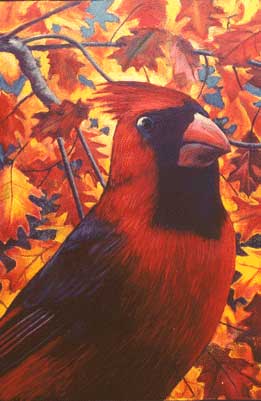
What is Nature's
Rights
"I swear there is no greatness or power that does not emulate those
of the earth,
There can be no theory of any account unless it corroborate the
theory of the earth,
No politics, song, religion, behavior, or what not, is of account,
unless it compare with the amplitude of the earth,
Unless it face the exactness, vitality, impartiality, rectitude of
the earth."
Walt Whitman, "Song of the Rolling Earth" 1851,1881
The idea of Nature's Rights
occurred to me back in the late
1990's to describe profound experiences about nature I had between
1998 and 2002 as I studied a
wetland called "Heroes Wetland". The poem about Nature's Rights (below) was written
in 2002 long before this essay ( 2007-8). This essay is an attempt to
turn my experiences into a practical understanding of Nature's Rights and
how these rights might be secured legally or politically. The purpose of
of a more aggressive seeking of rights for nature is to stop the wholesale
destruction of species, forests, oceans and climate that currently is
underway due to population pressures, the indifference of nation states
and corporate greed.
Heroes Wetland was more
than one place, in fact: it was a metaphor for any place deeply loved and
closely observed. I was absorbing how animals and birds, trees and water,
air and humans all relate to each other in communities and ecosystems. As
I began to watch the complex interactions of sun and water, seasons and
birds, I began to see deeper meanings. I did not begin to understand
nature until I spent enough time watching,
listening, smelling, touching
and hearing to take it all into myself deep enough to begin to see
a little from a Bluebird's point of view, a Raccoon's point of view, a
Goldfinch, a Heron, a tree or a turtle. One begins to see the land form
the earth's point of view. Whitman began to understand something of this
when he realized people do not have separate "souls" apart from our
bodies. We are our bodies, we are the earth. There is nothing beyond
earth, evolution and the facts of here
where we are.
When I started seeing for the non-human point of view I
began to see that that human rights,
animal rights and environmentalism are falsely and arbitrarily
separated
domains. The idea of Nature's Rights was to re-unify animal, human
and environmental rights under one concept, since they are not separate in
fact. I came to understand that the same forces and powers that cause
animal extinctions cause poverty and war. I
began to see that a human centered environmentalism is a waste of time.
The common argument one comes across some environmentalist writings is that the
Amazon or some other wild area should be preserved to benefit humans, so
we can have medicines to cure cancer, for instance.
It would of course be great to cure cancer. But Nature's Rights is not about what humans need so much as it is
about what individuals of whatever species need. It is about the right of individuals
within species to exist.
Nature's rights is not merely about species rights. Global
warming harms individual Polar Bears when it destroys the ice that the
bears live on. It is true that global warming threatens the entire Polar
bear population. But the concept of species is a taxonomic category and in
fact, we can only save individual bears, if we would save the species. The species will
survive so long as we stop killing individual bears. Cars and coal burning power plants among other sources of
pollution are that main culprits in the destruction of Polar bear, Harp
Seal, and Arctic Fox habitat. Suing corporations or states on behalf of
individual animals as well as on behalf of the biomes in which they live
in complex webs with other individuals is what Nature's Rights is about.
We must eliminate the fictitious idea of corporate personhood and
substitute in its place the real notion of the personhood lf bears,
chimps, whale dolphins and seals among others
The
concept of Nature's Rights is opposed to the ideology of property rights,
which is a human centered construction arbitrarily imposed on nature and
responsible for much of the destruction of nature. Animals, birds and fish
have need of territory too, Indeed, the idea of property is an outgrowth
of our animal nature and our genetic inheritance of the need of territory
as we mate and build communities. We do not have the right to force other
species out of their equal right to their places. Capitalism marginalizes
nature, and nature is forced to pay the unseen, unaccounted costs of capitalist
ventures. Mankind has profited at the expense of nature. It is payback
time. We need to payback what we have stolen.
Aldo Leopold's "Land Ethic" is an important idea and he hints at Nature's Rights
when he says....
When we see land as a community to
which we belong, we may begin to use it with love and respect. There is
no other way for land to survive the impact of mechanized man, nor for
us to reap from it the ethical harvest it is capable, under science, of
contributing to culture. That land is a community is the basic concept of
ecology, but that land is to be loved and respected is an extension of
ethics.
This points to the concept of
Nature's Rights. Leopold refers to the land ethic as "biotic rights".
But Leopold does not go far enough. Leopold 's Land Ethic is still
to too tame and human centered. Leopold wrote that soils, plants,
oceans and the other facts of earth are still to be controlled by humans.
"A land ethic of course cannot prevent the alteration, management,
and use of these 'resources,' but it does affirm their right to continued
existence, and, at least in spots, their continued existence in a natural
state." Leopold does not wish to
overly restrict 'resourcism", but merely preserve nature along the edges
of resource exploitation. What Leopold suggest is that
we merely save nature on the edges of the vast hegemony of private
property and the capitalist conquest of the earth. I disagree with this. Nature needs to be affirmed as having rights equal to humans,
apart from capitalism, as part of a
community of beings on earth and not merely as a sequestered 'resource'
kept alive as a relic or a threatened species relegated to reservations.
Nature's rights must apply everywhere. A forest does not exist to be owned
by humans: it also belong to squirrels,insects, fish, plants, monkeys and
whatever else has evolved in conjunction with the ecology of the region.
Nature's Rights grows out of our common genetic inheritance. Nature's
Rights begins with the effort of all being to survive. Nature's Rights is
about the effort of evolution to preserve the most lives among the most
diverse and various species. Human centeredness is anti-evolutionary and
unsustainable.
"In wildness is the preservation of the world", Thoreau wisely said.
Humans must grant the right of other species to find their own
evolutionary path, unaltered by human manipulation and genetic tinkering. My
Master's Thesis looked at violations of human rights in relation to
history. But that was 10 years ago. I am now able to recognize that history has its roots
in natural history, in the facts of evolution. Defending the rights of all
species and individuals among species is a logical extension of the
concerns of care and rights. I increasingly have turned my
attention to nature and have understood that the basis or origin of human rights,
women’s rights, and civil rights has to be found in the natural world. Even at the level of our genes we are part of
nature just as nature is part of the fabric of our existence. Preserving
nature begins with recognizing that all life is equally valuable.
There is a tendency
among left leaning intellectuals to define consciousness in exclusively
human centered terms. To seek to transform societies defining institutions
by promoting environmentally sustainable, non-racist, non sexist,
participatory and liberating outcomes is a praiseworthy goal. But what
part do animals and nature play in defining what our consciousness is?
What 'sustains' animal development and profit? How do oceans benefit from
'sustainable development'? How is consciousness supposed to be changed and
are how these transformations come about, if nature is not affirmed as the
basis of our humanity and then preserved from peril? The transformation of humanity is useless if it means
destroying nature and the earth in the process.
So how do we accord trees or deserts or
oceans rights? What about
trees, for instance? Do trees have
legal standing?— as Christopher D. Stone asked in his book
Should Trees Have
Standing? Towards Legal Rights for Natural Objects. (1971) Trees
have the right to exist in biomes where they have lived for eons. No trees
over a certain age should be cut down for instance. Clear cutting is a
violation not only of the integrity fo the forests, but it harms the earth
itself, causing erosion and spoiling of streams and rivers. It impacts all
species that live int hat forests. Humans do not
have the right to cut trees. Cutting trees needs to be
carefully controlled in view of preserving natural ecosystems, animals and
plants. The costs to individual species must be weighed in any
silvaculture calculation The fact of merely owing a piece of property should not
automatically grant anyone the right to cut trees, harm ecosystems, rare
species or upset the local balance of beings. The biology of the earth itself
depends upon the rainforests to survive and no corporation or group of
corporations can claim ownership of such forests simply by virtue of deeds
to property. 80% of the forests in Madagascar have been cut down, yet no
one has paid the cost of the damage that has been done there. Many species
of Lemur, tortoise and other species have gone extinct because of the
plunder of Madagascar's ecologies. Property rights cannot be allowed to trump nature's rights
where harm to other beings is considerable. The same is true of the oceans
rights. Current predictions are that the oceans are now at least 50-% fished to
death and will be totally over fished of commercial species by 2048--- how
do we respect the oceans rights and stop this decimation? There needs to
be intentional cooperation to stop the rape of the seas. There must be
some union of concerned people like a UN, only in this case devoted to
beings, biomes and habitats rather than to nations. Global warming is
just the most recent environmental problem to come into view—there are
many, many others…
Natures Rights do not arise from human rights but rather are the basis of
human rights. The right of diatoms of the sea far antedates the right of
people to fish in the oceans. This means that the relations of humans to nature is not one
of exploitation but of family and cooperation. This means that humans do not
have the right to cause extinctions or fundamentally violate the genetic
integrity of species, for instance. Goldfinch societies,
elephant societies, duck families, and algae and plankton in the sea are all
being with rights. We depend of them and they on us. We are not
nature's "stewards"-- that bit of Christian arrogance needs to go.
Mankind is the worst threat others species of all kinds have ever faced. it
is mankind that needs to change. Helping other species means learning about
what they say their rights are. This means to watch them as closely as
possible to learn their needs and ways. Bird’s concerns must weigh in when
we are considering how to transform society? When we build Malls with huge
parking lots, we cut down bird habitat. Someone must pay the birds for this loss of nesting sites and food. When we
build skyscrapers we kill
migrating birds? There should be means to sue developers who harm the
rights of birds or other species. BIrds deserve reparations for harms down to their
livelihood and habitats. Maybe skyscrapers should not be built and
Malls not constructed, or these designed in way that does not harm birds. The Masai tribe feel they have the right to kill rare elephants who graze on
land where Masai cattle live. But the rights of elephants certainly are
equal to that of the Masai. Just as Elephants have as much right to live as the Masai, Bison have a prior right
to land now used to grow feed corn for cattle in Nebraska, Iowa South Dakota
and Kansas. Bison
deserve reparations for the atrocity of 50 million of them murdered by
Americans in the 19th century.
More room must be made for
elephants and bison. The Masai must be prevented form killing elephants,
and a great deal of the land of the Prairie states must be returned to wild
herds of Bison. All ove rthe earth humans accord themselves the right to
steal form other species. This must be reversed by making it possible to sue
individuals or governments who harm the rights of Macaws, Sifaka Lemurs or
Redwood trees.
Nature's Rights means that humans must be restricted.
We need to redesign American "game" and "resource" agencies.
Each US state has a Division of Wildlife or Dept. of Natural Resources which
acts as agents
of hunters, who are only 5% of the population. he game agencies are
creating what amounts to killing fields of our forests and rivers. We must
end killing for pleasure as method of "scientific management". We need to replace these
agencies with Dept. of Nature's Rights, who would act as
preservers of nature's rights, representing Squirrels, songbirds, bison, as
well as trees and Armadillos. There must be someone to protect animals
and forests, oceans and deserts against those who see them merely as
resources. We need to become advocates of the non-human.
My concern with nature's rights reflected in various ways in the writings
of others. One can see the idea of Nature's Rights is implicit in Henry Thoreau's Journal,
for instance. His interest in biology combines implicitly with his concern
with social justice and civil disobedience. Chomsky observes somewhere
that his own interest in science and his interest in social justice are
closely
related, without the exact point of origin between science and justice
being obvious to him. That is because Chomsky's work in language is too
separated from his work with politics and justice. Val Plumwood's writings
explore aspects of theme as does David Niebert's Human Rights Animals
Rights. How the idea of justice has its origin in nature is only
just beginning to be visible on the far horizon of future science. Humans are not unique beings detached from
the
rest of nature, despite our tendency to abstract ourselves and thereby
declare ourselves exceptional or unique. Our use of peculiar sort of
socially constructed,
abstract use of language is one alleged source of this exceptionalism. DNA,
in fact, is a far more complex
language than what humans speak.
Nature's Rights arises from the language of
nature, and not merely from the human use of words. Chomsky writes
about the search for the origin of language that
"The answers may well lie not so much
in the theory of natural selection as in molecular biology, in the study
of what kinds of physical systems can develop under the conditions of life
on earth ..." (1988: 167). Yes. that is where language has its origin and
it is also where Nature's Rights comes from. Chimps show a remarkable
sense of justice in their behavior. They are upset by harms being done to
those they love, just as humans are.
Every species does all it can to try to survive and that purpose is the
basis of rights. Nature's Rights is about the relations of species to
large communities, the relations of all beings on earth to one another. The idea of rights is an effort to make rational
and coherent an idea that arises from the natural facts of
individuals of all species wishing to survive and care for their own kind. Species diversity
came about so that the maximum number of individuals of a species could
survive unmolested. Nature's Rights is the acceptance of this fact and the
effort to stop that which harms individuals and species of whatever kind.
Humans are now a major threat
to Nature's Rights in the same way that corporations and nation states are
a threat to human rights. The right of species to continue and survive is
obvious when one realizes that the primary threat to all species is
the selfish greed and environmental neglect of human beings. The rights of
sea turtles, say, need to be protected against long line fisherman, who
are killing them off at alarming rates. The solution to this lies partly
in abolishing long line fishing. Fishing needs to be severely regulated
anyway as nearly 50% of the oceans "commercial" fish are already gone.
Or take the case case involving
protection of dolphins under the Marine Mammal Protection Act, which held
that that federal agencies were in violation of the Marine Mammal
Protection Act by allowing certain countries to import Yellowfin Tuna into
the United States. Judge Thelton Henderson, an amazing African American
civil rights advocate and now judge, fought against American and Mexican
Tuna millionaires as well as the Clinton/Gore White House to help save
dolphins form Tuna fisherman. More than 7 million dolphins have been
drowned in tuna nets over the past 4 decades. But since 1990 and the
advent of the "dolphin safe" tuna program, brought about by
Henderson and others, dolphin deaths have decreased by 97% in the Eastern
Tropical Pacific region. One man can make a huge difference.
Humans,
both of the capitalist and the socialist variety,
are the primary threat to Nature's Rights in every biome and domain. As
Judge Henderson realized, the concept of civil, women's and
human rights needs to be expanded and developed both as a scientific area
of research as well as a rallying point for political action. Animals and
ecologies need to be protected now, just as we once had to fight against
abuse of women in factories or slave brought over on slave ships.
There are those, particularly among the Marxist or anarchist tendencies, who believe that human consciousness is the supreme fact
on earth.
Unfortunately many leftist thinkers are still human centered in this way.
The abolitionists of today are environmental and animals rights activists.
An example of backward thinking on the left is Michael Albert, of Z
magazine, who, in his autobiography states... "I
see no comparison in importance between seeking to eliminate the roots and
branches of sexism, and seeking to eliminate the roots and branches of
violence against animals." This justification fo violence against animals
and nature is precisely the attitude that is causing extinctions,
destruction of rainforest and the horrors of factory farming. The fate of the earth does
not rest in some imaginary “self conscious” human centeredness—as if human
consciousness were a god that could save or destroy nature. Humans who are the primary threat to nature, not just
capitalists but also Marxists. China and the former U.S.S.R. both have
horrible environmental and animal rights records. But it is
precisely human pride or the human belief in their own exceptional
superiority that is the problem, and this hubris is as part fo the left as
well as the right. Human
consciousness is itself grown from nature and evolution, but its counter-evolutionary tendencies must be
restricted or curtailed. As Jane Goodall and others have pointed out we need to return
to less destructive tendencies in our own nature in order to save the earth. The forces that currently
threaten the earth are all institutional, economic and religious. We need
to relearn that we share the earth with many others. Natures' Rights
is about learning to appreciate the consciousness of other species, even
at the level of plankton or plants, and how they view their own existence.
Left-wing speciesism will not help the oceans, forests or endangered
animals to the earth.
It is true we cannot escape
consciousness--- though what ‘consciousness’ is exactly is a complex
question. Clearly, Chimps are conscious, as are Cetaceans, and in a
different way Aphids, and Sponges, Diatoms and other simple species
possess some rudimentary consciousness. But each consciousness is
different and there is no hierarchy in nature. Humans like to create
hierarchies and put themselves at the top of it. It is true that
humans must intervene to save certain species such as Tigers, Whooping
Cranes and Condors. But by far the majority of threatened species are
threatened by humans. The primary question of Nature's Rights is not what
can humans do to save nature, but rather what can humans be encouraged to
do to change themselves. How can humans be
restrained from doing.
How
do we restrain and regulate humans in the interests of natural communities
and ecosystems so nature can heal itself. Nature's Rights is primarily
about re-educating humans and changing their behavior. In some cases, such
as in protecting Mountain Gorillas or Black Rhinos, parks have used guns
to shoot poachers who threaten these highly
endangered animals. Of course the actual poachers are the bottom of the
ladder of the international black market in rare animals, which needs to
be stopped at all costs.
How do we recognize the rights of other beings?
How do we admit they have their own
special ethology, or ways of knowing? To what degree does their
consciousness imply moral considerability? ( As Peter Singer rightly
asked) Just as slaves and women were
once considered to be neither citizens or persons, so animals and even
plants and whole biomes must now be thought of as having rights equal to
those of 'persons'. Orangutans are conscious of
trees in ways we are not: Bats are conscious of the dark in ways we are not; Ants in
their tiny worlds know things we do not. Bees can pinpoint
exact patches of flowers from a great distance and tell others about it is
a celar language unique to bees.
This list of the superior capacities of many species over the capacities
of humans can be extended as far
as knowledge of animals and birds, worms and Aardvarks will allow. Each
species is special and deserves preservation. What degree we admit that Orangutans have rights
must be defined by how
they relate to their world, rather than by how we relate to their world.
Forest destruction in Indonesia and New Guinea must be stopped not because
it is good for us to do so, but because the ecosytem and animals of that
region demand it.
The rights of Orangutans include the forest they live in. If we try to see the world though their eyes, we can begin to see their
rights, their purposes and concerns.
To understand what Nature's Rights is
means to overcome Speciesism. To over come speciesism means to cease
looking at the world though human eyes alone. What rights do Polar Bears have in the face of global warming caused by
humans? The continued existence of these bears requires humans change
their ways not just in the Arctic but all around the earth.
We must protecting, preserve, and
vindicate the rights of natural systems everywhere. To understand what Speciesism and how it functions
in the same way as racism and sexism see
Paul Waldau's book The Specter of Speciesism. Jane Goodall and
Marc Bekoff have also written on these subjects. Christianity and Buddhism
as well as all the other major religions share a common misogynistic view of nature and
animals as a lesser world of illusion, whereas human birth is superior to
animal or vegetable birth. This human centered view of nature as a "vale of
tears" and sin or as Maya is partly what is behind the destruction
of nature and the endangerment of species.
It is important to inquire into and preserve what matters on earth,
against the onslaught of those who exploit, abuse and terrorize others. A person is
something that matters on the earth. Birds and animals are people too....even
forests are people. Gods and corporations or other institutions that control
most aspects of the world are not people and really should not have equal
standing with birds and forests and individuals. Birds feel pain. Gods and
corporations feel nothing.
Nature's Rights is a effort to get
humans to
recognize that natural
communities and ecosystems are legal persons with legal rights. We need to
make the concept of corporate rights or the notion that corporations are
people, illegitimate. this needs to be surprised into every way possible. It should be clear
that the notion of “nature’s rights” is a very different idea than the concept of
"natural rights" or "natural law". Natural law and
natural rights were concepts used to justify antiquated, human
centered ideas of property rights,. This is clear for instance in the
ideas and philosophy of John
Locke, who conceived of "natural rights" as meaning property rights, and who supported
and profited from slavery. Property rights are not nature's rights but
rather a rights that treat nature as
a slave system of exploitable free raw material or labor. Factory farming, the Pet trade as well as some
forms of genetic engineering or the patenting of life forms are based on
property rights, intellectual property as a slave
system.
The idea of 'natural law' was created partly to
overcome the idea of the divine rights of kings and in that sense it was a
good thing. But corprorations have becaome as unjust as the kings of old
and must be stopped. Rights must be accorded to those who, heretofore have
been denied them. But with a few exceptions the thinkers of the
Enlightenment did
not go far enough in outlining the rights of nature's beings. By the end
of the 19th century, the rise of corporations led to the use the notion of
natural rights as a justification for the fiction of corporate personhood.
The history of the 14th amendment is an illustration of this. This
amendment was originally designed to protect the lives of ex-slaves, and
thus was a defense of human rights. But it
was soon corrupted to give corporations fictional personhood. Human rights
and what I am calling Nature's Rights are not fictional but are defined as
positive and inalienable rights accorded to actual beings.
Nature's Rights
are meant to eliminate the slavery of nature to human markets. So for
instance, in North America, the trade in Beaver skins soon wiped out the
population in many parts of North America. But, many species thrive when
beavers are present. The beaver is a keystone animal, essential to to the natural history of North America. When
beavers are wiped out other species suffer too. Humans must
recognize the rights of beavers to live and thrive and accommodate them to
the human world as much as is possible. Humans must accommodate beaver
ponds, lodges and dams. The should be ways to return creeks to Beaver
habitat that he been buried or by developments, for instance. Beaver
trapping, trapping of all kinds, should be outlawed.
Many beings need protection
against violations wrought upon individuals, species and ecological
systems. These damages inflict pain to beings and losses ecosystems. For
instance, Salmon in the Pacific region are disappearing because corporate
fishing fleets, as well as dams built upstream, which prevent or hinder the
migration of salmon. Moreover, farmers who use the water retrained by
these dams, believe their right to water permits them to violate the
rights of salmon. As a result of these factors Salmon are
prevented them from reaching their ancient spawning habitats.
Millions of years of successful salmon hatcheries have been destroyed. The
notion that humans have superior rights to Salmon and Salmon are a
"resource" is part of the fault here. Salmon are independently
existing beings who have the right to live as much as humans do.
Regulations and restrictive penalties must be dealt out to stop further damage to salmon
populations. Farmers must not be allowed to farm lands if such farming
harms Salmon. One does not preserve Salmon so other men can fish for
them. One preserves Salmon because Salmon in themselves have the
right to continued existence on earth. A vegetarian and fish free diet is
helpful here as in so many other areas of human/nature interaction.
Human rights can only extend so far as they do not unduly harm the rights
of other species. Human Rights are at bottom Natures' Rights and in no way
are human rights to be construed as superior to nature's rights.
Nature's right's are not corporate or property rights. Establishing
nature's rights means to remove the notions of nature as an exclusive
human property, just as the abolition of slavery required the removal of
the idea of slaves as property. No one owns forests or rivers, migration
routes or oceans, air spaces or prairies, deserts of mountains.
In of majority of cases where nature and
humans conflict, animals concerns, nature’s rights, are excluded from
human concerns, purposes and institutions, in exactly the same way that
once women, blacks, Indians or other groups have been excluded or
discriminated against--- they are left out of the definition of what is reasonable,
conscious and deserving of rights.
A person is something that matters on earth. We get upset if a human
rights are violated. But birds and animals are people too....even forests
are people, if by people is meant a community of beings who are conscious
and seek their own intentions and purposes. Nature's rights is the basis
of human rights. The process of evolution created species
differences so as to allow the most diversity of beings to coexist on our
planet. We owe nature the duty to respect these millions of other kinds of
beings, each as unique as ourselves. Neither fictional gods or
corporations or other institutions that control most aspects of the world
can be considered people. Neither gods or corporations should be accorded equal
standing with birds and forests and individuals. Birds and animals feel pain. Gods and
corporations feel nothing.
My question in this poem
is how do we stop automatically asserting human rights and human
consciousness above the claims of other species and their peculiar ways of
knowing? How can we come to grant rights to all nature, trees, birds,
animals, rivers, mountains, and the earth itself? We are all related and
every kind wants to survive as much as we do.
Nature’s Rights
The question of nature's rights is not
just a question of who represents
chimps in court,
or how to keep the Japanese from killing whales,
nor is it enough to object
to those who wish to
count every grass blade,
kill odd numbered “pests”
and reduce all plants and animals
to patents owned under the personal province
of bio-profiteers.
“Total ecosystem management”
is an excuse to turn cells into factories
create genetically engineered fish or cows
and refashion the ethics of slavery
under the guise of environmentalism.
this is no big surprise...
So what are Nature’s
Rights?
Do Trees have standing?
Do oceans, deserts, forests or rivers have rights?
The Pileated Woodpecker evolved relative to forests in North America
and its body and beak speak of the existence and scope of these hardwood
covered hills in Vermont, Ohio and Oregon. Without dying and fallen trees
and the ants and bugs that live in them the Pileated will disappear.
It has a right to these forests. These forests are not merely a resource for
humans.
The Godwits developed long beaks to eat worms and crustaceans in the estero
mud of salt flats.
The right of godwits grows up from this ecology.
Since we are all animals
humans rights derives from animal rights
and
what applies to you applies to Meer Cats and Geckos.
If human rights derive from animal rights
then
animal's rights derive from Nature’s Rights.
Nature's Rights is the basis of all other rights.
Nature's rights derive from he earth itself, as we call came from the seas
and share each other's genetic inheritance.
Rights for Africans, Indians and women must extend to wolverines,
wombats,
sea stars,
algae and the earth itself,
and therefore,
Nature’s Rights evolves
not just out of the folds of yours and my brain
but comes spinning with weathers
around the earth and
perhaps from the Milky Way’s vast arms,
a huge disc of stars,
turning silently
thousands and thousands of light years across
with our tiny sun revolving with the spinning galaxy
way out on one of those arms.
Look at all
the lives on the earth
according to their own terms.
You do not need to give
animals rights--
you only need to listen to what they say
their rights are.
If you listen to the forests long enough
you will hear trees claim to legal standing
and you will stop cutting them down.
Have you listened to the Monarch butterfly
speak of its right to Milkweed
as it flies around its pink flowers
each flower like a little star?
Have you listened to the
Red Milkweed
speaking of its need of clean water
in the wetlands where it grows?
The health of its leaves,
turning red after flowering
speaks of the water quality.
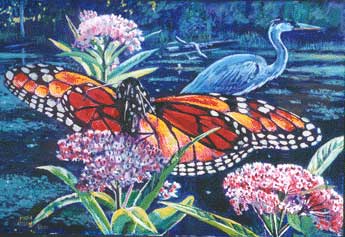
Monarch Butterfly on Red Milkweed
Or have you heard the
orioles song
as it builds its nest
from last years Milkweed fiber?
Its song sings of its rights,
a fact ignored by ornithologists,
too busy counting and dissecting to listen.
The “Science of Birds” was largely gained
through cruelty to birds,
which brings into question the value
of what is so far known of birds.
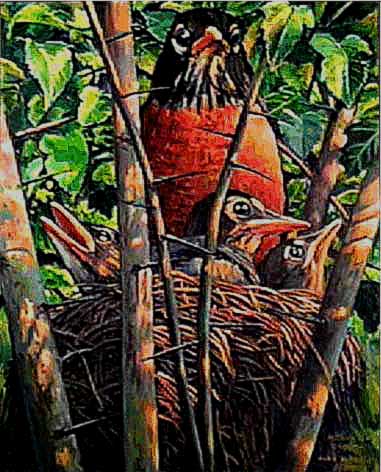
Nature's Rights:
(Robins Nesting)
Have you listened to the
Robin singing
above its nest full of little ones
and seen her eyes glower
as a cat or human approaches?
Have you seen the look of justice
when the blue jay complains of the hawk
and conspires with the Red Headed woodpecker
to drive it away?---
Inter-species declarations of rights.
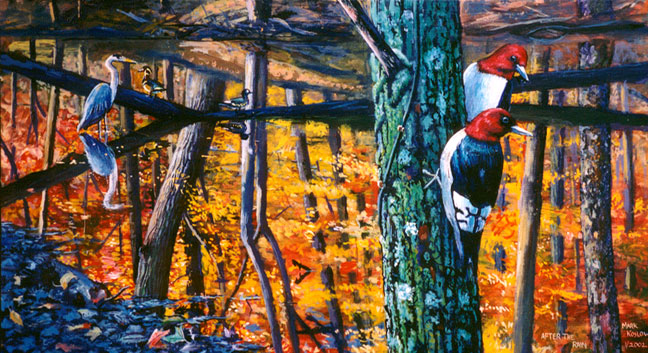
Red Headed
Or have you seen when a
raccoon approaches a
nest of geese, and the ganders sound an alarm
Lowering their necks in threat?
How the gorillas cry and growl when poachers approach
and the white tail of the deer is flag that flickers
between tree trunks, running,
a flag of alarm,
in so many words saying something like:
“Nazi hunters in Camouflage
have come to kill our babies”. Run, Run.
The hummingbird squeaks a quiet alarm
around its favorite patch of bee balm.
“Do not harm what helps me live” it says.
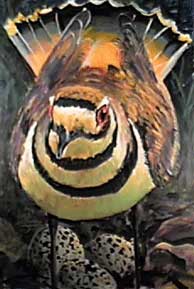
Killdeer Protecting Eggs
Have you seen how the
Killdeer
flashes her orange tail at you
and limps away, pretending injury
so you will not harm her eggs ?
And the Pileated
Woodpecker
cries
in the morning to its mate
with the sound of a monkey saying
”this is our land,
or –“do not tread on us”.
“Since we share, you share too”.
---And the crows gathering into flocks in the fall
a thousand caws in the oaks of November
all of them saying, together,
this roost is our families roost,
this is the land where we belong,
these are the trees of our awkward songs,
these are the branches of our birth.
Have you watched the
poppy’s orange color
announce its right to the fog shrouded hills
when the sun lifts its own orange
out of the grey and blue?
Orange sun and orange flower
meet in a meadow of harmony.
Justice is what comes together
and brings the meeting between.
It is why birds mate
and fox kits play.
Have you seen how the
air gives
its rights to the eagle's wings
or how the right to sunlight is shared
by all the forest leaves that feed the trees?
Life is what matters
and that is what death forgets
and why life always wins.
Because death is nothing
and the right to live cries its need
through the forests
and over the islands .
Have you heard
how the cry of gulls calls
over the silver sea,
and how lonely beaches answer back with
seaweed and crab shells?
The earth is talking about its rights
when the forest burgeons in spring
and the question of who adjudicates the rainbow
is all about listening.
Nature is not about
Darwinian dictators
but about hesitant listening.
Listening between leaves, between waves,
listening to owls between the whipoorwills
and the cicada between the acorn falling and
the frog at the waterfall.
Now that I know this:
I don’t eat meat either.
You are not the center
of the universe
commanding a Great chain of Being
from the top down., as your grandfathers imagined.
You are nothing more than a breath
across a glorious rainbow
worth all the dew that
plants drink at dawn.
No small thing to be worth as much as
sun on the gold fur of a chipmunk.
Sunlight in a chipmunk's eye shows
what a vast and infinite world she lives in.
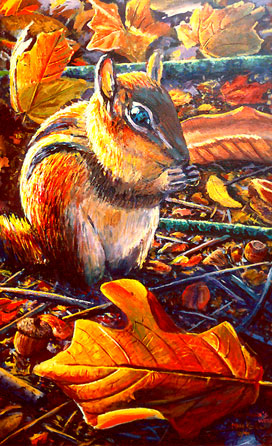
Chipmunk's World
Have you seen how the
rainbow’s
beauty dignifies the sky
and covers the land under its arch
with a memory of what needs to be?
A mouse startled by rustling leaves
while drinking from a stream
knows more of rights
than surveyors and developers.
Nature had its rights
stolen
when people stopped listening
to morning glories
or hearing how the
the land calls forth migrations,
or how traveling warblers
violate all private properties.
Nature’s Rights are not yet found
in courts
or governments.
They are found in the sprouts of ferns
out of the forest floor
or the dust of mushrooms
on the rotting log.
Consider the rights of
rotting logs
and the need of detritus and “debris”.
Consider how the right to wing-space
is measured in the flight of
the hummingbird over the Gulf of Mexico.
Measured in wonder
the rights of the hummingbirds are many, many
mountain chains long.
The moon knows more
about nature’s rights
than judges.
The tides know more
about winter and summer
than lawyers.
If you want to know what is coming
you need to ask what goes.
If you want to know what right
you have to kill albatrosses
or the mothers of elephants,
ask the sea breeze what dolphins mean
or barnacles about the purpose of kelp.
It is because of killers
Black widows and dart frogs have poison.
If killing stops poison will de-evolve.
Elk have antlers to defend females and fight off wolves. Antlers
defend Nature's Rights.
If you
want to know the rights of biomes
or the rights of tortoises
ask islands about the meaning of the sea
or mountains about why terns fly south
or ask the desert night
why macaws have multi-colored feathers.
The right of fish to the river is the same
as the right of your eye to light.
Animals Rights is meaningless
unless you ask the animals
what their rights are.
They have equal standing with us
they are animals like us.
Nature has prior claim to all property.
Just as humans understand human rights
nature announces its own needs.
Listen to their babies cry
just like your babies
watch how they suffer just as
you and your loved ones suffer.
There are no creatures and no creator,
natural beings are self-created.
Nature's rights is about their coexistence.
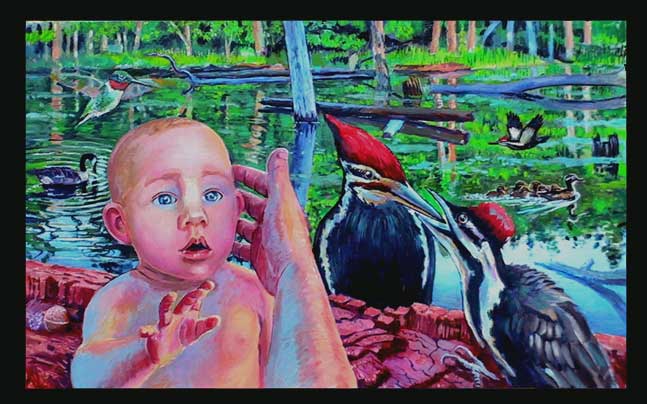
(Portrait of my Daughter with a Pileated
Woodpecker and his Daughter)
If you do not see this
then that is what darkens the world
and explains why the animals are dying
why the fish are gone
the forests cut over
and greedy men sit alone
in minimal rooms, doing accounts,
with no self worth mentioning
nor nature to be seen.
What clouds the issue of
rights
is due to what you are not seeing
and what you are not seeing
comes from your refusal to listen.
Nature’s Rights become clear
only when you begin to hear them.
It is not the laws you pass that matters
but the love that is in your listening.
Good laws will come
only if you begin where
mushrooms rot,
in the humus before gods
grew fangs of false justice--
eons before biologists got a raise.
The human refusal to listen to the rights of non- humans is destroying
the earth.
Rights begin
where sea gets salt
where the tree frog sings
between the ears of all your memories.
Rights begin in the fact of your listening,
in the very existence of ears and hearing.
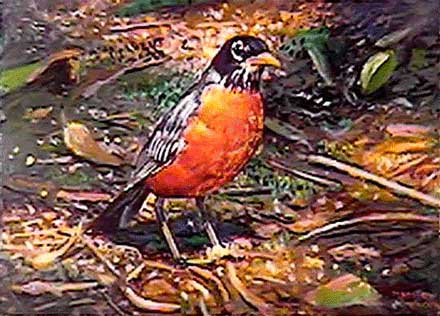
Robin: Dappled Light on the
Forest Floor
JJJJJJJJJJJJJJJJJJJJJJJJJJJJJJJJ
????????????
The Yangtze dam destroyed an area where rare cranes nest and eat. The human
development on this river also led to the extinction of the Yangtze River
dolphin, the Baiji. The ‘Marxist’ Chinese state defined ‘human
consciousness’ as excluding the concerns that
natural systems, dolphins or birds matter. Perhaps a third of species who
thrived in the Yangtze have recently been driven into extinction. These and
many other questions arise all over the world.
??????
http://www.celdf.org/GuestEditorials/NaturalRightsBuildingAMovement/tabid/219/Default.aspxsw
But a body of legal opinion is proposing what are being
called "wild laws", which would speak for birds and animals, and even rivers
and nature. One of the first was
introduced in September, when a community of about 7,000 people in
Pennsylvania, in the US, adopted what is called Tamaqua Borough Sewage
Sludge Ordinance, 2006.
It was hardly an event to set the world alight, except for
two things: it refuses to recognise corporations' rights to apply sewage
sludge to land, but it recognises natural communities and ecosystems within
the borough as "legal persons" for the purposes of enforcing civil rights.
According to Thomas Linzey, the lawyer from the Community Environmental
Legal Defense Fund, who helped draft it, this is historic.
Imagine if it happened here. Fish, trees, fresh water, or any
elements of the environment, would be recognised as having legal rights.
Local communities threatened with a damaging development would be able to
act to protect their environment by asserting fundamental rights on behalf
of the environment, instead of fighting losing battles against landowners'
property rights.
The idea has implications for climate change and other
debates. The right of polar bears to exist as part of an intact Arctic
community could be asserted in court to obtain injunctions against a range
of activities that could infringe that right. The law would also restrict
the mandates and powers of public institutions and entities such as
companies to do anything that increased greenhouse gas emissions, deeming
this to be an infringement not only of human rights, but also of the rights
of the whole "Earth community."
Pinsky
http://www.zcommunications.org/znet/viewArticle/16246
The official directives needn’t be explicit
to be well understood: Do not let too much empathy move in unauthorized
directions.
—Norman Solomon
The way we are educated and entertained keep
us from knowing about or understanding the pain of others . . .
—Robert Jensen
The nonprofit Edge Foundation recently asked some of the world’s
most eminent scientists, “What Are You Optimistic About? Why?” In
response, the prominent neuroscientist Marco Iacoboni, cites the
proliferating experimental work into the neural mechanisms that reveal how
humans are “wired for empathy.”
Iacoboni’s optimism is grounded in his belief that as these
recent findings in experimental cognitive science seep into public
awareness, “. . . this explicit level of understanding our empathic nature
will at some point dissolve the massive belief systems that dominate our
societies and that threaten to destroy us.” (Iacoboni, 2007)
Only five years earlier, Preston and de Waal predicted that
science is on the verge of “an ultimate level description that addresses the
evolution and function of empathy.” (Preston, 2002)
While there are reasons to remain circumspect (see below) about
the progressive political implications flowing from this work, a body of
impressive empirical evidence reveals that the roots of prosocial behavior,
including moral sentiments like empathy, precede the evolution of culture.
This work sustains Noam Chomsky’s visionary assertion that while the
principles of our moral nature have been poorly understood, “we can hardly
doubt their existence or their central role in our intellectual and moral
lives.” (Chomsky, 1971, 1988; 2005)
The emerging field of the neuroscience of empathy parallels
investigations being undertaken in cognate fields. Some forty years ago the
celebrated primatologist, Jane Goodall, observed and wrote about chimpanzee
emotions, social relationships, and “chimp culture” but experts remained
highly skeptical. Even a decade ago, scientific consensus on this matter
was elusive, but all that’s changed. According to famed primate scientist
Frans B.M. de Waal “You don’t hear any debate now.” In his more recent
work, de Waal plausibly argues that human morality—including our capacity to
empathize—is a natural outgrowth or inheritance of behavior from our closest
evolutionary relatives. It’s now indisputable that we share moral faculties
with other species. (de Waal, 2006; Kropotkin, 1902; Trivers, 1971; Katz,
2000; Gintis, 2005; Hauser, 2006)
Following Darwin, highly sophisticated studies by biologists
Robert Boyd and Peter Richerson posit that large-scale cooperation within
the human species—including with genetically unrelated individuals within a
group—was favored by selection. (Hauser, 2006, p. 416) There were
evolutionary (survival) benefits in coming to grips with others.
If morality is rooted in biology, in the raw material or building
blocks for the evolution of its expression, we now have a pending fortuitous
marriage of hard science and secular morality in the most profound sense.
The details of the social neuroscientific analysis supporting these
assertions lie outside this paper but suffice it to note that it’s
persuasive, proliferating, and exciting. (Jackson, 2004 and 2006; Lamm,
2007)
That said, one of the most vexing problems that remains to be
explained is why so little progress has been made in extending this
orientation to those outside certain in-group moral circles. That is, given
a world rife with overt and structural violence, one is forced to explain
why our moral intuition doesn’t produce a more ameliorating effect, a more
peaceful world. Iacoboni suggests this disjuncture is explained by massive
belief systems, including political and religious ones, operating on the
reflective and deliberate level. These tend to override the automatic,
pre-reflective, neurobiological traits that should bring people together.
Thus a few cautionary notes are warranted here. The first, then,
is that social context and triggering conditions are everything because
where there is conscious and massive elite manipulation, it becomes
exceedingly difficult to get in touch with our moral faculties. As Albert
cautions, circumstances may preclude and overwhelm our perceptions,
rendering us incapable of recognizing and giving expression to moral
sentiments (Albert, n.d.; and also, Pinker, 2002). For example, the
fear-mongering of artificially created scarcity may attenuate the empathic
response.
The second is Hauser’s (2006) observation that proximity was
undoubtedly a factor in the expression of empathy. In our evolutionary past
“there were no opportunities for altruism at a distance” and therefore the
emotional intensity was/is lacking. This can’t be discounted but, given
some of the positive dimensions of globalization, the potential for
identifying with the “stranger” has never been more robust. For examples of
help extended to strangers that wasn’t available in our evolutionary past,
including blood donations, Holocaust rescuers, adoption, and filing honest
tax returns, see Barber (2004).
Finally, as Preston (2006-2007; and also, in press) suggests,
risk and stress tend to suppress empathy whereas familiarity and similarity
encourage the experience of natural, reflexive empathy. This formidable but
not insurmountable challenge warrants further research into how this
“out-group” identity is created, reinforced, and its influence diluted.
The concept of empathy was first discussed by the German
psychologist Theodore Lipps in the 1880s. He introduced the term “einfuhlung”
(in-feeling) as a way of describing one person’s affective response to
another person’s experience.
Empathy is not synonymous with compassion, shared suffering or
sympathy with another’s pain. Limited to the former, one would be paralyzed
by “over-identification” and the inability to distinguish oneself from the
other’s distress. At a minimum, it requires being able to grasp another’s
feeling state, to put oneself in the place of another. This necessitates
making a distinction between self and others by employing the cognitive
capacity for detachment in order to act on that perception. (Hardee, 2003)
We know from neuroscientific empathy experiments that the same
affective brain circuits are automatically mobilized upon feeling one’s own
pain and the pain of others. Through brain imaging, we also know that
separate neural processing regions then free up the capacity to take
action. As Decety notes, empathy then allows us to “forge connections with
people whose lives seem utterly alien from us.” (Decety, 2007) Where
comparable experience is lacking, this “cognitive empathy” builds on the
neural basis and allows one to “actively projects oneself into the shoes of
another person,” by trying to imagine the other person’s situation.
(Preston, in press) Empathy is “other directed” and recognizes the other’s
humanity. But, again, why the disjuncture? What can we expect from this
potentially transforming synthesis?
Hauser, as I read his exposition of a “universal moral grammar,”
posits a more neutral or benign process at work. Given a moral grammar hard
wired into our neural circuit via evolution, this neural machinery precedes
conscious decisions in life-and-death situations. However, we observe
“nurture entering the picture to set the parameters and guide us toward the
acquisition of particular moral systems.” At other points he suggests that
environmental factors can push individuals toward defective moral reasoning,
and the various outcomes for a given local culture are virtually limitless.
(Hauser, 2006) For me, this discussion of cultural variation fails to give
sufficient attention to the socioeconomic variables responsible for shaping
the culture.
Cohen and Rogers, in parsing Chomsky’s critique of elites, note
that “Once an unjust order exists, those benefiting from it have both an
interest in maintaining it and, by virtue of their social advantages, the
power to do so.” (For a concise but not uncritical treatment of Chomsky’s
social and ethical views, see Cohen, 1991.)
Clearly, the vaunted human capacity for verbal communication cuts
both ways. In the wrong hands, this capacity is often abused by consciously
quelling the empathic response. When de Waal writes, “Animals are no moral
philosophers,” I’m left to wonder if he isn’t favoring the former in this
comparison. (de Waal, 2000)
One of the methods employed within capitalist democracies is
Chomsky and Herman’s “manufacture of consent,” a form of highly
sophisticated thought control. Potentially active citizens must be
“distracted from their real interests and deliberately confused about the
way the world works.” (Cohen, 1991; Chomsky, 1988)
For this essay and following Chomsky, I’m arguing that the human
mind is the primary target of this perverse “nurture” or propaganda, in part
because exposure to certain new truths about empathy—hard evidence about our
innate moral nature—poses a direct threat to elite interests. That is,
given the apparent universality of this biological predisposition toward
empathy, we have a potent scientific baseline upon which to launch further
critiques of this manipulation.
First, the insidiously effective scapegoating of human nature
that claims we are motivated by greedy, dog-eat-dog “individual
self-interest is all” is undermined. Stripped of yet another
rationalization for empire, predatory behavior on behalf of the capitalist
mode of production becomes ever more transparent.
Second, for many people, the basic incompatibility between global
capitalism and the lived expression of moral sentiments may become obvious
for the first time. (Olson, 2006, 2005) For example, the failure to engage
this moral sentiment has radical implications, not the least being
consequences for the planet. Researchers at McGill University (Mikkelson,
2007) have shown that economic inequality is linked to high rates of
biodiversity loss. The authors suggest that economic reforms may be the
prerequisite to saving the richness of the ecosystem and urge that “. . . if
we can learn to share the economic resources more fairly with fellow members
of our own species, it may help to share ecological resources with our
fellow species.” While one hesitates imputing too much transformative
potential to this emotional capacity, there is nothing inconsistent about
drawing more attention to inter-species empathy and eco-empathy. The latter
may be essential for the protection of biotic communities.
Third, learning about the conscious suppression of this essential
core of our human nature begs additional troubling questions about the
motives behind other elite-generated ideologies, from neo-liberalism and
nationalism to xenophobia and the “war on terror.” Equally alarming for
elites, awareness of this reality contains the potential to encourage
“destabilizing” but humanity-affirming cosmopolitan attitudes toward the
faceless “other,” both here and abroad. In de Waal’s apt words, “Empathy
can override every rule about how to treat others.”
Finally, as de Waal admonishes, “If we could manage to see people
on other continents as part of us, drawing them into our circle of
reciprocity and empathy, we would be building upon rather than going against
our nature.” (de Waal, 2005) An ethos of empathy is an essential part of
what it means to be human. We’ve been systematically denied a deeper and
more fulfilling engagement with this moral sentiment. I would argue that,
paradoxically, the relative absence of widespread empathic behavior is in
fact a searing tribute to its potentially subversive power.
Is it too much to hope that we’re on the verge of discovering a
scientifically based, Archimedean moral point from which to lever public
discourse toward an appreciation of our true nature, which in turn might
release powerful emancipatory forces?
Acknowledgement:
Dana Dunn, Marco Iacoboni, Kathleen Kelly, Stephanie Preston and
Joel Wingard provided helpful comments on an earlier version of this paper.
Thanks, per usual, to Mickey Ortiz.
_______________
Gary Olson, Ph.D., chairs the Political Science Department at
Moravian College in Bethlehem, PA. He may be reached at:
olson@moravian.edu
References
Cited
Albert, M.
(n.d.) “Universal Grammar and Linguistics,”
www.zmag.org/Zmag/articles
Barber, N.
(2004) Kindness in a Cruel World. New York: Pantheon, pp. 203-231.
Chomsky,
N. (1971) Human Nature: Justice versus Power, Noam Chomsky debates Michel
Foucault.
www.chomsky.info/debates
Chomsky,
N. (1988) Language and Problems of Knowledge: The Managua Lectures.
Cambridge, MA: MIT Press.
Chomsky,
N. (2005a) “What We Know,” Boston Review (Summer)
Chomsky,
N. (2005b) “Universals of Human Nature,” Psychotherapy and Psychomatics,
74.
Chomsky,
N., Herman, E. (1988) Manufacturing Consent: The Political Economy of
the Mass Media. New York: Pantheon.
Cohen, J.,
Rogers, J. (1991) “Knowledge, Morality and Hope: The Social Thought of
Noam Chomsky,” New Left Review, 187, pp. 5-27.
Decety, J.
(2006) “Mirrored Emotion,” Interview, The University of Chicago Magazine,
94, 4, pp. 1-9.
de Waal,
F.B.M. (1996) Good Natured: The Origins of Right and Wrong in Primates
and Other Animals. Cambridge, MA: Harvard University Press.
de Waal,
F.B.M. (2006) Primates and Philosophers: How Morality Evolved.
Princeton, NJ: Princeton University Press.
de Waal,
F.B.M. (2005-06) “The Evolution of Empathy,” Greater Good,
Fall-Winter, pp. 8-9.
Gintis, H.,
Bowles, S., Boyd, R., and Fehr, E. (2004) “Explaining altruistic behavior
in humans,” Evolution and Human Behavior, 24, pp. 153-172.
Gintis, H.,
Bowles, S., Boyd, R., and Fehr, E. (2005) Moral Sentiments and Material
Interests. Cambridge, MA: MIT Press.
Hardee, J.
T. (2003) “An Overview of Empathy,” The Permanente Journal, 7, 4,
pp. 1-10.
Hauser, M.
D. (2006a) Moral Minds, New York: Harper Collins.
Hauser, M.
D. (2006b) “The Bookshelf Talks with Marc Hauser,” American Scientist,
www.americanscientist.org
Iacoboni,
M. (2007) “Neuroscience Will Change Society,” EDGE, The World Question
Center. http:www.edge.org/q2007pp14-15
Jackson, P.
L., Meltzoff, A. N., and Decety, J. (2004) “How do we perceive the pain of
others?” Neuroimage, 125, pp. 5-9.
Jackson, P.
L., Rainville, P., and Decety, J. (2006) “To what extent do we share the
pain of others?” PAIN, 125, pp. 5-9.
Jensen, R.
(3/20/02) “The Politics of Pain and Pleasure.” Counterpunch.
Katz, L.
D., ed. (2000) Evolutionary Origins of Morality. Bowling Green,
OH: Imprint Academic.
Kropotkin,
P. 1972 (1902) Mutual Aid: A Factor in Evolution. New York: New
York University Press.
Lamm, C.,
Batson, C., and Decety, J. (2007) “The Neural Substrate of Human Empathy:
Effects of Perspective-taking and Cognitive Appraisal,” Journal of
Cognitive Neural Science, 19: 1, pp. 42-58.
Mikkelson,
G. M., Gonzalez, A., and Peterson, G. D. (2007) “Economic Inequality
Predicts Biodiversity Loss,” PLoS ONE 2
(5):e444.doi:10.1371/journal.pone.0000444.
Olson, G.
(2005) “Scapegoating Human Nature,” ZNet, 11/30/05.
Olson, G.
(2006) “Graduates face choice between love or ‘selling out.’” ZNet
Commentary.
Pinker, S.
(2002) The Blank Slate. New York: Viking.
Preston, S.
and de Waal, F.B.M. (2002) “Empathy: Its ultimate and proximate bases,”
Behavior and Brain Sciences, 25, pp. 1-72.
Preston,
S. (2006-2007) “Averting the Tragedy of the Commons,” SHIFT, 13,
pp. 25-28.
Preston,
S., Bechara, A., Damasio, H., Grabowski, T. J., Stansfield, S. M., and
Damasio, A. R. (in press) “The Neural Substrates of Cognitive Empathy.”
Social Neuroscience.
Solomon,
N. (4/17/03) “Media and the Politics of Empathy,” Media Beat.
Trivers,
R. (1971) “The evolution of reciprocal altruism,” Quarterly Review of
Biology, 46, pp. 35-57.
November 16, 2007
Wheat Biopiracy The Real Issues the
Government is Avoiding
By Vandana Shiva
The epidemic of biopiracy
is an assault on our living heritage of biodiversity and cumulative
innovation embodied in the traditional knowledge of agriculture and
medicine. In the long run, it determines livelihoods and economic
sovereignty because what is commonly available becomes an ?intellectual
property? of a company for which royalty must be paid.
It is the governments
duty to protect the resources and heritage of the country and prevent its
usurpation by foreign interests and commercial corporations. The governments
affidavit is in effect arguing that the government will allow the theft of
our heritage and the public good that belongs to the Indian people.
The moment a patent is
taken on plants and seeds derived from Indian biological resources,
biopiracy have occurred. Challenging and stopping such biopiracy is the duty
of government. The governments repeated failure to legally challenge
biopiracy has forced the petitioner to take up such challenges on behalf of
the Indian people, and to protect the public interest and the national
interest.
Biopiracy refers to the
use of intellectual property systems to legitimize the exclusive ownership
and control over biological resource and biological products and processes
that have been used over centuries in non-industrialized cultures. Patent
claims over biodiversity and indigenous knowledge that are based on the
innovation, creativity and genius of the people of the Third World are acts
of ?biopiracy?. Since a ?patent? is given for invention, a biopiracy patent
denies the innovation embodied in indigenous knowledge. The rush to grant
patents and reward invention has led corporations and governments in the
industrialized world to ignore the centuries of cumulative, collective
innovation of generations of rural communities.
A patent is an exclusive
right to make, sell and distribute the patented product. Patents on
biodiversity imply that corporations who own patents get exclusive rights to
the production and distribution of seeds, livestock and medicine. This
establishes monopolies on food and health, makes it illegal for farmers to
save and exchange seed, and prevents decentralized, pluralistic economies
for the production of food and medicine. It also encourages ?Biopiracy? or
theft of our indigenous knowledge.
The new IPR laws embodied
in the TRIPs agreement of WTO have unleashed an epidemic of the piracy of
nature's creativity and millennia of indigenous innovation. RFSTE/ Navdanya
started the campaign against biopiracy with the Neem Campaign in 1994 and
mobilized 1,00,000 signatures against neem patents and filed a legal
opposition against the USDA and WR Grace patent on the fungicidal properties
of neem (no. 436257 B1) in the European Patent Office (EPO) at Munich,
Germany. Along with RFSTE, the International Federation of Organic
Agriculture Movements (IFOAM) of Germany and Ms. Magda Alvoet, former Green
Member of the European Parliament were party to the challenge. The patent on
Neem was revoked in May 2000 and it was reconfirmed on 8th March 2005 when
the EPO revoked in entirety the controversial patent, and adjudged that
there was "no inventive step" involved in the fungicide patent, thus
confirming the ?prior art? of the use of Neem.
In 1998, Navdanya started
a campaign against Basmati biopiracy (Patent No. 5663484) of a US company
RiceTec. On Aug 14th 2001 Navdanya achieved another victory against
biopiracy and patent on life when the United States Patent and Trademark
Office (USPTO) revoked a large section of the patent on Indian Basmati rice
by the US corporations RiceTec Inc. These included (i) the generic title of
the RiceTec patent No. 5663484, which earlier referred to Basmati rice
lines; (ii) the sweeping and false claims of RiceTec having `invented?,
traits of rice seeds and plants including plant height, grain length, aroma
which are characteristics found in our traditional Basmati varieties and
(iii) claims to general methods of breeding which was also piracy of
traditional breeding done by farmers and our scientists (of the 20 original
claims only three narrow ones survived).
The next major victory
against biopiracy for Navdanya came in October 2004 when the European Patent
Office in Munich revoked Monsanto?s patent on the Indian variety of wheat
?Nap Hal?. This was the third consecutive victory on the IPR front after
Neem and Basmati, making it the third consecutive victory. This was made
possible under the Campaign against Patent on Life as well as against
Biopiracy respectively. MONSANTO, the biggest seed corporation, was assigned
a patent (EP 0445929 B1) on wheat on 21 May 2003 by the European Patent
Office in Munich under the simple title ?plants?. On January 27th 2004
Research Foundation for Science Technology and Ecology (RFSTE) along with
Greenpeace and Bharat Krishak Samaj (BKS) filed a petition at the European
Patent Office (EPO), Munich, challenging the patent rights given to Monsanto
on Indian landrace of wheat, Nap Hal. The patent was revoked in October 2004
and it once again established the fact that the patents on biodiversity,
indigenous knowledge and resources are based on biopiracy and there is an
urgent need to ban all patents on life and living organisms including
biodiversity, genes and cell lines.
Through citizen actions,
we have won three-biopiracy battles and have thus contributed to the defense
of farmers' rights, indigenous knowledge and biodiversity. Navdanya?s focus
on collective, cumulative innovation embodied in indigenous knowledge has
created a worldwide movement for the defence of the intellectual rights of
communities.
Our challenge in the EPO
forced the EPO to recognize that Monsanto?s ?Naphal? patent was a biopiracy
patent. Instead of challenging the US patents on ?Naphal?, the government is
making excuses to avoid performing its duty. It seems instead to be wanting
to help the biopirates in their biopiracy.
The weak excuses the
government has given are:
Patent EPO 445929 is not
valid in India, and it has no adverse impact, therefore no action is to be
taken. (p 1.4) (The petitioner is fully aware that the EU patent is not
valid in India. But the EU patent was given for a variety derived from
Indian genetic material. Hence, we needed to intervene. The EPO recognized
that the patent was based on biopiracy. However, the government is refusing
to admit what the EPO has already admitted.
The US Patent No. 5763741
on a variety derived from an Indian variety with claims covering the unique
properties of the Indian variety need not be challenged because the patent
expires on 18th February 2010. A theft is a theft. Whether the patent
expires 2007 or 2010 is not the issue. The main issue is that the properties
and traits which Monsanto is claiming as their ?creation? are derived from
an Indian variety. This is relevant not just for this variety but for the
hundreds of thousands of India?s traditional varieties. Tomorrow Monsanto
will claim patents on varieties derived from our salt tolerant varieties, or
our flood resistant varieties, or draught resistant varieties.
A
broad patent on varietal traits derived from traditional Indian varieties is
an act of biopiracy in itself. If such trends continue, and precedence is
established that Indian biodiversity is up for grabs we will loose our
heritage and economic sovereignty. That is why precedence must be
established by challenging biopiracy. The petitioner has done it in the case
of the EU patent. The government must do so at least in the case of the US
patent.



|

